 BURST
BURST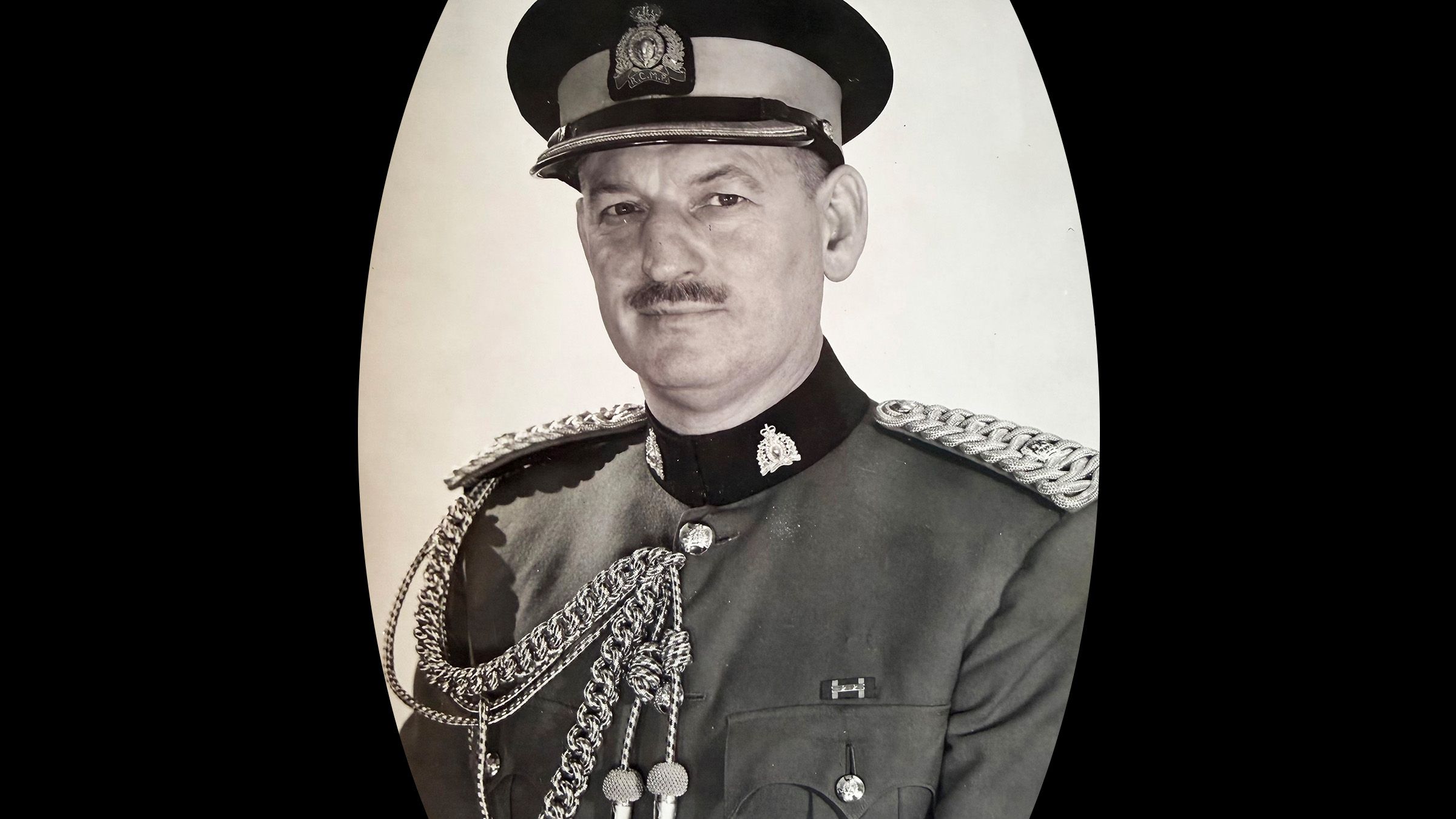
“We’ve got your uncle. What do you want us to do with him?”
The phone call from the Vancouver RCMP in the fall of 2024 was disconcerting, to say the least. And a little puzzling. Uncle Joe Atherton was no scofflaw. His nieces and nephews knew him as a devoted husband, an engaging raconteur, a gifted wood carver and a competitive archer. Oh, and a high-ranking Mountie.
We also knew he had been dead for 36 years.
And therein lies a tale — a mystery, really — beginning with an idle comment over a couple of beers that would lead to a clandestine burial, a half-believed legend, and a grand quest coloured by controversy. And it would leave my siblings and me with new respect for an old chestnut: “The Mounties always get their man.”
Rumours of a Mountie under the flagpole
This spring, a year and a half after that phone call, I found myself in a Regina chapel in the company of my two sisters, my daughter, two of Joe’s nieces by marriage, and various senior members of the RCMP, resplendent in red serge. A lone piper, at the back of the nave, skirled The Flowers of the Forest as my uncle rested just below the altar.
Well, what remained of my uncle after cremation, burial, exhumation and forensic reconstitution.
Joe was about to be laid to rest — again and for good — this time with all due pomp and ceremony in the sylvan tranquility of the cemetery at Regina’s RCMP Depot Division , sometimes called “the Home of the RCMP.” This is where almost every member of Canada’s national police force has come to train since 1885, and where many rest eternally, among them now, my uncle, RCMP Supt. Joseph John Atherton.
For the genesis of this ceremonial weekend in the heart of the prairies, you’d have to go back decades, when a boozy rumour began to circulate in the Vancouver RCMP Officers Mess. The scuttlebutt was that a senior member of the RCMP had been secretly buried under the flagpole at Fairmont Barracks . Fairmont is a handsome, rambling Tudor-Revival pile in the Vancouver neighbourhood of South Cambie, and had once been the headquarters of the Mounties in British Columbia.
By the 2010s, that rumour had all the weight of a whispered message at the end of a protracted game of broken telephone. The only thing that everybody agreed on was that IF there was an officer buried under the flagpole, it was my uncle. How he got there, and who put him there, were matters of speculation.
It was largely idle speculation until 2013, when the RCMP moved from the 21-acre parcel of land around the Fairmont Barracks to new provincial headquarters in Surrey. The Canada Lands Company (CLC), the Crown corporation that oversees Crown land, entered into a partnership to develop the prime property with the Musqueam Indian Band, Squamish Nation and Tsleil-Waututh Nation, lower-mainland First Nations upon whose traditional territory the Fairmont Lands sit. It was one of several CLC projects in B.C. with the twin goals of privatization and reconciliation.
It soon became clear that the First Nations alliance, formalized as the MST Development Corporation, had no interest in preserving the century-old Fairmont Barracks, regardless of its Class-A heritage status. Indeed, there was considerable antipathy toward the building as a symbol of the RCMP’s checkered history with the Indigenous people of B.C. Suddenly, the legend of the Mountie under the flagpole became of more pressing interest. Would Joe Atherton, if he was there, be unceremoniously excavated to make way for a highrise, or paved over in the forecourt of a planned Indigenous cultural centre?
By 2017, when there was already a spirited campaign to save Fairmont from the wrecking ball, the saga of the surreptitious burial gained currency, thanks in part to a former Mountie digging into the narrative.
The possibility of a Mountie burial on the site was cast as an argument in favour of preserving the building, but soon enough, confirming the tale and preserving the remains became a crusade all on its own. It would eventually engage the most senior ranks of the RCMP in British Columbia, require sign-off from the First Nation group, and spark a Byzantine search that would involve the force’s tactical and forensic squads before its conclusion.
In the end, the search would answer the mystery’s lingering questions: the who and how and precisely where. But what of the existential question: why?
For why, we have to go back long before the future of Fairmont came into question, to the beginning of the path that would lead Uncle Joe to become, among other things, the scourge of heroin dealers in postwar Vancouver, aide-de-camp to Canada’s first native-born governor general, Vincent Massey, in the 1950s, and esteemed enough in law-enforcement circles to get an attaboy from J. Edgar Hoover in the 1960s.
We have to go back to 1932, when Joe Atherton was 23, living in Vancouver with his parents and several brothers, including my dad, Frank Atherton, two years Joe’s junior.
Becoming a Mountie
In Depression-era B.C., thousands of men Joe’s and Frank’s age were being warehoused in remote federal work camps, clearing scrub and swatting black flies for 50 cents a day. Joe and my father weren’t among them because my grandfather, the impetuous, irresponsible and utterly charming J.J. Atherton, was, at the age of 60, finally able to support his family with steady work as a customs officer after stints as a professional foot-racer, itinerant actor, and owner of failing newspapers in the Kootenays (the last he lost in a poker game).
There was probably an element of J.J.’s swagger in Joe’s decision to become a Mountie. He wasn’t just taking a much-needed job, he was donning the red serge, joining the ranks of Canada’s most romantic icon. For Joe, the romance began with mucking out the stables at Regina’s Depot Division. Along with horsemanship, cadet Joe took instruction in judo, firearms, fingerprinting, criminal investigation and that most essential of police skills, typing.
As a new 3rd-class constable, Joe was immediately assigned to “E” Division (British Columbia) and found himself at Fairmont Barracks, where young Mounties lived in spartan conditions. After a couple of promotions and brief stints in Penticton and Kamloops, Joe was back in Vancouver by 1939 and assigned to plainclothes work, earning an extra 25 cents a day, a 15-per-cent bump in his first-class constable pay.
This is likely when he started to become intimate with Vancouver’s notorious Downtown East Side, then simply called “Skid Road.”
Joe would spend much of his career with the RCMP drug squad, in a city with one of the highest rates of drug abuse in North America. By 1949, when now-Staff Sgt. Joe Atherton was running the seven-member squad, it was estimated that 60 per cent of Canada’s street addicts lived in Vancouver. Joe worked the streets around Hastings and Columbia when heroin was the predominant menace. Reports from the time tell of elaborate RCMP undercover operations that could last months, often focusing on the trade around the notorious Broadway Hotel, ironically now run as a supportive housing centre. As a longtime member of the drug squad — eventually its senior officer — my uncle would have been in the thick of it.
That 25-cent a day pay bump in 1939 likely came in handy. That was the year he married my Auntie Eileen, an elegant and fun-loving woman who, on their honeymoon, according to family lore, started to exhibit the symptoms that would lead to her diagnosis of multiple sclerosis.
Theirs was a true romance, filled with love and laughter despite the slow, steady ravages of my aunt’s condition. There are family photos of the couple on horseback and hiking on North Vancouver’s Grouse Mountain. Joe was always active and, for as long as she could, Auntie Eileen kept up with him. When that became impossible, she became his most ardent spectator.
Joe was a competitive archer and a stalwart of the Greenwood Archers in Vancouver’s Stanley Park. He was also a “heel-and-toe” racer, the sport we now call race walking, no doubt influenced by his father, J.J. Atherton, who had competed in the sport professionally in Victorian England.
Joe was also a talented woodcarver. Visiting Joe’s home later in life, I marvelled at his collection of miniature Mounties, hand-carved in whimsical poses and painted to represent the historic progression of the force’s uniforms, from the pillbox-hatted members of the North West Mounted Police to the modern uniform. The collection includes a self-portrait, in the familiar red serge and navy jodhpurs, and is now on display in the mess hall of RCMP division headquarters in Surrey.
As a child in the late ’50s and early ’60s, my interaction with my uncle was almost entirely at the annual Atherton family Boxing Day party, and even that was limited. I would watch him carry my Auntie Eileen into my Uncle Reg’s Shaughnessy-area home, place her gently in a chair and fuss over her most of the evening. Joe and Eileen never had children.
Honours in Ottawa
Joining the Atherton clan at Joe’s Regina reinterment this spring were Janan Carr and Jacquie Stinson, the daughters of Auntie Eileen’s younger sister, Olive. As the only children on Eileen’s side of the family, they got the bulk of Joe’s attention.
“He was like a whirlwind when he visited, you couldn’t take your eyes off him,” says Carr. “He’d sing a song, he’d tell a joke, he’d lose his hat, and he’d be honestly interested in you.”
Joe was Carr’s godfather, and when she and her sister were very young, he’d take them for outings in Stanley Park. As a teenager, Carr took up archery under Joe’s tutelage. Joe and Eileen hosted Stinson’s 21st birthday celebration at the Fairmont Barracks, and Joe gave the toast to the bride at Carr’s wedding.
Twelve years into their marriage, Joe and Eileen moved to Ottawa where Joe had been assigned to administrative duty at HQ Division. He was promoted to full inspector in 1953, and soon after was appointed honorary aide-de-camp to Vincent Massey, then four years into his term as Canada’s 18th governor general. Joe continued in the role until the day Massey stepped down in 1959, one of several who briefed the governor general on the events he attended, managed protocol and handled administrative duties.
You have to wonder why Joe was chosen. A tattered Ottawa Journal newspaper clipping might offer a clue.
It shows a uniformed Joe standing tall and imposing in a House of Commons elevator with Queen Elizabeth, the Queen Mother, tucked in a corner behind him. It dates from November 1954, during the Queen Mum’s five-day visit to Ottawa. Obviously, Insp. Atherton served as escort during the royal tour, which included a lunch and reception on Parliament Hill where the diminutive Queen Mum charmed backbenchers and ministers alike. Did Joe make an impression on the vivacious royal?
Regardless, Joe eventually returned to his true home within the RCMP: Vancouver and the Fairmont Barracks. He was appointed superintendent in 1964, about the same time he assumed command of the Vancouver subdivision, overseeing an estimated 600 to 700 officers and civilian members. His promotion prompted a congratulatory letter from FBI director J. Edgar Hoover. “This honour,” Hoover wrote, “is indeed an expression of the respect and esteem you enjoy.”
Whether the letter was just a courtesy note between co-operative police forces, or a reference to something more specific, perhaps from Joe’s time combating crime in one of North America’s major drug ports, is a matter of speculation. But my uncle deemed it important enough to hang on to.
Hoped to be buried ‘facing the rising sun’
Superintendent Joe’s new office, until his retirement in 1967, overlooked the flagpole in the forecourt of Fairmont Barracks, the place where, he would much later tell some mess-hall cronies, perhaps idly, he wanted to be buried “facing the rising sun.”
Joe was only 58 when he retired after 35 years with the RCMP; I have no doubt he would have stayed until they kicked him out were it not for the increasing care required by my Auntie Eileen. She died at 60 in 1971, and was very ill in her final years, according to her nieces. Eileen was buried near her parents in a family plot.
Two short-lived marriages later, and following a decline into dementia before his own death in 1988, it seemed like Joe had made no arrangements for his own final resting place. It fell to Bruce McLean, son of his third wife, Jean, to deal with his death.
McLean says his mother “had a real wonderful time with Joe for a couple of years,” but signs of Joe’s dementia were already becoming apparent. Eventually, my uncle was admitted to long-term care.
When Joe died in December 1988, he was a widower again; Jean had passed four months earlier. McLean, her son, found that some rudimentary arrangements had been made for Joe’s cremation and funeral service, though he’s not sure whether it was Joe or someone else who made them. Our branch of the family was 4,000 kilometres away in Ontario.
Joe, a devout Catholic, had apparently not left instructions for a funeral mass, but there was a modest service, attended by an elderly sister and sister-in-law, and his nieces by marriage, Janan and Jacquie.
After the service, Joe’s ashes were sent to Bruce McLean. He remembers being approached by two men who identified themselves as Joe’s former RCMP colleagues and who said they knew where Joe wanted his remains to rest.
McLean doesn’t remember their names, nor was there any official approach by the RCMP, he says, but the plan to bury Joe at the RCMP barracks seemed to make sense. He handed over the ashes.
Buried under the flagpole?
Flash forward to 2015. After decades of mess-hall musings about a secret burial at Fairmont Barracks, retired RCMP Supt. Joe Healy strung the rumours together in a post he published on his website, The RCMP Graves Discovery Database (rcmpgraves.com), honouring deceased colleagues. He reached out to 80-year-old Don Wilson, the deputy commissioner who had been commanding officer at Fairmont Barracks in the late ’80s.
Wilson remembered being approached in 1988 by two retired members — his recollections seemed to refer to Staff Sgt. Jack Duggan and Chief Supt. Al Cart — about depositing my uncle under the flag. After that, his memory of the incident was vague.
Almost two years later, Healy’s story was brought to the attention of retired RCMP Cpl. Donna Morse, a feisty trailblazer who was among the first troop of 32 female officers sworn in to the RCMP in 1974. Morse, then president of the Vancouver Division of the RCMP Veterans’ Association, had made it her mission to save Fairmont Barracks.
By then, the former RCMP campus known as Fairmont had been renamed the Heather Lands and the First Nations-owned MST Corporation had made it clear it had no interest in preserving the building. In fact, its long-term plans called for the creation of an Indigenous cultural centre situated — not by chance — at the barracks site.
“(Fairmont) was the home, the working place, the social place for the RCMP up till when it was turned over to the Indigenous nations,” says Morse. “I took it upon myself to contact the city of Vancouver and start making inquiries.”
Built as a private school in 1914, the Fairmont building became a military hospital at the end of the First World War and was transferred to the RCMP in 1920. It is listed on Vancouver’s heritage register as “an outstanding example of the Tudor Revival style,” and in the past would have been seen as untouchable.
But for thousands of years before Fairmont was built, the property was traditional hunting and gathering grounds for the Musqueam, Squamish and Tsleil-Waututh Nations. And, among First Nations, the RCMP’s role in enforcing residential school policy was still an open wound. A decision on Fairmont would be the first test of a reconciliation framework passed by Vancouver city council in 2014, under which normal city policies could be set aside to advance the goals of reconciliation.
Morse says her mission to save Fairmont shifted into another gear when she read Joe Healy’s web post. “I thought, OK, if, in fact, this is true that there is … one of our own buried under the flagpole, then I really have to push with the city, because to me, that’s sacred.”
She says she confronted the ranking officers of the B.C. Division at the time with the story of my uncle’s furtive interment and was told they “didn’t have the resources, nor (were they) wanting, to get involved.” The barracks was becoming a bit of a hot potato.
By 2022 , Vancouver city council had reached a compromise: the Fairmont building would be moved — if a willing partner could be found to provide a new site and underwrite the estimated $47-million cost before the MST Corporation got around to developing that corner of the Heather Lands, still some years away. To date, there have been no offers.
In a council meeting before that decision, First Nation representatives were unmoved by arguments that the possibility of my uncle’s remains on the site warranted the preservation of the Fairmont building.
As reported by CTV News, Squamish Nation Coun. Syexwáliya/Ann Whonnock told the meeting that multiple members of her family had been buried at what became, in the 1930s, the footings of the Burrard Street Bridge. “No consideration was given for the feelings of our families, and we were forced to dig them up and move them up to where our family lived, 25 miles up the Squamish River. Then the land was expropriated, given as a tree farm licence, and a logging road had to be constructed, and they were asked again to move the remains.”
When it became clear that the Fairmont building could not remain on the Heather Lands, Morse again approached the RCMP about my uncle, and got a sympathetic hearing from a new commanding officer. Deputy Commissioner Dwayne McDonald assigned his executive officer, Insp. Veronica Fox, to investigate.
“I had two problems,” says Fox. “No. 1 was the witnesses had passed away.” No. 2, she says, was that the site had apparently been renovated at some point.
Old photos showed two flagpole sites: one closer to the building and now paved over, and the second farther away and surrounded by shrubbery. Fox could see that the change took place sometime between 1965 and 1992, four years after my uncle’s death. If my uncle was buried at the old site, the search would likely be abandoned.
That’s when a representative from the site’s new owners mentioned that stacks of early blueprints for the Fairmont had been left in the building’s attic. On a “ridiculously hot day” in August of 2023, Fox sifted through the papers in the sweltering attic and, after several hours, found a blueprint that showed the old flag and its new position. The date of the relocation was May 1985, three years before the supposed surreptitious burial.
About the same time, Fox interviewed retired Sgt. Major Hugh Stewart, who remembered chatting with some retired members 11 years after Joe’s death. They were swapping “war stories” in the mess, according to Fox, when one said, “Did you know that we’ve buried somebody near the flagpole in the Rose Garden?” The members, believed to be former deputy commissioner Don Wilson, and former members Jack Duggan and Al Cart, then walked him over to the flagpole and pointed to the burial spot.
That was enough for Fox. With the permission of the site’s Indigenous owners, she arranged a retrieval operation for June 25, 2024, calling upon members of the RCMP tactical troop to handle logistics — heavy equipment, tools, food and water, even a latrine — and members of the forensic recovery team to oversee the dig. Witnesses included representatives of the Musqueam, Squamish and Tsleil-Waututh nations and representatives of the RCMP Veterans’ Association. The divisional chaplain offered a prayer before the exhumation began. “If we didn’t find him, we wanted to acknowledge that, you know, his spirit is here,” says Fox.
Supt. Nav Hothi, head of the B.C. division’s forensic evidence recovery team, says that searching for cremated remains was new to her team, “because, from a criminal perspective, there’s not a lot of forensic evidentiary value there.”
“We started looking at the photos from (the late ’80s), and we were able to identify a radius of probably six feet by six feet in which we would focus our search efforts. And if we were unsuccessful in that area, we would then move to the left or right of it. But after that, we would really have to reassess.”
They used a small excavator to pull up some overgrown rhododendron bushes, making sure not to go too deep. “We knew this was dug by … friends and close colleagues of your uncle, and they were probably a little intoxicated when they did it, having come out of the mess,” says Hothi. “So we knew that they hadn’t dug deep.”
The team carefully scraped away the exposed soil by hand, looking for changes in composition. About two feet down, they found a quantity of grey powder that looked like industrial fertilizer, says Hothi. It wasn’t until they found pieces of decomposing cardboard mixed in with the ash that they realized they had found my uncle.
The ash and the soil around it were harvested and brought back to the forensic laboratory in Surrey, where as much of the dirt as possible was meticulously extracted. Then they called our family.
Insp. Fox gave us three options. Joe could be buried at a private cemetery, perhaps with one of his former wives, or flown out to Ottawa with an honour guard, and buried ceremonially in the RCMP section of Beechwood Cemetery. Or, he could be sent to the cemetery at Depot Division in Regina. Regina was the one place none of Joe’s remaining nieces and nephews lived near or had reason to visit, but the symbolism was persuasive.
In Regina, the final sendoff
So that is how, this year at the end of May, we found ourselves in the oldest building in Regina, a wood-panelled chapel that started life in 1883 — two years before Louis Riel was hanged nearby — as a mess hall for the outpost that would become the headquarters of the North West Mounted Police.
Insp. Fox and Deputy Commissioner McDonald had flown out from Vancouver for the ceremony, as had retired Cpl. Donna Morse. Also present, dazzling in red serge and burnished leather, were Assistant Commissioner Robin McNeil, the commanding officer of the force in Saskatchewan, and senior members from Depot Division. Thirty-eight years after his death, almost 60 years after his distinguished career with the RCMP had ended, my uncle was getting the sendoff he deserved.
He would not rest in front of his beloved Fairmont Barracks in Vancouver, but through the contrivance and generosity of the Vancouver branch of the RCMP Veterans’ Association, he would spend eternity close to it in a different form. His remains had been transferred to a handsome walnut urn, adorned, on its face, with a finely detailed etching of the building, whose past was so much a part of Joe’s career.
After funeral mass, after the hymns and the blessing, the entire party retired to the Depot cemetery, an oasis of green in this dry Prairie city, overarched by elms. For nearly a century and a half, RCMP members have been buried here at no cost.
A piper, at a discreet distance, rendered the first familiar notes of Amazing Grace as we stood before the columbarium. The sense of occasion was palpable. When the urn had been placed inside the niche, the assembled Mounties gave a final salute. By chance, Joe’s neighbour, just a few niches over, is Don Wilson, the district commissioner who colluded in his first burial. It seemed fitting.
For a variety of reasons — mostly physical distance — I did not pay enough attention to my Uncle Joe while he was alive. I don’t mean that I was inadequate in my familial duty, though I suppose that’s true, too. What I regret, after months of being immersed in the story of his life and the mystery that followed it, is that I missed out knowing better a remarkable man. I am mourning my loss, not his.
Main image: A portrait of RCMP Supt. Joseph John Atherton shows his braid and aiguillettes over his right shoulder, indicating his role as an aide to someone of high rank — in this case, Vincent Massey in the mid-1950s. Photo courtesy Atherton family