 BURST
BURST"Legacy airlines don't really compete with each other." - JetBlue CEO Robin Hayes
Today, Spirit Airlines is liquidating, laying off its staff and canceling all operations, after the Trump administration failed to negotiate a bailout with Spirit’s creditors. It’s awful for travelers, who have to rebook flights, and it’s worse for the 17,000 employees of the airline, who are now jobless. It’s an important moment, as the shocks from the Iran War start to hit our corporate infrastructure. It’s also an important political moment, because the narrative over Spirit’s demise is now a political football for different factions.
So let’s ask the question. Why did Spirit Airlines fail?
Donald Trump and the Iran War Spikes Jet Fuel Prices
Well the most obvious reason is Donald Trump, who launched a war with Iran that caused jet fuel prices to double. Jet fuel takes up 20-30% of the operating cost of an airline, and all airlines globally are canceling flights and hiking prices. The low-cost airline sector as a whole asked the administration for $2.5 billion in relief. So Spirit, which was financially fragile to begin with, is the first, but likely not the last, to go under, and the airline cited high oil prices as the causal factor.
There are more causes here, and I’ll go over them. For instance, it’s quite eyebrow-raising that the big airlines were lobbying against the Trump administration rescuing Spirit. They promised the Trump administration they’d certainly hire Spirit’s employees, arguing that Spirit should be allowed to fail. Oddly, when they get bailouts, that’s not their attitude. And there are reasons for that.
But first, let’s talk about who Wall Street is blaming - antitrust enforcers under Biden. To normal people, that’s a weird villain, since, well, war in Iran. And it’s also wrong. But there’s a certain logic behind it, because the Biden Antitrust Division filed a case against JetBlue’s illegal attempt to buy Spirit, and a Reagan-appointed judge blocked the deal in 2024. Had that not occurred, goes the argument, Spirit would be flying.
Here’s Transportation Secretary Sean Duffy trying to avoid Trump’s culpability:
“If the markets say there needs to be a merger because of health issues with an airline, we HAVE to make sure we make the right choices. History has judged the denial of the JetBlue-Spirit merger under Biden as a MASSIVE MISTAKE!”
It’s not just the Trump administration. Here’s corporatist Democrat Neera Tanden, the head of domestic policy under Biden, and the head of the Center for American Progress, making the same point. Tanden is covering for Trump because she is, as journalist Ryan Grim noted, settling scores with the Warren wing of the party.
Wall Street Democrat Conor Sen makes the stakes more explicit.
Of course, this entire line of logic doesn’t make sense, since a merger with JetBlue would have also eliminated Spirit as an airline. Still, that’s what they are claiming.
The motive for Wall Street to blame the antitrust enforcers under Biden is clear. They don’t like any constraints on their behavior. It is also the case that vulture investors, such as Citadel, Ares, and Cyrus, were bondholders in Spirit and refused to allow a government rescue, calculating, as Nidhi Hedge says, they’d “recover more money liquidating Spirit’s gates and airport slots” and firing the 17,000 workers. And they’d prefer to keep that quiet. There’s also insane mismanagement, like a promised $3.8 million bonus to the Spirit CEO a week before the company declared Chapter 11.
But what exactly did happen to weaken Spirit to this point? The list of culprits is longer than just Trump. The first is JetBlue.
The JetBlue Factor
Spirit Airlines was absolutely hated in the industry, because it was a much more efficient operator, using its planes and gates at a higher turnover rate than the big four. It flew nonstop “point-to-point” routes, instead of building higher cost hubs. And Spirit was an aggressive “maverick” that used low prices to pull customers away from the legacy carriers. That is one reason the big guys lobbied to have Trump kill Spirit.
The way to understand competition in airlines is not with national market share, but through routes themselves. After all, people book flights from, say, Boston to Orlando, and choose among the airlines offering that route. They don’t buy a portion of the national market. So antitrust enforcers look at how many overlaps two airlines have, because that’s how to understand what would happen to competition in a merger.
When Spirit entered a route, prices dropped on all carriers for that route by 17%, the so-called “Spirit effect.” When it left a route, fares went up by 30%. For example, in 2019, to compete with Spirit, United Airlines had to implement an “extraordinarily low” walk-up fare of $29 for flights from Newark to Santo Domingo. (It’s worth noting that over the last two years, because of the antitrust win, consumers have continued to save money because it continued to operate, saving the ‘Spirit effect’ for a little longer.)
JetBlue was particularly vulnerable to Spirit, because the two had competitive routes to/from Los Angeles, New York City, San Juan, and Boston, and JetBlue hasn’t made a profit since 2019.
In 2022, Spirit was trying to merge with fellow low cost carrier Frontier, which would have expanded Spirit’s model. It was also a legal deal, because there weren’t many route overlaps between the two carriers. JetBlue then decided to intervene, and bid for Spirit with a higher cash offer than Frontier. If they won, their plan was to rip out seats from Spirit’s planes and raise prices, by up to 40%.
JetBlue’s plan was obviously illegal. How do I know? Well, Spirit’s board hired a bunch of experts to analyze JetBlue’s bid, and came to the conclusion they couldn’t get it through regulators or antitrust analysis. Here’s a slide Spirit showed shareholders urging them to reject the deal.
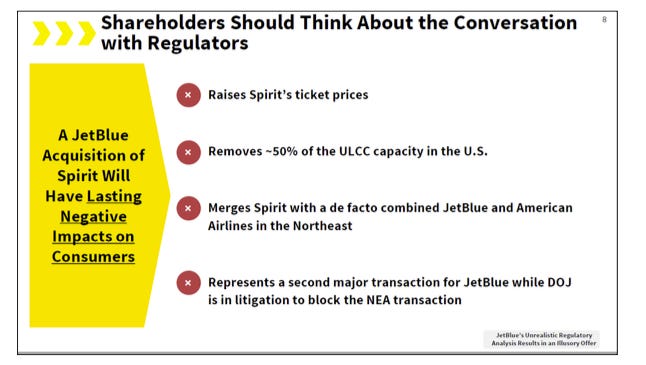
And here’s the CEO of Spirit Airlines on CNBC publicly trying to get shareholders to reject the JetBlue deal as illegal. When you hear arguments from people saying that Biden’s enforcers are at fault, remember that Spirit’s own executives thought it was an illegal deal and publicly said so.
But JetBlue went ahead anyway with their bid. And Spirit shareholders were warned not to take the JetBlue bid, but they chose greed over common sense. Many of those shareholders are today complaining about the Biden administration blocking the merger, as if they didn’t make the choice in the first place.
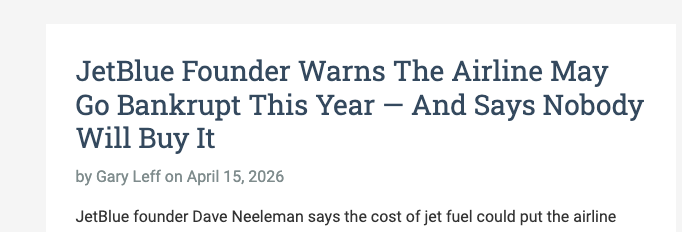
I’ll also note that JetBlue itself is in trouble. Analysts give the carrier a 75% chance of going bankrupt, and the airline’s founder even said he thinks it’s likely.
There were a few reasons why the judge blocked the deal, but one of them was because of the financial fragility of JetBlue. As the judge noted, the company had historically kept its debt to capital ratio at around 40%, a conservative amount, but if it bought Spirit, that amount would go as high as 110%. Putting together JetBlue and Spirit was a bit like having two drunks holding each other up. And there was an insanity to JetBlue’s strategy; on the stand during the Spirit-JetBlue trial, it came out that JetBlue was considering bidding for Alaska Airlines. Imagine that debt load!
In recent years, JetBlue has been serial dating in attempts to align with other carriers rather than competing. Ironically, two of those relationships have been with the same Big Four carriers JetBlue has complained about: the Northeast Alliance with American that also was struck down by a federal court, and the current Blue Sky collaboration with United.
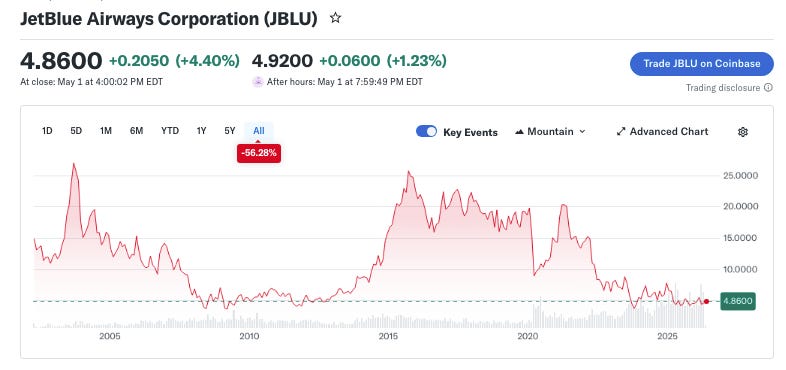
The stock is basically where it was in 2008, and its bond rating is at CCC+. Had the merger gone through, we might be talking about JetBlue-Spirit liquidating, not just Spirit.
The Big Four Legacy Airlines As Factors
Then there are the big guys who lobbied against a Spirit rescue. It’s well known in the industry that the big four legacy airlines - American, Delta, Southwest, United - try to avoid competing with each other over price, and that they go after the low fare guys using a variety of tactics, some with a questionable legal basis.
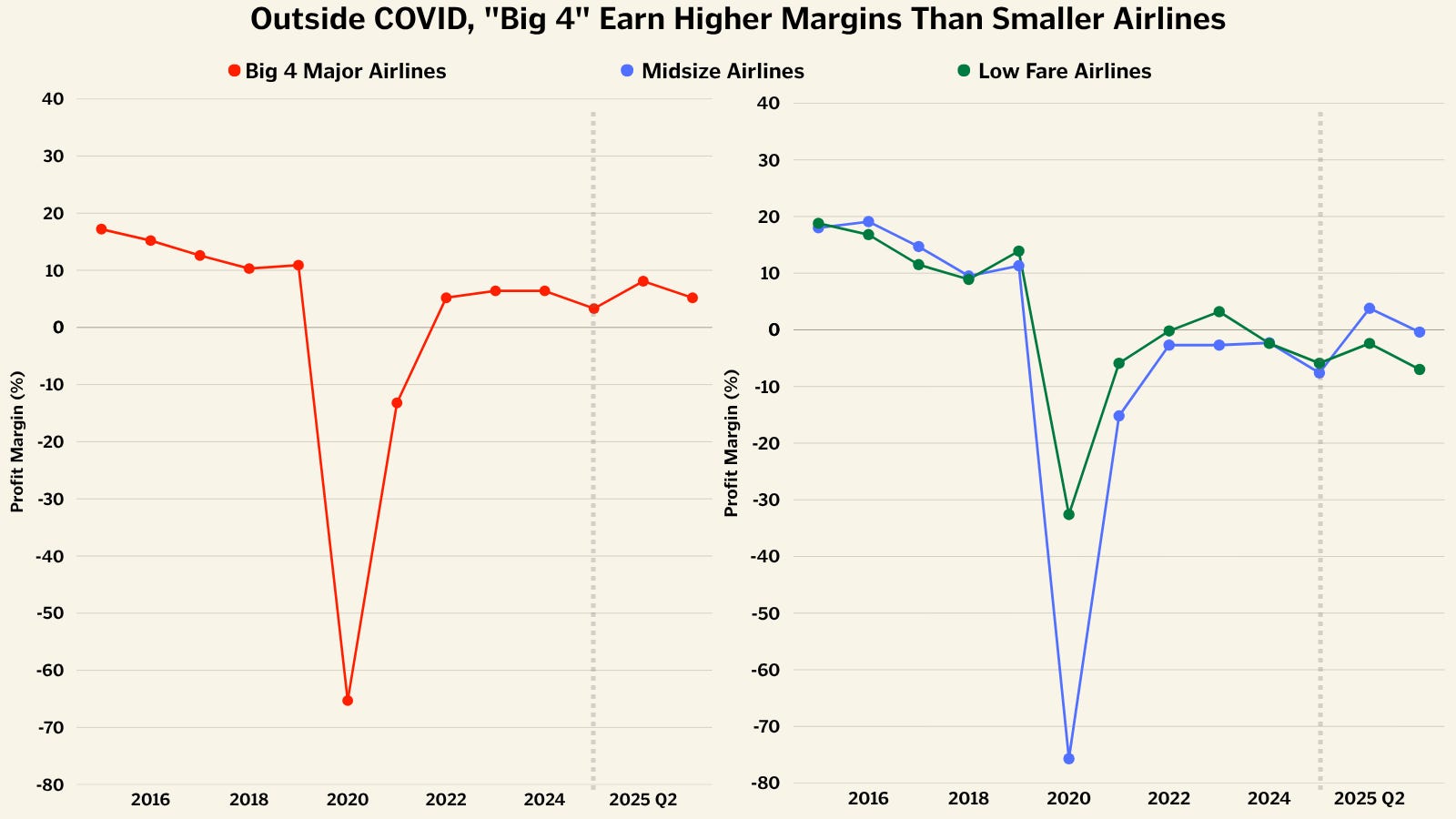
When you zoom out, it’s clear that something is going on splitting the legacy airlines and everyone else. Airline analyst Bill McGee laid out the data last week. He put airlines into three groups:
Big Four Majors (American, Delta, Southwest, United)
Mid-Size Airlines (Alaska, Hawaiian, JetBlue, Virgin America)
Low-Fare Airlines (Allegiant, Avelo, Breeze, Frontier, Spirit, Sun Country).
Before Covid, small, medium, and big airlines were profitable. But since Covid, the big guys make money, while the small and medium size entities are not. In fact, Delta and United Airlines now have most of the industry profits.
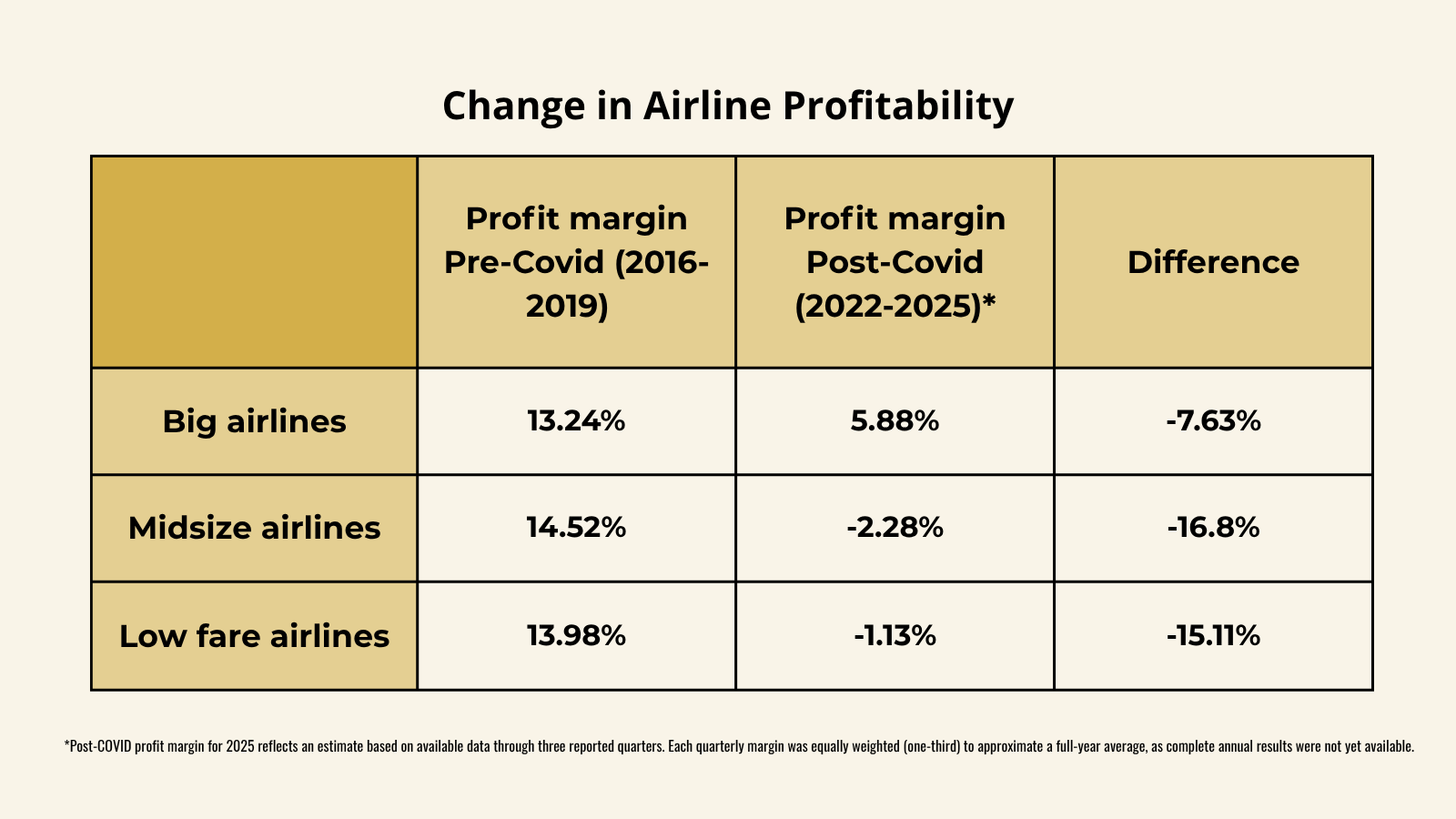
What’s behind this split? Well, the big airlines have a host of advantages over the little guys, and they exploit them. They have lots of slots at airports, ‘fortress hubs,’ and scale in credit card programs, as well as reciprocity with each other but not the little guys. There are other more questionable tactics rumored about.
For example, in a brief last year, airline analyst Bill McGee did a case study on how Southwest Airlines intentionally lost money for years on its routes in Hawaii to drive Hawaiian Airlines out of business. In most of Southwest’s domestic routes less than 250 miles, it charged at least $159. But in intra-island Hawaiian flights, its prices were $39, and it lost money on more than half of them. And these weren’t some introductory price, the money losing occurred for five years. Eventually Hawaiian Airlines bled out, and sold itself to Alaska Airlines.
Intentionally losing money to destroy a competitor and then increase prices later is known as predatory pricing. Predatory pricing violates one of the fundamental assumptions behind capitalism, which is that producing something should only happen if a consumer buys something for more than the sum of the inputs. Otherwise, it’s wasteful, because the firm is taking a bunch of stuff, in this case a pilot, an airline, fuel, et. and selling it for less than it cost to put it together. Doing so to acquire market power is clearly destructive, it’s just weaponizing balance sheets and the one closer to Wall Street always wins.
Two things happened to make predatory pricing seemingly routine in the airline sector. The first is that airline deregulation introduced price competition into the sector in 1978. In the early 1980s, during the immediate aftermath of pulling away public rules, one of the early low cost international airlines, Laker Airlines, was driven out of business by predatory pricing. Laker was able to sue and settle for some cash because the legal environment allowed it.
The second dynamic is that predatory pricing became defunct through a series of court decisions in the 1980s and 1990s that made it very hard to prove. Throughout the next couple of decades, different big airlines attacked low cost entrants with below cost strategies. Examples include American going after Sun Jet and Vanguard, Delta attacking ValuJet, Northwest undercutting Spirit and Sun Country, and United trying to beat out Frontier and Western Pacific. It was so bad that Spirit actually won motion on predatory pricing at an appeals court level 2005. But it didn’t really matter, the doctrine was beyond repair.
So what happened to Spirit? It’s hard to know exactly because we don’t have the data. Spirit used to be quite profitable, as the legacy airlines couldn’t match Spirit’s efficiency. They were legacy hub-and-spoke carriers, Spirit could pick at specific routes where it had an advantage. The majors tried selling cheap tickets; in 2012, Delta created a basic economy fare to compete with the no frills carriers, followed by American and United.
But there are rumors of more sordid behavior. I heard a thesis from an investor in the space who tracked what happening in real-time. He did research and realized the big guys figured out they could make Spirit’s business model non-economic with a strategic pricing strategy.
Here’s what he told me. Consumers of low fare airlines tend to book a few weeks before their trip. So a few weeks before a Spirit flight from, say, New York to Orlando, one or more of the big guys would radically discount their price on just 20 seats on a similar route. The discounts would come on a flight the same time as the Spirit flight, so a direct competitive choice.
This move would pull 20 passengers from a Spirit plane that could carry 220 people, meaning the flight would lose 9% of its revenue. That pushed such a Spirit flight from being profitable to being in the red. Spirit could either respond by dropping prices on all 220 tickets, losing money that way. Or it could give up on those 20 passengers, and lose money that way. But because the big carriers were willing to strategically forfeit revenue on those 20 seats, it meant Spirit would stop making money.
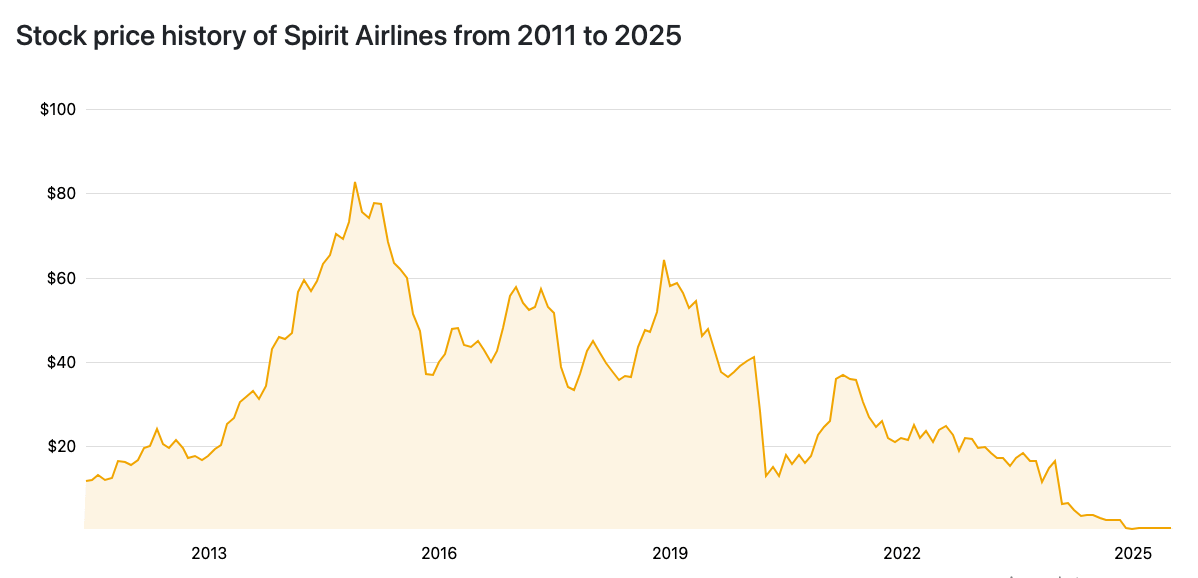
You can see, in 2015, when the big guys likely realized how to beat Spirit. And so goes Spirit, so goes all low-cost airlines. Most low and medium cost airlines started to take hits in their stocks in 2015 so something likely started around then.
Bush and Obama Antitrust Enforcers Created a Mess
But why do the big four legacy airlines exist in the first place? Well one reason is because the Bush and Obama antitrust enforcers, and Department of Transportation regulators, allowed consolidation. There was Delta-Northwest (2008), United-Continental (2010), Southwest-AirTran (2011) and American-US Airways (2013), Alaska-Virgin (2018). Here’s McGee:
Between 2008 and 2013, the six largest network hub-and-spoke airlines paired off to become the much larger Big Three — Delta and Northwest, United and Continental, and American and US Airways. This left the industry with unprecedented concentration at the top. As federal Judge William Young said when he blocked the JetBlue-Spirit merger in 2024: “The airline industry is an oligopoly that has become more concentrated due to a series of mergers in the first decades of the twenty-first century, with a small group of firms in control of the vast majority of the market.”
These mergers cut the number of big airlines from eight to four. There were a host of bad effects, like the big airlines cutting off online travel agencies, like Expedia, from getting access to their pricing data. Cities across the country, like Memphis, Cleveland and Cincinnati, lost service.
The Deregulators: Alfred Kahn, Ralph Nader, and Jimmy Carter
While the big airlines are the culprits, they are also acting to prevent the low cost carriers from bleeding off the cream from their fixed costs. We have to start asking why the same tactics keep recurring for forty five years, along with routine government bailouts. And the cause is deregulation. Airlines are public utility systems, but are regulated like they aren’t. The result is a financially fragile industry; there have been over 200 bankruptcies since deregulation in 1978, and 45 mergers. Before deregulation, bankruptcies were rare.
Basically, the airline grid is a network where having more access to scale, more flights and routes, more airports and planes, and so forth, makes the system work better. If one flight gets canceled, you can move all those passengers onto another flight. Similarly, if you want to ensure that all regions of the country have some access to the air grid for roughly similar prices, it’ll require making sure the places that are hard to get to and have small airports get some subsidies from the busy easily accessed cities. It’s like the U.S. mail, we charge one price for a stamp, even though it’s more expensive to deliver to a rural post office. And sometimes those rural areas grow and become cities.
But without competent regulation, the system malfunctions. Americans understood this dynamic when they set it up in 1938, because railroad systems and steamship systems have similar high fixed cost / low marginal cost public utility principles. Here’s McGee:
Without the right government rules, the incentive for airlines would be to offer inexpensive long-haul flights between big cities, and very few expensive flights to smaller cities. Entire regions could either face much higher costs and limited flights or be cut off from the air grid entirely. Similarly, air carriers would be tempted to over-invest in long-haul flights between big cities or even more commonly between their own big hubs, leading to fare wars and systemwide structural insolvency that came be known as “ruinous competition” in the railroad era but continues today among airlines. That would then lead to price regulation by a private oligopoly, which would be able to manage a thinner, less robust air grid.
For much of the 20th century, we regulated the air grid reasonably to prevent this scenario. The Civil Aeronautics Board set rules around pricing and routes to make sure we had a universal and low cost system. And from 1938-1978, prices kept coming down, as the jet age emerged.
Then came deregulation, which eliminated the CAB. Nader, Kahn, and Carter were the key figures here, along with Ted Kennedy. And it was a disaster. As Phil Longman noted, the impressive price declines of the industry slowed, as prices came down more slowly than they had in the regulated era.
But there were other bad dynamics that recurred.
In the years after deregulation, we’ve seen exactly what you’d expect. There are higher prices on routes not served by low fare airlines, and major carriers charge higher prices to the richest air travelers in big cities. Meanwhile, major hubs in cities as large as Cincinnati, Cleveland, Pittsburgh, St. Louis, and Nashville have closed, taking with them easy connectivity across regions of the country. These cities have seen fewer nonstop destinations, fewer flight frequencies, and higher fares.
Consider that Atlanta is the 37th most populous city in the United States, but it is the busiest airport not only in the country but the world, because Delta’s mega-hub processed 106 million passengers in 2025. Simply put, under regulation, planes were sent where the people were; under deregulation, people are sent where the planes are…
Any public utility, whether a railroad or phone company or anything else, when it is in a poorly regulated structure, becomes a plaything for financiers. And that happened to Spirit Airlines, and increasingly many of the others as well. In the 1960s, when the railroads were poorly regulated, the leaders of companies like the New York Central and the Pennsylvania Railroad undertook a slew of mergers, buying not just each other but real estate and random companies most of which failed, but were done by financiers trying to wring something out of an inevitably losing situation.
Today, the airlines are making much of their money on credit cards and frequent flyer programs. Organizing a transportation system based on who can sell credit cards is an insane way to decide how to move people and goods around a country. But that’s where we are.
So who killed Spirit Airlines? Well, there’s a bit of a Murder on the Orient Express dynamic to it. Yes, it was Trump’s Iran war spiking costs, but it was also JetBlue sabotaging Spirit’s Frontier deal, and the big four legacy airlines, and Bush and Obama enforcers/regulators blessing a roll-up of power to the big four, and behind all of that, Jimmy Carter/Ralph Nader/Alfred Kahn deregulating the airlines and creating a criminogenic environment for all these games. You’re not going to hear that on CNBC, but then, we know why that is.
Spirit won’t be the last to go. And until we decide as a country we want an airline system that serves all of us, and put the rules in place to make that happen, it’s going to get worse. We either re-regulate our airline sector to operate as a public utility, or the American travel system will be regulated by just four airline CEOs, for their benefit.
Thanks for reading! Your tips make this newsletter what it is, so please send tips on weird monopolies, stories I’ve missed, or other thoughts. And if you liked this issue of BIG, you can sign up here for more issues, a newsletter on how to restore fair commerce, innovation, and democracy. Consider becoming a paying subscriber to support this work, or if you are a paying subscriber, giving a gift subscription to a friend, colleague, or family member. If you really liked it, read my book, Goliath: The 100-Year War Between Monopoly Power and Democracy.
cheers,
Matt Stoller