 BURST
BURST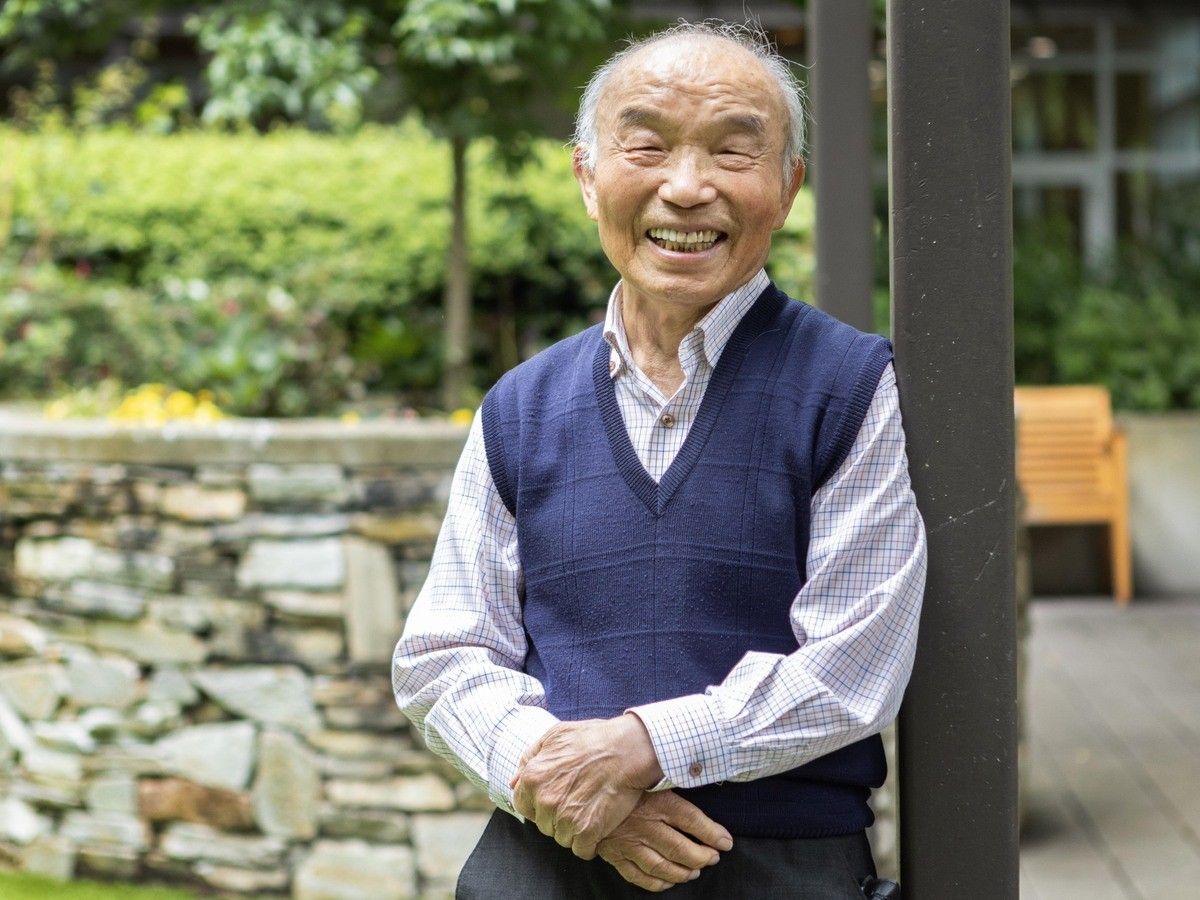
At this year’s BMO half-marathon last month, Yul Kwon won in his category with a time of 3:50:33. He also came in last in his category.
That’s because he was the only runner in the 90-plus division.
Until this year, the marathon categories ended at the 85-89 age group.
“It would be unfair for someone in their 90s to race against someone in their 80s,” he joked.
So Kwon, who is 90, wrote to marathon organizers to plead his case. They responded by adding a new category.
Kwon beams like a kid.
“Happiness is my priority now,” he says. “At my age, I can see the end of my life. It’s important to cherish every moment.”
Running, a hobby he took up at the age of 60, is part of that. At the age of 80, he won his age group in the Boston marathon.
In the lobby of Seasons Wesbrook Village Retirement Community, where he lives near UBC, a woman reaches for his arm, stopping him to talk. He is on his way to the washroom. She won’t let go.
Kwon, a retired economics professor, is something of a celebrity here. He has been nominated for the community’s “remarkable residents” honour.
“Running is hard,” he says. Moving through what is uncomfortable brings rewards. One of those is joy, he explains. He runs because he can.
Kwon wears clean New Balance sneakers, neatly tied.
Born to impoverished farmers in a village on Korea’s southern peninsula, Kwon had no shoes until he learned to weave his own out of rice straw.
The rice his family harvested was allocated to the Japanese colonial occupiers. There was no running water or toilet, and Kwon felt shame about his distended belly, swollen from starvation and parasites.
Kwon was one of nine children. Three did not survive infancy. “Somehow I survived.”
His parents scraped together money to send him to elementary, and later middle school, in Masan, something his siblings did not get to do.
His best hope was “the vague prospect” of working in an office. He wasn’t sure exactly what that meant, only that he wouldn’t have to work in the fields.
But the North Korean invasion on June 25, 1950, ended his schooling. He returned home. Luck stepped in again, briefly. “I was too young to be drafted,” said Kwon.
Kwon’s village was caught in months of bombardment between North Korean and American forces.
His mother was killed, and the family displaced. When the war ended, his father did not have money to send him back to school. He was sent to work in the fields. Kwon decided to run away. His sister-in-law sewed him a backpack, loaded it with his text books and some dry rice.
On the 20-kilometre walk back to Masan, the grief-stricken child saw the devastation of the war.
“There was nothing left. All the villages were burned.”
Kwon began his studies again. To support himself, he peddled newspapers. “I was so lonely,” he said.
His father helped Kwon with what little he had.
“He was struggling, too.”
One day, a distant family member came to visit the tombs of the family. “He looked almost like an angel, in these beautiful clothes,” said Kwon. The man was a professor.
“I decided then that was what I could be,” he said.
He rededicated himself to his studies, and became a whiz at the abacus.
When he wrote the national exam, Kwon came in third, and won entrance to a commercial high school, which focused on vocational training. He knew his father could not support his university dreams. But Kwan was tenacious, and later passed the entrance exam to Seoul National University.
His father sold the small plot of land he farmed to pay the substantial entrance fee.
“I knew I had to do well,” said Kwon.
After graduation, he landed a position with the Bank of Korea, Seoul. He was an office man at last. But he longed for more.
Kwon applied to 54 American universities, and was accepted to all. But there were no scholarships. Then he found out about a Canadian scholarship, to the University of Saskatchewan, and won it.
It was fully funded, but didn’t cover airfare.
“The airfare was $540,” Kwon said. “It was impossible.”
Finally, with airfare help from the Rotary Club, Kwon arrived in Canada on Sept. 4, 1964.
It had been a marathon.
Kwon’s fiancée, Joanne, soon joined, thanks to the kind efforts of two families in Saskatoon.
He eventually earned a PhD in economics from McMaster University. His distinguished academic career was capped by 18 years as Korean Foundation Chair in Korean studies at Griffith University in Queensland, Australia.
After retiring, Kwon accepted a position as adjunct professor at SFU’s Beatty School of Business, and created the Kwon Family Scholarship in conjunction with the Vancouver Korean-Canadian Scholarship Foundation .
“I had such difficulty getting tuition. I want to help others,” said Kwon. Giving to others is part of his happiness practice. So is running four to five marathons a year.
Kwon said the lessons of his youth have given him the strength to do what is difficult, and run through the pain. “Out of poverty, and the struggle, I learned diligence, perseverance and frugality.”
He has also tied his running to giving, in support of the B.C. Cancer Foundation. In the last two years, he has raised $20,000 toward cancer research.
“By extending my running to fundraising, that gave me a bigger purpose,” said Kwon. His retirement home’s “remarkable residents” award comes with a $6,250 donation to the charity of the winner’s choice.
If Kwon wins, he plans to donate it to the B.C. Cancer Foundation.
Although his beloved wife died in 2017, and Kwon can see his own finish line, he’s not quite ready to cross it. He has discovered that after his email, the BMO Marathon committee also extended the age divisions to include those 100 and over.
In 10 years, he plans to request they extend it yet again.