 BURST
BURSTOn Aug. 12, 2026, a total solar eclipse will sweep across Earth, giving skywatchers across Greenland, Iceland and northern Spain an incredible view of totality. As the moon completely covers the sun, day will briefly turn to twilight, revealing the sun's faint outer atmosphere, the corona. But could totality reveal something else too?
Although totality never produces true nighttime darkness, it does briefly dim the sky to roughly the brightness of twilight. Since eclipse chasers in Greenland and Iceland will be in the auroral zone — the geographic zone around Earth's magnetic pole where auroras are most frequently seen — it's natural to wonder whether the two phenomena could appear together.
The answer is yes — but only if everything falls perfectly into place.
"During totality, the sky brightness is comparable to civil twilight (the first period of darkness after sunset, until the sun reaches six degrees below the observer's horizon). It's uncommon to see auroras during this time, but by no means impossible," Tom Kerss, independent astronomer and Chief Aurora Chaser for tour company Hurtigruten, told Space.com in an email.
Kerss knows this from experience. Last year, he photographed the northern lights in Norway at twilight, demonstrating that sufficiently bright auroras can remain visible even before the sky becomes fully dark.
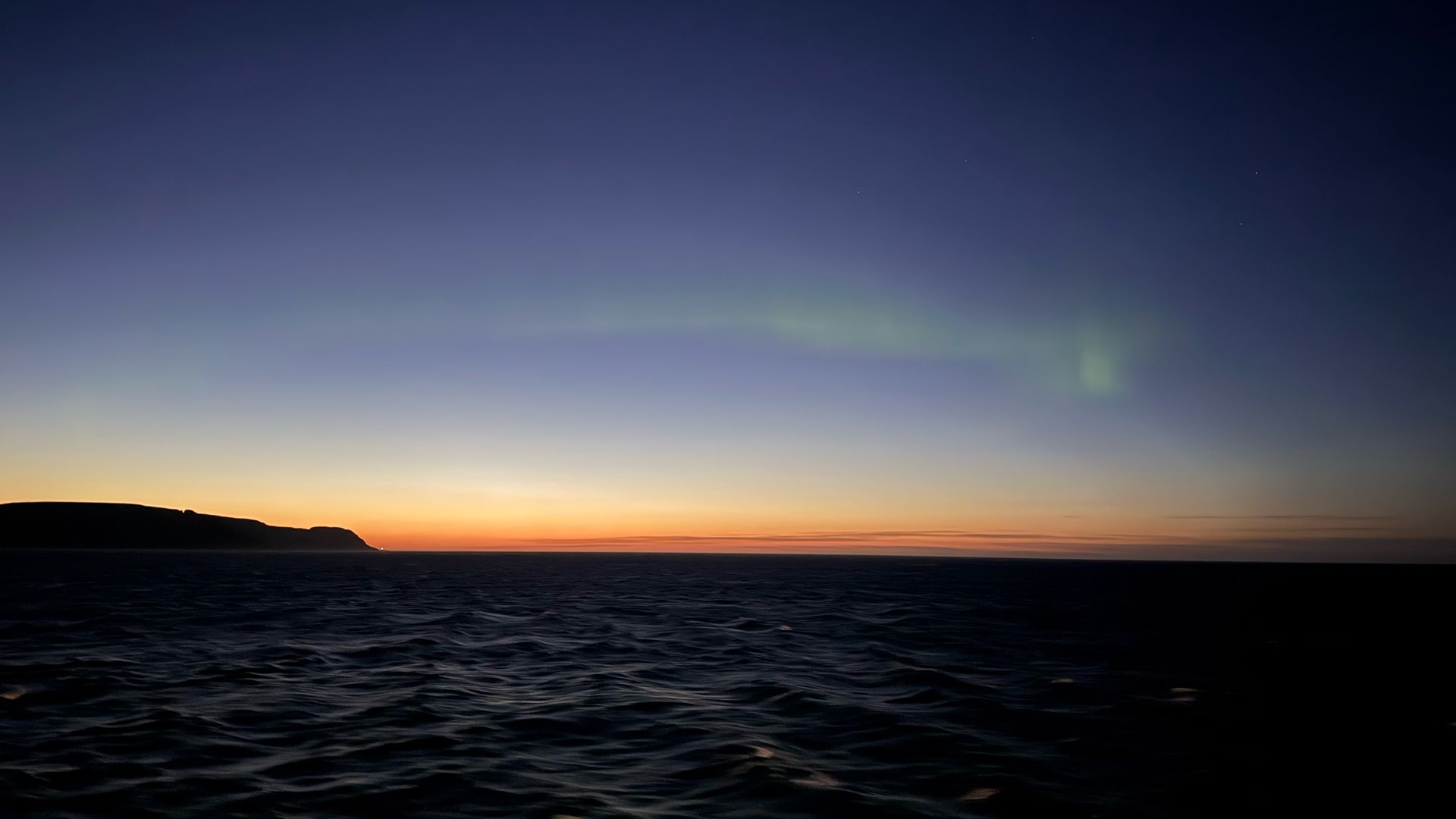
However, the aurora's position in the sky would impact its visibility.
"During totality in August, the surface brightness of the sun's corona would almost certainly outshine auroras in its vicinity, but other parts of the sky away from the eclipse could host visible auroral structures," said Kerss.
So while it's physically possible, how likely is it?
Not very.
"If the auroral activity stays quiet, we wouldn't expect to see it during totality even though we know some energy is probably being emitted in the dayside portion of the oval," Kerss said.
To have any realistic chance of seeing the northern lights during the eclipse, Earth would need to be in the grip of a severe geomagnetic storm. These storms occur when eruptions from the sun, such as coronal mass ejections (CMEs), slam into Earth's magnetic field. During such conditions, auroras can get a dramatic boost, appearing brighter and more widespread than usual.
Kerss explained that observers would almost certainly need a G4 or G5 geomagnetic storm (G5 is the most powerful category) to overlap with the eclipse to have any realistic chance of seeing an aurora show because they will be on Earth's dayside.
"Bright, nightside aurora can be driven by powerful substorm activity, in which energy is stored and released," Kerss explained. "The dayside aurora is driven by a combination of favorably aligned solar wind (which opens the field lines around the Earth's polar cusps) and strong precipitation directly into the auroral oval. This latter requirement is contingent on very strong or extreme geomagnetic activity."
Kerss' thoughts are echoed by Pål Brekke, a solar physicist and northern lights expert working as Lead of Space Science at the Norwegian Space Agency.
Brekke knows just how difficult this is. He attempted to spot auroras during the 2015 total solar eclipse over Svalbard but found the sky never got dark enough.
"The sky never got that dark — we could hardly see any planets and no stars," Brekke told Space.com in an email. "Most probably because the snow-covered valley and mountains reflecting lights leaking in from the side of the moon's shadow. Making the sky too bright even during the eclipse."
Brekke also pointed out that the timings work against eclipse chasers. Totality occurs in the afternoon over Greenland and Iceland, meaning observers will be beneath the daytime portion of the auroral oval. Unlike the nighttime aurora oval, which expands dramatically during geomagnetic storms, the dayside auroral oval changes much less, making displays harder to see even during active space weather.
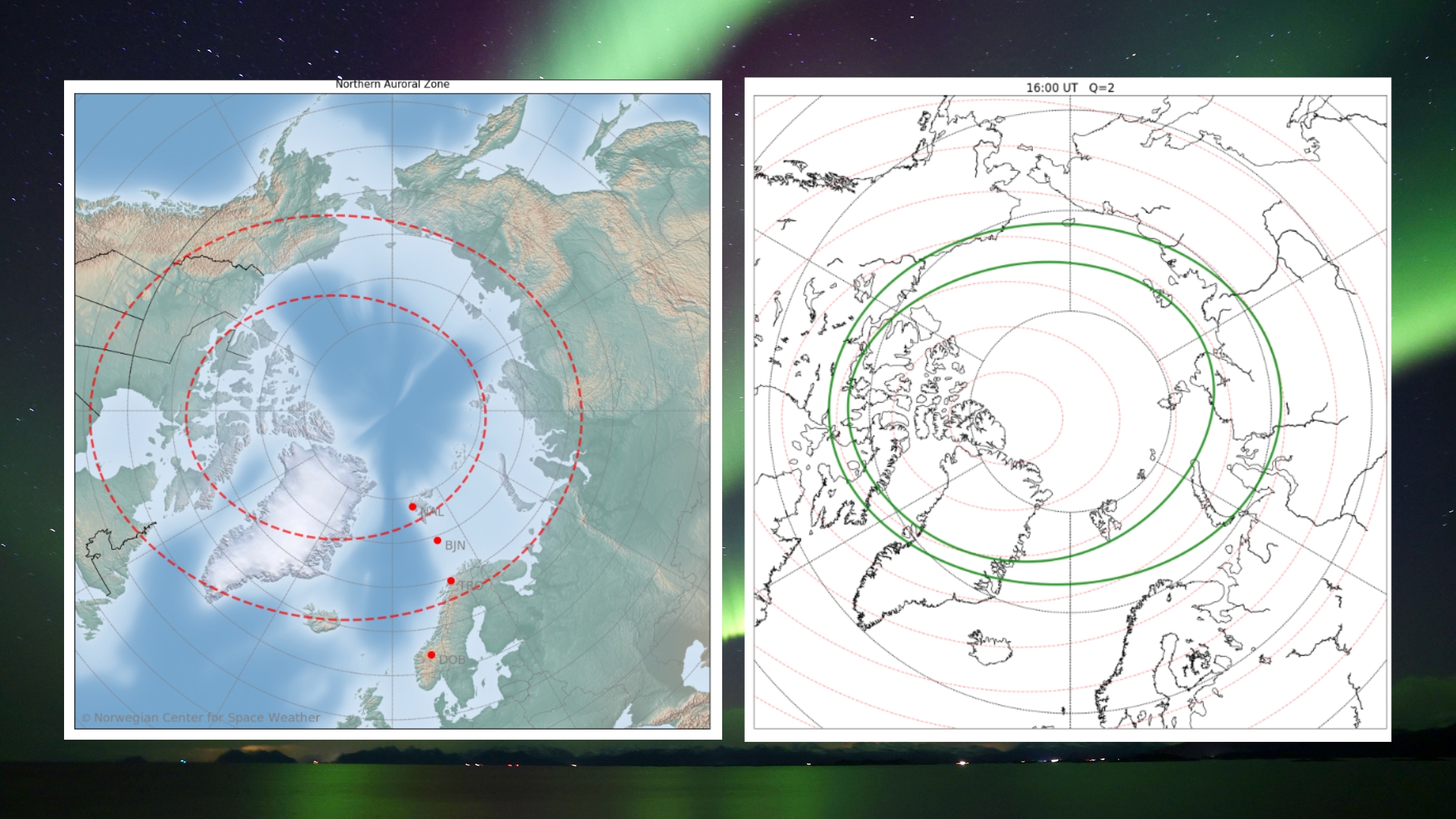
"The chance for aurora over Spain is very low — that would need a KP=9 or so — and 20:00 [UTC] is still very early so the fattest part of the oval is still not over Spain at that time. So our guess is it will not be very likely," said Brekke.
There is one scenario, however, that could make eclipse day even more extraordinary.
"If the sun launches CMEs in the days before the eclipse, it'll be very exciting for anyone going to Iceland or Greenland, and since the exceptional Perseid Meteor Shower will also peak on that date, there's a rare opportunity to see three of the sky's greatest wonders together if conditions line up," said Kerss.
The odds may be slim, but they're not zero.
If the sun happens to unleash a powerful geomagnetic storm in the days leading up to Aug. 12, eclipse chasers in Greenland or Iceland could witness something truly remarkable.
If not, don't be too disappointed. During totality, the sun itself puts on one of nature's greatest spectacles — and that's where your attention should be.