 BURST
BURST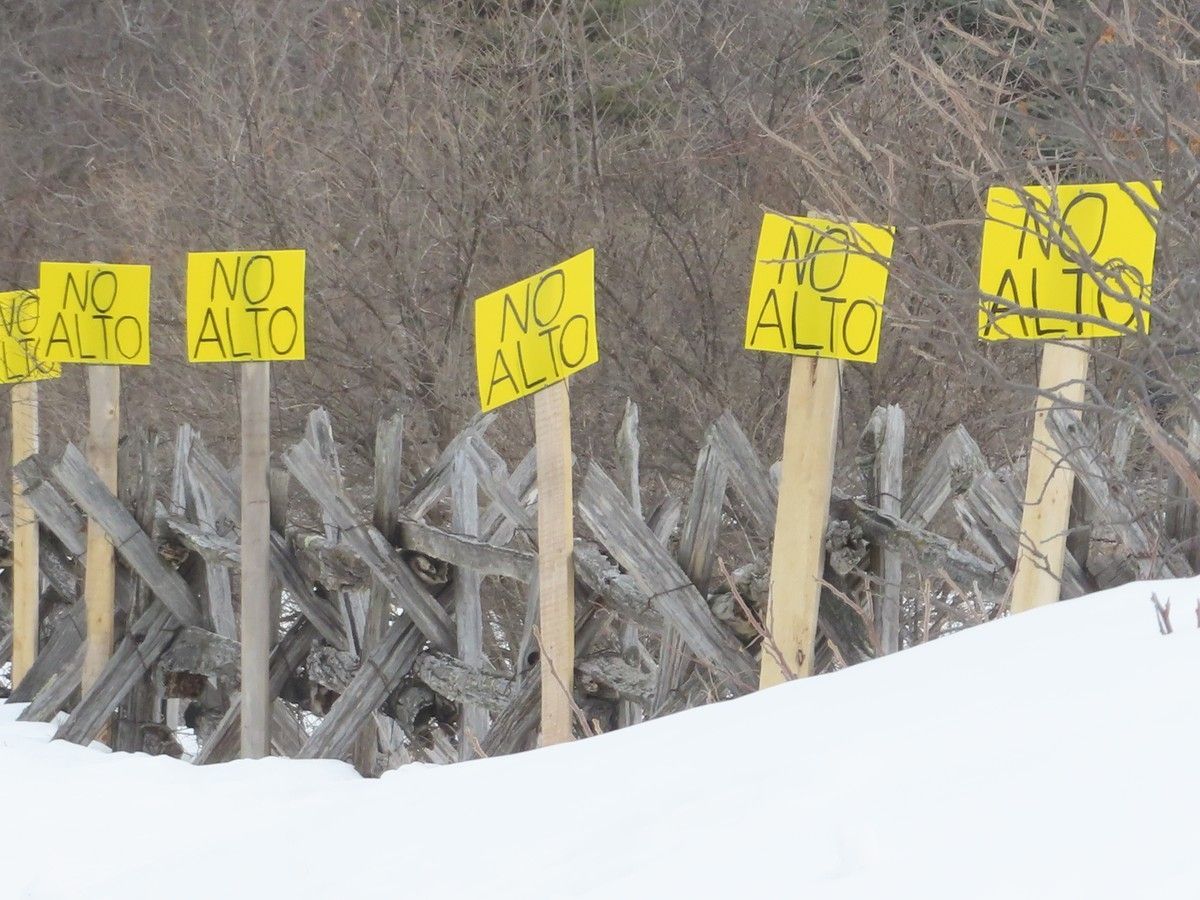
CENTREVILLE — Standing on the ice along the shoreline of her property, Heather Coulson Levy pondered what the addition of a high-speed rail track would look like at Varty Lake, a 600-hectare water body ringed by permanent and seasonal houses. In the summer, it is a busy recreational spot, with residents and visitors boating, fishing and just enjoying their days by the lake.
But Varty Lake also straddles nearly the complete width of the study corridor for the southern route of a proposed high-speed rail project that would run from Toronto to Quebec City. If the southern option is selected as the final route, the track would likely cross the lake.
Trains travelling in excess of 300 km/h between Peterborough and Ottawa would cross the lake every 20 minutes or so.
“Devastation is the word that comes to mind,” Levy said.
Levy acknowledged her property likely wouldn’t be expropriated for the project, but she would be left with a lake bisected by a high-speed rail line.
Her plans to spend her retirement gardening have been set aside as she founded Save Stone Mills to organize community opposition to the rail project.
“I’m not an expert. I’m not a politician. I’m not a train builder and I’m not an economist. But now I’ve lived, slept and breathed high-speed trains, ” she said.
Rural townships opposed
Across rural townships in eastern Ontario, many residents have found themselves having to opposing Alto and the federal government’s nation-building high-speed rail aspirations.
The Alto high-speed rail project is among the high-profile infrastructure projects the federal government has proposed as nation-building endeavours.
The project would construct an all-electric passenger rail line between Toronto and Quebec City, with stations in Peterborough, Ottawa, Laval, Montreal, Trois Riviere and Quebec City.
Trains would travel 300 km/h or faster and cut travel times between destinations in half.
The company projects that the rail line, once completed, would add about $24.5 billion to Canada’s economy and increase its gross domestic product by 1.1 per cent.
The company said the project would produce 51,000 construction jobs and thousands of permanent jobs, generate $800 million in annual tourism revenue and $7.2 billion in environmental benefits including greenhouse gas emissions.
Alto projects that by 2084, the train would carry more than 43 million passengers a year.
But that plan, and those promises, have run into opposition from rural residents who fear their land will be expropriated and their communities cut in half by a 60-metre wide completely fenced off rail line.
‘Great Wall of Ontario’
There are concerns about the project’s potential impact on the Cataraqui watershed, threatened species and sensitive environments, such as the Frontenac Arch.
“This is the Great Wall of Ontario,” said Lanark County resident Kim Davis, who is trying to inform residents living along the northern route . “If it gets built, it’s essentially going to sever eastern Ontario in half, north to south. If they build it where they want to build it, whether it’s the northern or southern route, eastern Ontario is going to be cut in half.
“I really don’t think most people from Central Frontenac north even know about it,” Davis said. “I don’t think there’s enough information coming from Alto for people to get a realistic and rational understanding of what it is.”
In mid-January Alto, the Crown corporation tasked with developing the high-speed rail line, unveiled the study corridor and launched a public consultation period.
The proposal includes two options for passing through eastern Ontario: a northern route roughly following Highway 7 between Peterborough and Ottawa; and a southern route connecting those two cities by passing closer to Kingston. For many people in the Kingston area, the southern route was a surprise addition to the project.
The company is, until the end of March, collecting public input about the project, including comments about the eastern Ontario route options.
That process includes 70 open houses and 10 online sessions in communities along the route. An open house had not been planned for any locations along the southern route until public demand convinced Alto to host one in mid-February near Sunbury .
Citizens groups emerging
In rural parts of eastern Ontario, that message may not be gaining much traction.
“Opinion is uniformly negative and for good reason,” Lanark-Frontenac Conservative MP Scott Reid said. “If this project goes through, some people will lose their property, it will be expropriated. Some people will lose access to their property, its value will decline.
“The whole community is just united at this being a bad idea.”
“I haven’t, on balance, heard a tremendous amount of support for this project and the price tag is one that’s also pretty eye-watering,” said Michael Barrett , the Conservative MP for Leeds-Grenville-Thousand Islands-Rideau Lakes. “I haven’t been convinced of the project’s benefits and neither has the community.”
Citizens groups opposing the project , in the meantime, have been staging their own open houses to provide a different perspective and spread the word.
“The project has been approved before there’s been any consultation with residents, any consultation with any of the local organizations or environmental agencies,” said Gord Boulton, a South Frontenac Township resident and one of the organizers of Save South Frontenac. “The project is a go, it’s already been approved.
“This is not a train that has level crossing, so you cannot cross it with a vehicle anywhere unless there is either a tunnel or a bridge,” said Boulton, whose 260-hectare property could be cut in half by the southern route.
“There’s no way they’re putting in a 60-metre tunnel for me to go through with my four-wheeler to go fishing.”
Many experts have also been skeptical of the project.
“I have concerns that they’ve that they’ve underestimated the cost and that they’ve overestimated the benefits,” said Matti Siemiatycki, a professor of geography and planning and director of the Infrastructure Institute at the University of Toronto. “We don’t even know what the ticket fares are yet, and that also has an impact on whether this is really a point of social connection for Canada or is this more of a business travel type of system.
“In many European places, the high-speed rail is not cheap. You’re not taking this for the price of a bus ticket or for the price of a subway token. The pricing tends to be slightly below flying, and in that case, most Canadians are not doing that on a daily basis,” said Siemiatycki, who sits on academic advisory panel for Alto.
Kingston lobbying for stop
The southern route option was added to the project only in January, when the public consultation period was launched. Prior to that, it was generally accepted that the train line would follow the northern route between Peterborough and Ottawa.
The new southern route was welcomed as an opportunity by Kingston-area officials. They have mounted a campaign to convince the federal government to change Alto’s mandate to include have the southern route extended into Kingston and a station added there .
“We need to look beyond just the two routes that are being proposed by Alto,” Kingston and the Islands member of Parliament Mark Gerretsen said. “The mandate that Alto has is to have four stops in Quebec, three stops in Ontario. I think that mandate needs to be updated to have four stops in Ontario as well as four in Quebec.
“It just doesn’t make any sense to me that we can have a huge distance between Ottawa and Peterborough that doesn’t consider all of the people that live along the 401 corridor between Brockville and Belleville,” Gerretsen said.
“I just think from an economic perspective, it makes a ton of sense.”
South Frontenac Township council and Kingston city council passed motions calling for the southern route to be moved into Kingston and a station built there.
“I think our positions are actually complementary here,” Kingston Mayor Paterson added. “I think we both agree that the southern line should come as far south as close to Kingston as possible. I think that just makes the most sense and that ultimately there needs to be a stop here.”
In mid-February, Kingston city council passed a motion supporting a southern route and calling for Alto to consider the Kingston route, including a station in the city .
City council’s support for the project is contingent on Kingston receiving a station.
No local station, no municipal support
Not that it matters. The discussion around most council tables before any motions opposing the high-speed rail project have taken place under the assumption that the federal government does not have to listen to municipal councils .
“That’s a constant in the life of a small-town politician. Everything above you controls you and you control nothing,” said John Wise, reeve of Stone Mills Township. “The old phrase is that municipalities are creatures of the province and, in this case, I guess we’re creatures of the federal government.”
Discussion leading up to city council’s motion included growing interest in scrapping the northern and southern routes in favour of building a better passenger rail along the Highway 401 corridor.
As proposed, the high-speed rail project would harm the environment and split communities, said Lisa Asbreuk of the Corridor Train Alliance, which is lobbying to have Alto take another look at improving passenger train service along the Highway 401 corridor .
“I don’t think these routes have social license right now,” Asbreuk said. “A true nation-building project should be capable of uniting urban and rural people, rich and poor people, liberal and conservative people. We have a natural route and an ability to do that right now that is not divisive. This is too divisive.”
The final route for the high-speed rail line is to be determined by the end of the year.