 BURST
BURSTA few weeks ago, Lina Khan’s successor at the Federal Trade Commission, a former Mitch McConnell advisor named Andrew Ferguson, had some pretty harsh words for his predecessor. After accusing Khan of essentially being dishonest about her merger policy, he then said she pushed forward some “pretty hard to justify” decrees in the oil industry, which he has subsequently undone.
Now, normally these kinds of fights are hard to parse, because the effects play out over long periods of time. But in this case, a war in the Middle East broke out just a few weeks later, and oil has surged to over $90/barrel, with gas prices following. And price hikes resulting from this war are becoming a major political issue. So it’s worth looking at exactly what happened, and whether it will have any consequences.
Ferguson was angry because in 2024, the Federal Trade Commission moved against a few oil executives, over a possible price-fixing scheme in which they were involved. These men were seeking to sell their shale producing companies to major international oil firms. And when the FTC looked into the mergers, lo and behold, they found what seemed like a conspiracy.
There was substantial evidence showing these men may have coordinated with Middle Eastern oil rich states who ran the Organization of Petroleum Exporting Countries, or OPEC. They held multiple meetings, publicly and privately discussed price and output, and broadcast to investors through many different channels the need to not drill so as to allow for higher profits.
“Everybody’s going to be disciplined, regardless whether it’s $75 Brent, $80 Brent, or $100 Brent,” said Scott Sheffield, the then-CEO of shale oil driller Pioneer Natural Resources, in 2021. He pledged that his firm wouldn’t drill more even if oil went to $200/barrel, and went on multiple panels telling shareholders publicly across the industry about the plans.
Sheffield’s view resonated far beyond his own company; Wall Street Journal called him the “de facto” leader of the U.S. shale industry. And he was neck-deep in the communication networks with OPEC, dining privately with OPEC’s General Counsel in 2017 and maintaining relationships with OPEC officials for years. The FTC detailed many WhatsApp chats with them.
Prior to these discussions and meetings, in the mid-2010s, competition was fierce, and oil prices, and profits, were low. After these meetings in 2021, the domestic producers de facto joined OPEC, and prices skyrocketed.
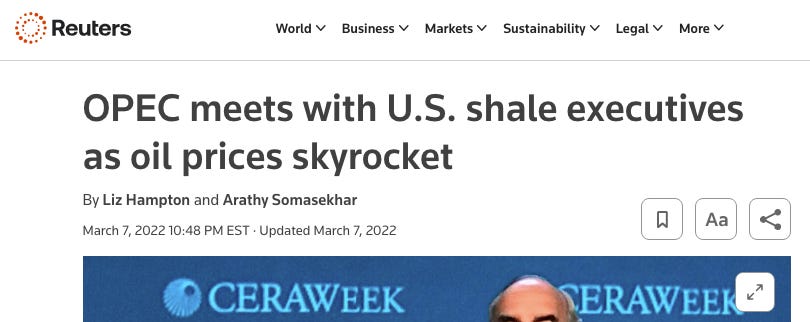
The goal of the alleged scheme was to prevent a price war where shale producers would take share from Arab producers, instead reducing drilling to juice profits and return money to shareholders. And it seemed to work. For a few years, oil companies were insanely profitable. But on the other side, these actions may have caused hundreds of billions of dollars in elevated costs to Americans. And they paved the way for broader inflation. Not only is oil an input into everything, but after corporate America saw the oil guys reducing capacity to take advantage of higher prices, they all started doing it.
The conditions attached to these mergers were very light. In 2024, Khan cut a deal with Exxon to ensure Sheffield couldn’t be on the board of the company, as a condition of allowing its $60 billion takeover of Pioneer to proceed. Sheffield got to keep hundreds of millions in profit and has faced no charges, though several major lawsuits from plaintiff lawyers are now winding their way in the courts making the price-fixing charge directly.
But despite getting richer and not facing any actual penalties, he was angry and embarrassed, isolated from the industry he helped build. Sheffield is a legend among drillers, beloved in Texas for helping to kick off the fracking boom. And Texans, even center-left types, responded defensively. Sheffield himself, though he profited handsomely from the sale of his company, hired a lawyer, a former Obama enforcer named David Gelfand, to fight the order that said he couldn’t be a board member of Exxon.
Industries have internal cultures, and the oil and gas industry is characterized by an insular network who see nothing wrong with the arrangements that Sheffield put together. And that makes sense, there’s been little enforcement of antitrust laws in the oil and gas industry for decades. So the FTC suddenly acting was a shock. But if Biden had been reelected, or if the Trump FTC had continued the enforcement work, the oil guys would have changed their behavior, and become more competitive over price.
But the 2024 election cut that change short. Trump, when running for office, promised to help oil drillers in return for campaign donations. And before the attack on Iran, he had been bragging about “Drill baby Drill” and saying that oil prices and gas prices are at record lows. So it wasn’t a surprise that Ferguson set aside the decree fairly quickly, and has been complaining about it publicly. It’s the kind of decision he can easily criticize and reverse. It won’t be noticed much by anyone except Republican Wall Street types, who will approve. Journalists and right-wing populists don’t follow these kinds of details, so they will continue to write stories about “MAGA antitrust.” It’s a very cynical move, all in all. And it signaled to industry, don’t worry, do whatever you want.
But then came the attack on Iran. Over the past six days, oil markets have been in turmoil, with the price per barrel going up roughly 20%. Gas prices have jumped from $2.80 to $3.30 a gallon, the fast increase in decades. And that’s causing heartburn in the White House, with multiple cabinet officials “being screamed at” to find some good news somewhere on energy inflation.
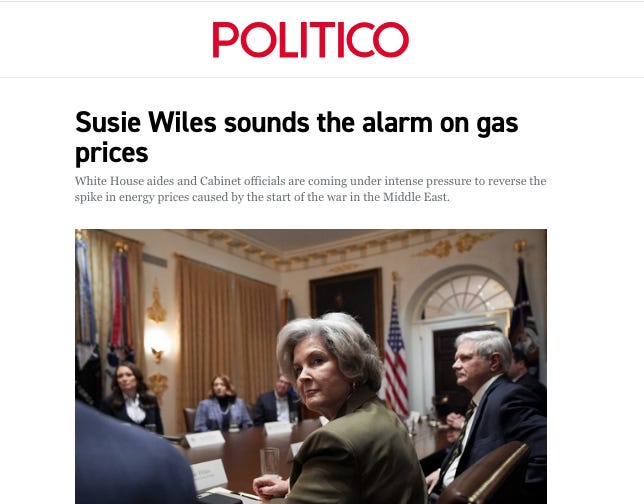
There’s no doubt prices are going to rise, and rise rapidly. So you’d think that domestic shale producers in Texas and North Dakota, who can ramp up production quickly, would act. The oil industry are Trump’s people, surely they would not like to see him put in political jeopardy over higher prices. And the opportunity to grab market share from Arab producers who can’t ship oil now due to the disruption in the Middle East is ripe.
But unsurprisingly, that’s not what’s happening. Here’s a story that came out in the Financial Times three days ago.
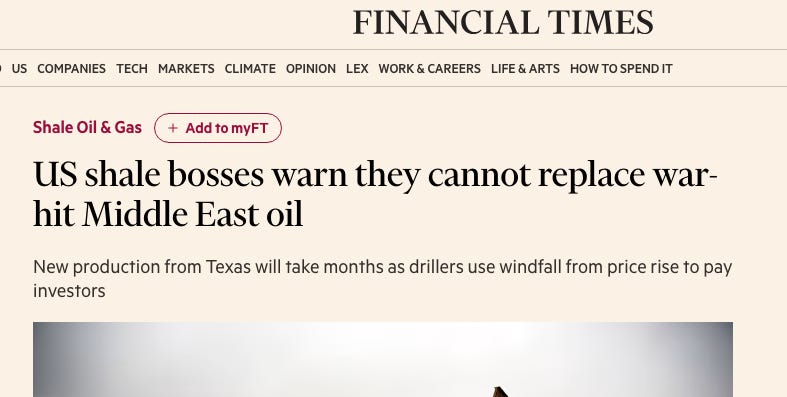
And who is the very first and most extensively cited of the “shale bosses?” Yup, you guessed it, Scott Sheffield.
Scott Sheffield, a veteran shale boss, said producers would resist costly new drilling programmes until they were certain oil prices — which hit an 18-month high above $80 a barrel this week amid fears of supply disruptions from the Gulf — would last.
A lack of good drilling prospects would also hold back companies, which have cut spending, idled rigs and laid off workers in the past 12 months during a period of weak oil prices, he said.
“It’ll just give them extra cash flow. They can reduce debt. They can do buybacks. They can pay dividends,” Sheffield said of the price surge this week. “But once the war ends, then it’s gonna fall back pretty quickly.”
He added: “Also, you got to remember the companies are running out of [drilling] inventory . . . I do not anticipate anybody adding any rigs.”
In other words… he’s back. While not on Exxon’s board, Sheffield’s isolation has ended, and he once again has the ability to direct broader oil investment activity. He’s on the board of the Williams Company, which handles a third of the natural gas in the U.S. And he is working with investment firm Kimmeridge in a hostile proxy fight over control of oil and gas producer Coterra.
I don’t mean to cast aspersion on Sheffield’s intent, he no doubt believes that shareholders should get their due and that he was treated unlawfully. Plus, the FTC decree was undone. So nothing he’s doing is insincere. But he is signaling to major investors that they pressure the firms in whom they own stakes to keep prices high. And why wouldn’t he do that? It’s not like Lina Khan is in office to take a hard line against any possibilities of soft collusion. And the new person who took her job, whatshisface, well, he doesn’t seem to mind. Though the big boss, Donald Trump, might.
Thanks for reading! Your tips make this newsletter what it is, so please send me tips on weird monopolies, stories I’ve missed, or other thoughts. And if you liked this issue of BIG, you can sign up here for more issues, a newsletter on how to restore fair commerce, innovation, and democracy. Consider becoming a paying subscriber to support this work, or if you are a paying subscriber, giving a gift subscription to a friend, colleague, or family member. If you really liked it, read my book, Goliath: The 100-Year War Between Monopoly Power and Democracy.
cheers,
Matt Stoller