 BURST
BURST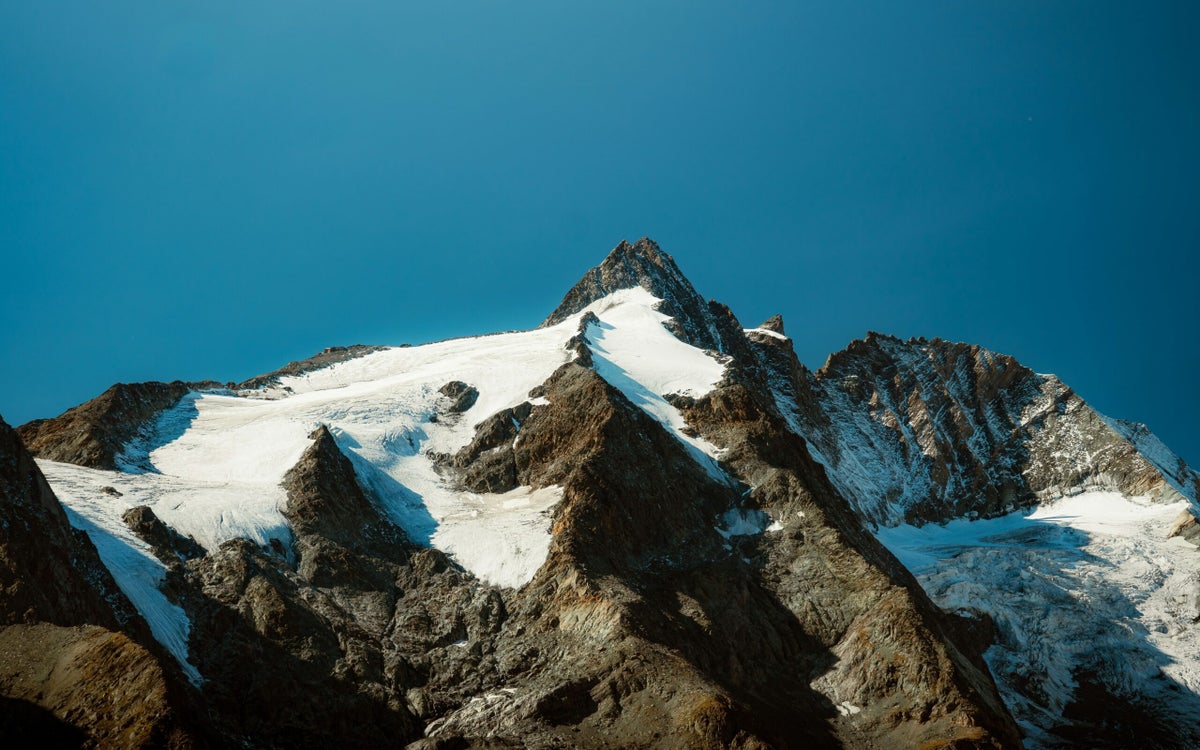
After leaving his girlfriend to die on Austria’s highest peak, Grossglockner (12,461ft), an alpinist was convicted last week of grossly negligent homicide. The incident occurred in January 2025. Then-36-year-old Thomas Plamberger and his girlfriend and climbing partner, 33-year-old Kerstin Gurtner, attempted an overnight ascent of the Grossglockner via a technical ridgeline called the Stüdlgrat (UIAA III-IV [5.4]). After a 14-hour trial on February 19, judge Norbert Hofer found Plamberger guilty. He sentenced him with a €9,600 (roughly $11,300) fine and a five-month suspended prison sentence.
With the verdict decided, new insights from a local reporter in the courtroom and alpinists across Europe shed more light on Plamberger’s actions, his level of responsibility, and what this means for climbers worldwide.
As editor for Austrian newspaper Die Presse, Bernadette Bayrhammer has covered the Grossglockner case since Gurtner’s death, and was in the courtroom when Plamberger was convicted. She told Climbing that although Plamberger’s account of what happened on the mountain differed from the prosecution’s, what’s certain is that he and Gurtner were making a remarkably slow ascent. Allegedly, a stuck rope hampered their pace. They started their climb at 6:45 a.m., roughly two hours later than the suggested start time for a winter ascent of the Stüdlgrat, per the charges.
Long after nightfall, they had still not reached the summit, nor had they turned back. Around 10:30 p.m., a ferocious storm descended on the mountain. Alpine rescuers dispatched a helicopter to check on the couple. Other climbers on the peak, who bailed under the foul conditions, called the rescuers after seeing the couple still on-route.
The authorities said the helicopter circled Plamberger and Gurtner at least six times. Rescuers attempted to signal them with a spotlight. Yet the pair gave no distress signals. Bayrhammer says the prosecution alleged that Plamberger then turned his phone on “silent,” ignoring subsequent attempts by the rescuers to contact him. Local officials had his phone number on file from his climbing permit.
Plamberger claimed that he didn’t see the missed calls. He added that he ignored the helicopter because when it flew over, Gurtner felt fine. She only becoming exhausted later, according to Plamberger, around midnight. At 12:35 a.m. realizing the severity of the situation, he allegedly called to request rescue. The prosecution acknowledged that this call occurred, but claimed his intent was “unclear.” Plamberger failed to effectively communicate the emergency.
At 2:00 a.m., Plamberger left his exhausted partner near the summit in sub-zero temperatures and 45 mph winds and descended alone. Authorities say his only explicit call for aid came at 3:30 a.m. By that point, the winds were too violent for a rescue flight.
Gurtner’s body was found on the mountain at 10:00 a.m. that morning. A coroner’s analysis determined she died of hypothermia.
A mountaineer in the judge’s seat, an ex-girlfriend on the stand
The prosecution’s case hinged on the argument that Plamberger constituted the more experienced of the two climbers. Therefore, he held responsibility for Gurtner’s safety on the mountain. The defense, meanwhile, argued that the pair, who had been dating for around a year, constituted equal partners.
Bayrhammer explained that, because of the nature of the charges, a single judge, Hofer, delivered the verdict, instead of a jury. Outside the courtroom, Hofer works as a mountain rescuer, and has published several articles on liability in the alpine. In 2020, he authored an article on the criminal prosecution of alpine accidents in the German magazine Bergundsteigen, where he offered some insight into his philosophy. “The goal is never to ‘find a culprit’ for every accident,” he said. “Nevertheless, alpine terrain is not a lawless space.”

Some media outlets questioned whether Hofer’s intimate background in the field might make him biased against Plamberger, Bayrhammer said. He’d witnessed fatal climbing accidents. And he’d put his life on the line to rescue inexperienced mountaineers. Would he have a bone to pick?
This became a moot point, however, because Plamberger’s defense team never objected to Hofer’s appointment. Media pamphlets distributed by the Innsbruck Regional Court on the day of the trial acknowledged concerns about bias. But they clarified that being a mountaineer “does not in itself constitute grounds for impartiality.”
Once he took the stand, Plamberger made it his strategy to appeal to Hofer by painting himself as woefully inexperienced, as Bayrhammer describes. He said he had no formal training and had never taken an alpine course. Entirely self-taught, he learned most of what he knew through trial-and-error and “online videos.” Thus, although Plamberger said he felt “infinitely sorry” for what happened to Gurtner, he argued that he should not be responsible for her death.
In addition to Plamberger, 15 witnesses and experts were called to the stand during the trial. They included rescuers, police officers, and Gurtner’s mother. Gertraud Gurtner actually defended Plamberger, claiming he was not at fault.
The alpine police officer who questioned Plamberger on the morning of January 19, when he got off the mountain, served as another witness. He said that at the time, Plamberger made it clear that he was acting as a de-facto guide. “He essentially confirmed that he was the one who planned the tour,” said this officer, identified as “Christian J.”
The police officer who received Plamberger’s “unclear” 12:35 a.m. distress call also took the stand. “That was definitely not an emergency call,” said this officer, identified in court as “Mattias A.” He added that after the call, he tried to contact Plamberger several times, both by phone call and WhatsApp text messages. One of those messages read: “Do you need help now or not?” Mattias A. never received a response. “There was no indication that an emergency situation existed,” he said.
The witness who ignited the biggest stir in the courtroom was among the last to take the stand: Plamberger’s ex-girlfriend. This woman, identified in court as “Andrea B.,” testified that in 2023, Plamberger also left her alone on an overnight summer ascent of the very same peak. The pair had been arguing during the climb, and she wanted to take a shortcut down. That’s when Plamberger bailed.
“Apparently, I was too slow for him, and suddenly he was gone,” Andrea B. recalled. “It was the middle of the night, I was completely alone, my headlamp went out, I was dizzy, I was yelling and screaming. I was all alone; he had gone ahead … That was also our last mountain tour.”
“For many of us in the courtroom, this was a ‘Wow’ moment,” Bayrhammer recalled, “but I’m not sure it ended up mattering that much. It shed some light on a facet of Thomas’s personality, but the judge said this testimony had nothing to do with Kerstin and what happened on the day in question.” Consequently, Hofer did not mention Andrea B.’s account in his decision.
The errors this alpinist made—and which ones the judge upheld
Despite the concern that the judge, Hofer, could be biased against Plamberger due to his background in alpine rescue, his ultimate sentencing was far more lenient than the maximum possible punishment—three years imprisonment—associated with a guilty verdict.
Part of the reason Plamberger received this lesser sentence is because Hofer struck down several of the charges. Originally, the prosecution charged Plamberger with 10 errors, including starting too late, failing to abide by a reasonable turnaround time, and not using bivy gear to cover his partner before leaving her alone. Collectively, the prosecution suggested these errors indicated gross negligence. (Readers can view a list of the original nine charges here. A tenth charge, added prior to the trial, stated that Plamberger should have used a running belay instead of a fixed belay.
But Hofer rejected the charges that Plamberger and Gurtner started their climb too late. The judge said alpine start times were guidelines, not legally binding mandates. He also struck down the allegation that Plamberger had not made a clear rescue call until 3:30 a.m. In Hofer’s view, the confusion about the 12:35 a.m. call was irrelevant. “For you [Plamberger], it was an emergency call; you have to be given credit for believing he would respond to it,” Hofer said.
A disturbing detail: Where Plamberger left Gurtner on Grossglockner
The terrain where rescuers found Gurtner’s body also became a point of contention—and another aspect of the case where the judge seemed to let Plamberger off easy. When Plamberger descended, he told authorities that he left Gurtner on flat terrain just below the summit. However, photos submitted as evidence during the trial revealed that rescuers found her body 50 meters below the summit. Gurtner was hanging in her harness on a rope fixed to the final pitch of the route. Her pack was still on, her crampons loosened, and her boots half-untied.
Bayrhammer said most members of the media expected this revelation to be a smoking gun. Some speculated it indicated foul play. But Hofer’s opined that this didn’t so much signal ill intent as Plamberger’s sheer inexperience.
“There’s one explanation for that situation,” Hofer said. “That someone who was already so exhausted at the end of that section was no longer able to climb through it. That you tried for 1.5 hours to get her over that point, but couldn’t.”
Bayrhammer summarized: “The judge basically said he wasn’t able to get her up because he didn’t know how to. It was proof that this was not an experienced alpinist, with training in rescue methods. The judge’s version was actually beneficial to Thomas, in that way.” Why Plamberger lied about where he’d left his partner, however, remains unclear.
Did Kerstin Gurtner call for rescue?
Another courtroom revelation? Contrary to previous reports, Kerstin Gurtner may have attempted to call for aid on her own.
Her phone records revealed that at 5:22 p.m., she dialed the number 149. The number for emergency services in Austria is 140, and on most cell phone displays, the number 9 is next to the number zero. It’s not exactly proof she meant to call for aid. Furthermore, Gurtner made no further attempts to call this or any other number. But it’s unclear why someone would attempt to dial a three-digit number in the first place. This call also stands in confusing contrast to a text she sent to her mother less than an hour later, at 6:07 p.m. Gurtner wrote: “we’re down.”
Plamberger claimed in court to have no knowledge of either the text or the failed call.
Was Thomas Plamberger really an “excellent mountaineer”?
At first glance, the result of this case can seem a paradox. Thomas Plamberger was convicted of grossly negligent homicide because he was experienced enough to be considered the de-facto guide. He knew what he was doing, and he was in charge. Yet, the judge also believed that Plamberger clearly didn’t have the experience to take someone up the Grossglockner. He lacked sufficient skill to, for example, rig a pulley system to haul his girlfriend up the final pitch. Had he been able to get Gurtner up to the summit, he could have attempted to stabilize her and let her rest on relatively flat ground before attempting a descent.
Although Plamberger represented the stronger and more experienced of the two climbers, his experience was largely self-contained. He knew how to move fast, but not how to lead. And he lacked the skills to know what to do when things went wrong. What he failed to recognize is that in a two-person rope team, it’s not the strongest link that matters, but the weakest.
“You are an excellent mountaineer,” Hofer told Plamberger. “But you are also someone who struggles to switch from your own abilities to the abilities of others, and react accordingly.”
Analyzing video footage taken by the helicopter at 10:30 p.m., Hofer said that even at this point, it became obvious that Gurtner was in trouble. “She’s having an incredibly hard time finding a handhold to continue climbing from, and finding a foothold. In five minutes, she only manages to move 20 centimeters upwards in what is quite manageable terrain.”
“I don’t see you as a murderer, not as someone trying to save his own skin,” Hofer added.
He said Plamberger was, in effect, exactly what the charges state: grossly negligent. Someone who had “misjudged the situation, who tried to get help, to support his girlfriend … It’s incredibly tragic what happened.”
The result: a guilty verdict, but a lenient punishment.
Will this verdict change partnerships in alpinism?
In the wake of Plamberger’s conviction, some in the mountaineering community are asking what this means for the future of responsibility and liability in the alpine. Predictably, sensationalism abounds. On Friday, a headline in the Austrian newspaper Kurier reported that the verdict was “changing the world of mountaineering.” The same day The Guardian wrote that the ruling “could alter climbing in Europe.”
The headlines at least partially reflect reality: This verdict is unprecedented, at least in Austria. In the Kurier article, Andreas Ermacora, who served as president of the Austrian Alpine Club for a decade (2013-2023), said this represents the first time in the country’s history that an individual has been criminally convicted for acting as an unqualified guide.
The closest parallel is an incident that occurred on Piz Buin (10,866ft) in the Austrian Alps in 1998. Decades ago, an experienced climber brought a less-experienced friend on a climb that resulted in the friend’s injury, in part because the veteran climber failed to supply him with crampons. The man was subsequently convicted—albeit in a civil case—on the basis that he was a Führer aus Gefälligkeit (“guide/leader acting as a courtesy”). This case defined the principle of Führer aus Gefälligkeit, which Hofer also used to convict Plamberger.
Severin Glaser, a professor of criminal law at the University of Innsbruck, told The New York Times that the verdict may have a chilling effect. “This could shift the responsibility for yourself if you’re doing something dangerous,” he said. “The costs of mountaineering … might rise, and maybe some people are not willing anymore to pay this higher price.”
Most experts seem to disagree with Glaser’s opinion. Plamberger didn’t just make one error, others argue—he made several, then several more. (Recall, the prosecution brought 10 separate negligence charges against him.)
“There’s no need to worry that everyone will be charged,” Ermacora, the former Austrian Alpine Club president, told Kurier. “As in the current case, many factors have to coincide for such a charge of ‘guiding as a favor’ to be brought.”
Former alpine prosecutor Robert Waller, a member of the Austrian Board of Trustees for Alpine Safety, shared a similar opinion with Bayrhammer. “On the contrary, the verdict has affirmed personal responsibility,” Waller said, “but it has also clearly shown where this ends and where negligent behavior begins. I believe that, given the facts as presented by the judge, the community can live very well with the verdict. The fact that this situation is considered negligence shouldn’t worry anyone.”
According to informational pamphlets passed out to members of the media by the Innsbruck Regional Court before the trial, under Austrian law, grossly negligent homicide occurs when a person acts “in an unusually and strikingly careless manner, such that the [outcome] was virtually predictable.”
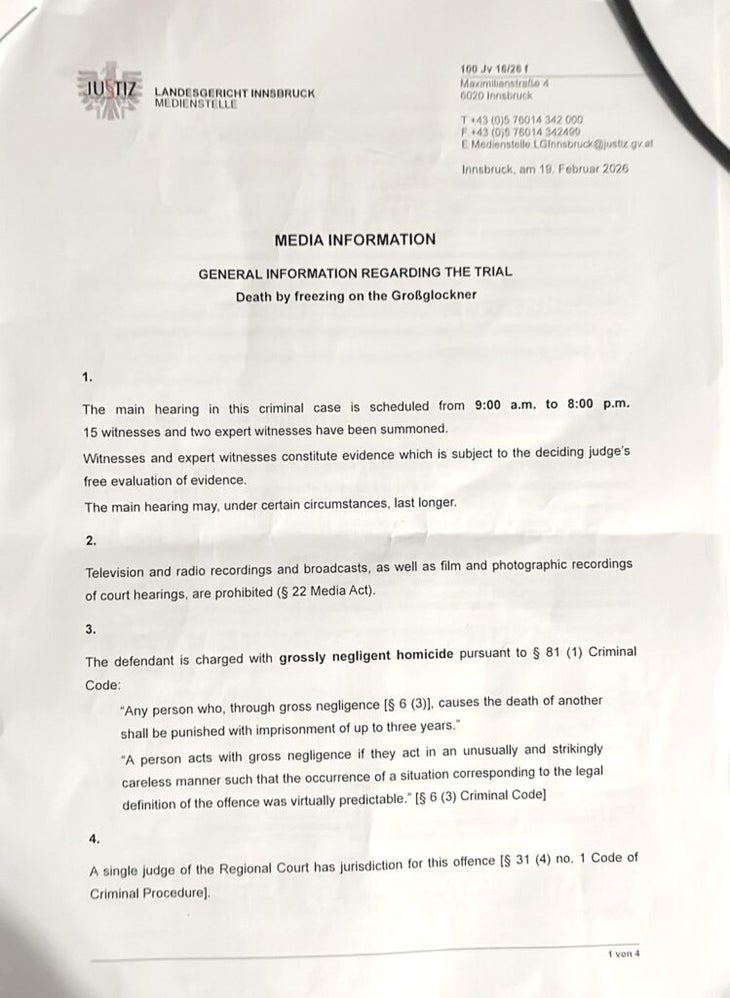
Waller said that above all else, climbers should see the verdict as “a call for more respect and humility before the mountains.”
Writing for Der Standard, guidebook author and alpine journalist Thomas Neuhold said anyone worried about a perceived increase in liability has missed the point.
“Aren’t those who now lament that experienced mountaineers will no longer be able to take anyone into the mountains indirectly admitting that they often take excessive risks?” he wrote. “Let’s recall the early days of mountaineering. The maxim of the alpine pioneer Paul Preuss was: ‘Ability is the measure of what is permissible.’ Preuss primarily meant personal responsibility. The Innsbruck ruling indicates that this responsibility extends not only to oneself, but also to others.”
German rock climber and alpinist Alexander Huber has climbed Grossglockner’s same Stüdlgrat route. Huber offered Climbing insights regarding the implications of the case. “It is crucial for any alpine activity to have an open and constructive error culture,” Huber reflected. “That is how the maximum number of accidents can be avoided in the future … It is always good to be awake and cautious as soon as we know that we are in alpine terrain.”
Huber also rejected the idea that alpinists might be reluctant to mentor or partner with less experienced climbers in light of the verdict. If they are, he implied, they’re part of the problem.
“Yes, as soon as I am the more experienced climber, then I automatically do have the responsibility,” Huber said. “What is the risk of getting judged guilty compared to the loss of life?”
The post Mistakes vs. Manslaughter: How Austria’s Guilty Verdict Could Redefine Recreational Climbing appeared first on Climbing.