 BURST
BURST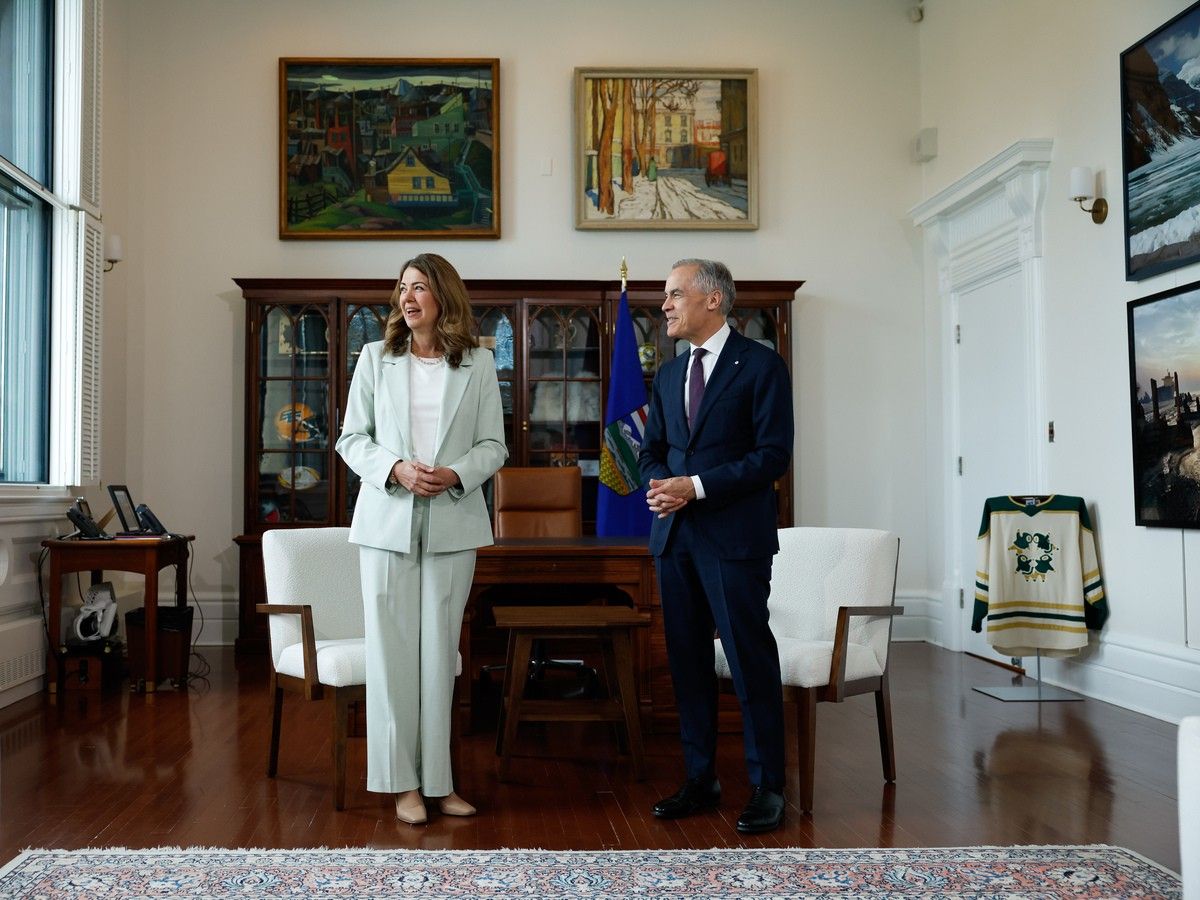
OTTAWA — Less than a week after winning last year’s election and just days before he was set to meet with U.S. President Donald Trump, Prime Minister Mark Carney was looking for art to hang on his office walls.
Staff who arrived at the National Gallery of Canada that Saturday morning had been instructed to dress casually: sport coats and dress pants, although one mentioned they would be bringing a tie, “just in case there is a last minute change.”
Preparations for that 8:40 a.m. visit had come together quickly. The gallery’s director, Jean-François Bélisle, had been in St. Louis attending a conference when it received word from the Prime Minister’s Office that Carney wanted to tour its galleries of Canadian and Indigenous pieces, including a look inside its vaults.
He made sure to be back in time.
Staff, including senior curators, pulled together pieces they felt might work and could pique Carney’s interests, mapping out their precise route.
“One of his senior advisers shared with me that they were discussing a very big wall behind the PM’s desk in Langevin Block,” wrote Paul Genest, chair of the gallery’s board of trustees, ahead of Carney’s visit.
“And that he’d like to get something for it. ‘Big, bold, very Canadian.'”
A look inside the efforts the national gallery made to help the prime minister outfit his walls and the considerations that Carney had in mind have been outlined in internal emails, released to National Post under federal access-to-information legislation. Many of the roughly 350 pages were redacted.
Borrowing art from Canada’s national gallery or the art bank run by Canada Council for the Arts is nothing new for prime ministers, with that decades-old option existing for the Governor General, the Supreme Court of Canada chief justice and federal ministers.
That Carney made doing so one of his first priorities as a newly elected prime minister, however, did not go unnoticed.
“Oh I love this,” wrote Sara Stasiuk, another of the gallery’s board of trustee members. “That art was a priority for the new PM to spend time on during his first week is a big deal.”
“Historic moment and great capture indeed,” Katerina Atanassova, senior curator of Canadian art, said of photos snapped from the occasion, but which were redacted.
The Privy Council Office, which acts as the administrative wing of the Prime Minister’s Office, has said that Carney borrowed nearly 50 pieces, with around one-third coming from the national gallery itself, home to more than 90,000 works.
In mapping out his visit, gallery staff focused on presenting pieces from its collection of historical English and French Canadian works, as well as Indigenous pieces, contemporary art and those from the Arctic. They also were mindful of the lighting and temperature conditions within his two offices, which impacted what could be borrowed.
Bélisle remembers that they began by preparing lists of hundreds of different works and described Carney’s visit as introducing him to the gallery and its many collections, with talk about how some could be used in his offices.
One surprise they found when he arrived: Carney knew art history, and Canadian art, which Bélisle said led to “meaningful discussions.”
“I would say that his level of understanding and knowledge of art is quite a bit bigger than what I’ve encountered in other elected parliamentarians,” he recalled in an interview.
“It was a great surprise.”
Since taking office, Carney has presented himself as a prime minister who embraces Canadian culture. Whether quite literally, holding Heated Rivalry star Hudson Williams’ leg in a close hug on a red carpet, a photo of which now hangs in his office, to making a surprise appearance at this year’s Politics and the Pen gala in Ottawa.

Carney has also employed consistent references to Canada’s historical past in describing its current situation with the U.S., including by featuring a figurine of Sir Isaac Brock, the British general who put preparations in place for a possible American invasion.
But Carney’s penchant for art began before entering politics, with he and wife, Diana Fox Carney, acting as collectors, one piece of which came from his now artificial intelligence minister, Evan Solomon, whose years-old brokering of a deal for the former governor of central banks in England and Canada as well as other high-profile clients, ultimately led to his firing from CBC.
Carney is also no stranger to the national gallery, with him being appointed to serve on a board reserved for what the institution’s board chair Ann Bowman characterized in 2022 as being reserved for “c hampions of the visual arts.”
“The happy surprise of his knowledge of art extended to the fact that we were thinking about this the same way that we would think about building a public presentation of anything,” Bélisle said.
“So not colour coordinating to the sofa, but what is the best of Canadian art that can go into that space, which is wonderful.”
He said there were many artists whose work the prime minister was drawn to, with one in particular being Alex Janvier who hailed from Cold Lake First Nations in Alberta, where Carney was raised. “He was pulled quite strongly to that one.”
Others included Luke Parnell, Emily Carr and Edward Burtynsky, plus Quebec artists.
A summary of Carney’s visit to the national gallery from last May outlines how the prime minister and his wife spent two-and-a-half hours touring its exhibits, with staff fielding “his questions and interests.”
“His goal is to display artwork in his two offices that reflects our country in all its diversity and across our history,” Genest wrote in an email to others, debriefing the visit.
“Staff in the (Privy Council Office) indicated that they would like to see the artwork in at least one of his offices in place very soon as there are dignitaries that will soon visit Canada. Including King Charles and Prime Minister (Keir) Starmer of the U.K.,” Genest said.
To make that happen, while Carney was out of the country, sitting down for his first high-stakes meeting with Trump at the Oval Office last May, gallery staff were invited into Carney’s two offices, one within West Block and the other, across the street, to participate in what emails described as being an “art-oriented walk.”
“They spent a couple of hours mapping out options for the spaces that would reflect the prime minister’s interests,” Genest wrote.
In email exchanges after his gallery visit, its national director hinted that discussions revolved about more than simply admiring Canadian art, but what message it could convey to future visitors.
“ Everyone at the (National Gallery of Canada) highly enjoyed it and it is exciting to talk about art as soft diplomacy,” Bélisle wrote.
In an interview, Bélisle outlined how Carney approached selecting art by wanting to ensure regional diversity, adding that he was “quite acutely aware of how these works could be received by his guests.”
“How do we represent Canada through its art, I think, was one thing that he seemed quite interested to be thinking about.”
After visiting Carney’s office, gallery staff quickly got to work designing detailed mock ups for where prospective pieces would go: A landscape by Group of Seven founding painter Frank Carmichael above a fireplace, an Inuit print from the gallery’s vault nearby; a burst of vibrant colour against a white canvas by Janvier.
Gallery spokeswoman Josée-Britanie Mallet said in an email these rendering were “essential” to ensure the size of each piece “integrates harmoniously with the specific dimensions and architectural heritage of the rooms.”
Emails show time was clearly of essence, with King Charles’s impending trip to Ottawa only weeks away.
“I believe that you have been aiming for the end of the week for the two mock ups,” wrote Matt Shea, assistant secretary to cabinet, who handled the office curating. “Would having it today be possible? If not that’s ok, but I was asked if there was a way for the PM to have a package this afternoon.”
Audrey Champoux, a spokeswoman for the Prime Minister’s Office, said in a statement that Carney has continued the longstanding tradition of displaying Canadian artwork in official spaces and residences, as it “h ighlights an ongoing commitment to celebrating Canada’s history and artistic heritage.”
“Featuring Canadian artworks in these spaces invites distinguished guests, dignitaries, world leaders and Canadians to experience the country’s rich diversity, history, and identity.”
When it comes to the gallery itself, Bélisle says he sees how the national pride Canadians have been experiencing has played out at the intuitions.
He points to a recent exhibition that featured works focused on the North, one that near the end saw upwards of 2,000 visitors per day, some who came multiple times. “Somehow the North became a symbol of Canada.”
National Post
Our website is the place for the latest breaking news, exclusive scoops, longreads and provocative commentary. Please bookmark nationalpost.com and sign up for our politics newsletter, First Reading, here.