 BURST
BURST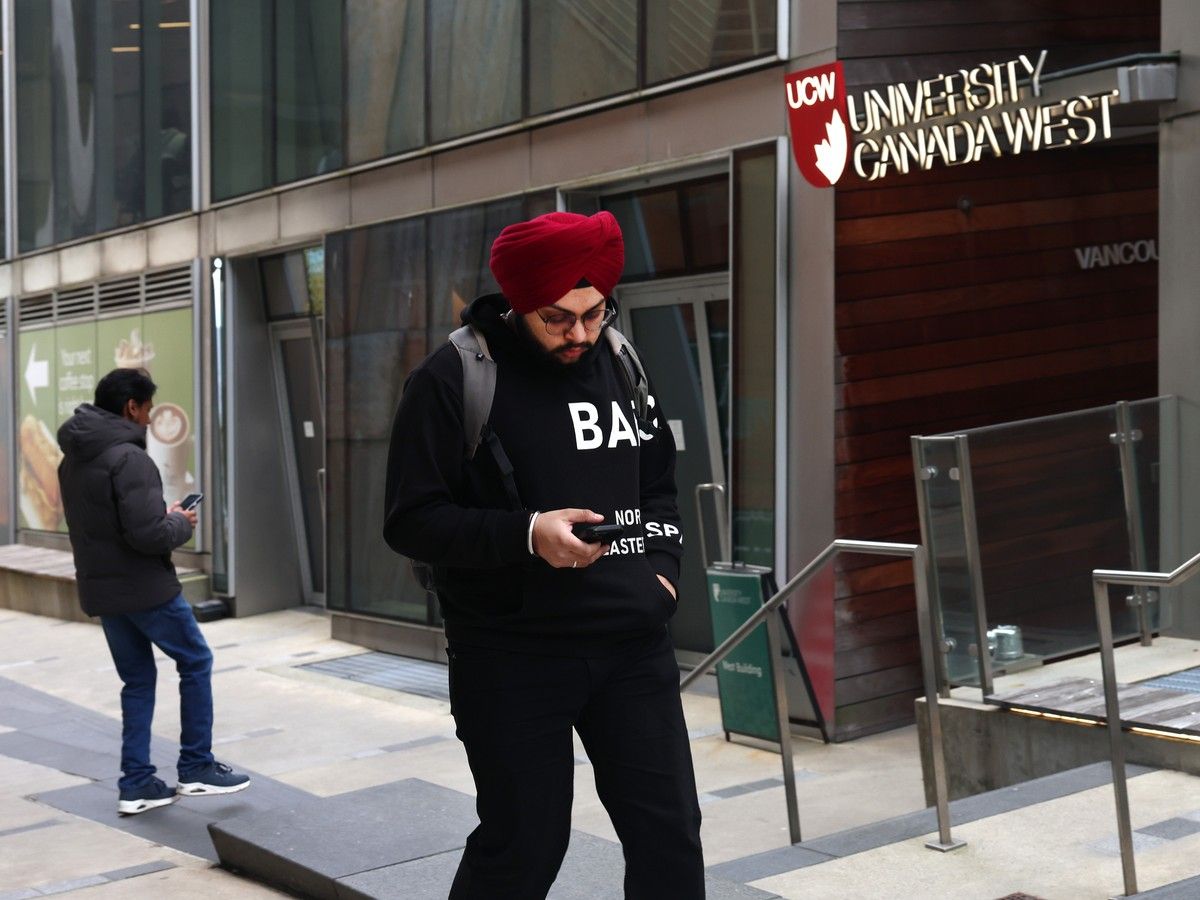
University Canada West has laid off 240 of its more than 800 staff and faculty at one of its downtown Vancouver campuses, in a sweeping restructuring it says is tied to dropping international student enrolment.
An associate professor who taught at the private, for-profit university’s Yaletown campus, and who spoke on condition of anonymity, said he logged into his work email on April 8 to find a notice from the institution’s human resources department telling him his job had been terminated without cause.
“UCW has relieved you of all work duties effective immediately. You are not required to perform any further tasks for the university,” reads the notice seen by Postmedia.
“This decision is the result of a necessary organizational restructuring and is in no way a reflection of your dedication to our students and academic community. We want to thank you for your contributions to UCW and wish you success in your next professional chapter.”
Within minutes of receiving the termination notice, the professor said he was locked out of university systems — including email, course platforms, and access to professional materials — despite having a full roster of students enrolled for the spring term.
“I couldn’t download anything, not even my own files or publications. But my profile is still on the university’s website,” he said.
The professor said one of his colleagues, who was also laid off, had come out of retirement on Vancouver Island to take a job at the university.
“How is this fair?” the professor asked. “I also moved for this job.”
University Canada West offers business and technology-oriented undergraduate and graduate programs, including a bachelor of commerce, bachelor or arts in business communication, and master of business administration, both online and at downtown Vancouver campuses in Yaletown and in the financial district.
A separation agreement sent to laid-off employees told them to return university-owned equipment, including laptops and accessories, by Friday to receive extended health, dental, travel, and life insurance benefits.
None of the documents provided to laid-off employees indicated a rationale for who was selected for layoff, including any consideration of seniority.
University Canada West confirmed the job cuts this week, saying “like many post-secondary institutions across Canada, the government’s decision to reduce the number of international study permits has significantly impacted student enrolment at University Canada West, posing substantial challenges to our university operations.”
“We have already taken steps to reduce operating costs across our institution and recently had to take the difficult step to lay off additional faculty and administrative staff. We … have ensured that these layoffs do not impact our academic programs and the student experience,” the university said in an email statement.
A federal cap on international students made provincial governments responsible for allocating limited spots among institutions.
Gregory Gerber, president of the Society of Independent Degree Granting Institutions of B.C., says the layoffs come as no surprise.
“We saw this coming,” said Gerber, who noted that the changes have been linked to a financial crisis in B.C.’s private post-secondary sector, leading to institutions cutting staff, suspending programs and, in some cases, shutting down campuses.
There are more than 20 private degree-granting colleges and universities in B.C., and hundreds of private training institutions, with many of them operating for profit.
Gerber, who is the association campus dean of New York Institute of Technology Vancouver, says the private university has had to close as a result of decreased revenue from declining international student enrolment. In February, NYIT said its programs will continue online only for students already enrolled until they complete their degrees. After spring 2026, no new students will be admitted.
He said NYIT went from 1,087 international students last year to being allocated 106 this year, Gerber said. “We’re already down 30 staff, and it will be the rest of us this year.”
Private graduate programs have become “essential infrastructure” in B.C., Gerber said, arguing they serve working professionals, provide industry-specific credentials in emerging fields and those with labour shortages, maintaining direct pipelines to employers.
He pointed to NYIT Vancouver’s master of cybersecurity program, saying that many graduates move into in-demand roles and that firms such as B.C.-based cybersecurity company Fortanet have hired more than 50 of the institution’s alumni.
Gerber said the university spent the past seven months developing an occupational therapy program proposal that was ready for submission to the degree quality assessment branch of B.C.’s Ministry of Post-Secondary and Future Skills.
If approved, it would have been Canada’s first osteopathy training school.
“I think there was a need to rein in international enrolment,” said Gerber. “But what should have happened was a proper assessment of the kinds of programs we actually need in B.C. and Canada.”
“B.C. is now academically closed,” he added.
The laid-off University Canada West professor said he doubts the institution will be able to maintain its academic standards with fewer staff. In September, he said the university required faculty to sign a new contract that reduced paid vacation time from eight weeks to four.
“At this point, I don’t know where I will go. I hope to find a dishwashing job in the interim, or a warehouse job, so that I can stay in the city.”