 BURST
BURSTThere’s a lot of news this week, as usual. The AI bubble is deflating as a Chinese firm released an open-source model that is nearly as good as the best of what America has. Elon Musk’s SpaceX fell below its IPO price. And there was an important first hearing on the Paramount-Warner merger on Friday, with the states seeming to come out narrowly ahead. And lots more.
But before getting to all that, I want to talk about an uprising among video gamers, one that reaches back, believe it or not, over four hundred years. Roughly 60% of Americans play video games, so we’re talking a lot of people and an important part of our culture. Video gamers, particularly the more hard-core ones, have gotten increasingly angry over the past five years as prices go up and layoffs in the industry foster a sense of hopelessness and creative despair. Yet because it’s a industry built mostly during the neoliberal era of the 1970s going forward, there is no history of collective action to foster a reasonable regulatory scheme.
That is starting to change.
Earlier this month, Sony announced that starting in 2027, they would stop producing physical copies of their games. Purchases must be fully digital, and go through Sony’s online store, which takes a 30% cut. To most people, this move looks like one more unfortunate business decision, perhaps a bit exploitative, but not unreasonable. Sure, there will be no more gifting, reselling, or lending games to friends. But 85% of games are now bought digitally, and the idea of purchasing a physical copy seems quaint.
And yet, there was a rebellion.
PlayStation fans are now “out for blood,” according to Tom Faber in the Financial Times, with social media “flooded with tirades from gamers.” The backlash is widespread, as Nitish Pahwa explained in Slate. Important game designers are calling this decision“frightening,” and game retailers are expressing “disappointment.” Even former PlayStation Chair Shawn Layden is unhappy. There’s an online petition with a third of a million signatures, with some fairly intense political language around what ownership means.
A disc is a real game you own. You can lend it, trade it, resell it, gift it, collect it, or pass it down to your kids. A box with only a download code is not the same thing. It is a digital license in plastic packaging. You do not own it. You are renting access that can be revoked, and people have already had purchased movies deleted from their libraries and games pulled from sale weeks after launch.
This is also about jobs. Physical games support an entire industry that an all-digital future quietly erases: retailers, distributors, manufacturers, warehousing and logistics, the pre-owned and trade-in market, and the collector and preservation community. That is thousands of jobs and countless small businesses. Ending physical media removes consumer choice, weakens local economies, and hands a few platform holders total control over how, and whether, you can access the games you buy.
On first blush, such popular anger doesn’t make much sense. There aren’t that many consumers of discs, and most of the people protesting probably do buy digital games. So what exactly is going on? Well people across the board are protesting the end of property rights, as the combination of certain forms of intellectual property protection, the growth of monopolies, and digitization are locking us out of rights we used to take for granted.
Getting rid of physical games eliminates secondary markets that placed a competitive check on the game makers and platforms. What makes this end of physical games more pernicious is that gaming is far more vertically integrated than it ever has been. Sony and Microsoft have both been rolling up studios, building big subscription services, and effectively locking in gamers. Meanwhile, those who play games on personal computers are increasingly subject to Valve’s Steam monopoly.
The net result is twofold. From a consumer perspective, prices are up. Since Microsoft bought giant gaming firm Activision in 2023 over the Federal Trade Commission’s objection, Xbox has doubled prices of its Game Pass service. And the Activision acquisition wasn’t a one-off, both Sony and Microsoft have been buying studios for years. The end of the used game market is just one more foreclosed road for consumers.
From a game studio perspective, the situation is deeply problematic as well. To get your game onto a platform increasingly requires going through an app store or getting into a streaming service, meaning permission from a small number of gatekeepers. As Sony kills the physical channel, it’ll just be one gatekeeper after another.
This problem is not limited to Sony and video gaming, of course. Amazon recently said that people who have older Kindles will not be able to buy new books anymore. Mercedes won’t let car owners have software allowing faster acceleration without an addition $1200 payment, Echelon deactivated features on its exercise bikes to stop users from accessing third party apps, Apple was caught deleting non-iTunes songs from its devices, and farmers can’t repair their John Deere equipment with their own software. And of course, the U.S. military has serious problems repairing equipment as well, given the restrictions it faces from contractors.
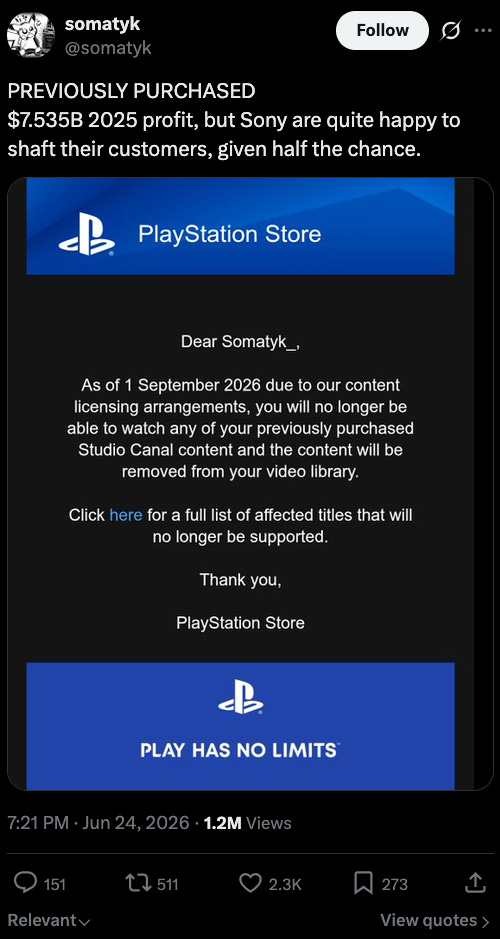
In other words, the move Sony made last month is one more move in a longstanding conflict to strip us of our property. And often it’s a lot more direct than killing resale markets. To return to Sony, that company recently removed the ability of UK residents to watch movies they had already purchased.
The Second Enclosure Movement
In 2003, law professor James Boyle, who specializes in copyright and patent law, drew an analogy to what is happening now.
In an essay called “The Second Enclosure Movement and the Construction of the Public Domain,” Boyle discussed one of the most brutal and controversial mass seizures of property in English history - the enclosure movement. From the 1500s to the 1800s, aristocrats appropriated lands traditionally held in common by villagers, land used for grazing, drawing water, fishing, and fuel. They turned this land from open fields into private property, hedged or fenced off. It was violent, but also legal in nature, with Parliament passing over five thousand pieces of legislature from 1604 and 1914 to enclose over a fifth of the arable physical landscape of England.
Boyle argued that we are in the midst of a second great enclosure movement, but this one involves intellectual property. Since the early 1980s, we have been extending property rights over what had been commons. Boyle pointed to the patenting of the human genome, control over seeds, the extreme lengthening of copyright terms in the 1998 Digital Millennium Copyright Act, as well as much stronger protections over software. He noted that these changes overwrote a previous way of understanding intellectual property, what Brandeis called “the noblest of human productions - knowledge, truths ascertained, conceptions, and ideas,” which had traditionally been, after “voluntary communication to others, free as the air to common use.”
Boyle’s paper was in 2003, and has been deeply influential. What he didn’t sufficiently emphasize is that the second enclosure movement is as much or more about monopolization and the rise of platforms as it is about patents/copyrights, that Walmart pushing predatory pricing mattered as much as Disney’s pushing copyright extensions. But it was 2003, before the dominance of Apple, Amazon, Google and Meta was apparent, so this under-emphasis of market power is understandable.
I like another point Boyle makes, which is on the elite justification for enclosure. The first enclosure movement was understood by historians and economists as sad, and elevating pauperism, a revolution of the rich against the poor. But, they argued, it was necessary, prompting investment in agricultural productivity and ultimately sparking the industrial revolution. In 1968, Garrett Hardin’s essay Tragedy of the Commons articulated the rationale, which is that people don’t take care of property held in common, but do invest when it is owned by an individual. Recent scholarship casts doubt on this whig historian view of the enclosure movement, but it was for a long time dominant.
Today, economists and business leaders believe something similar about strong intellectual property rules and monopolization. Big tech firms do most of the research and development in the U.S., so goes the argument, a result of their fat margins being reinvested. I watched an Armed Services hearing a few weeks ago on “right to repair,” and Rep. Adam Smith, the top Democrat on the committee, went off on how the major incentive for contractors to invest in research was strong intellectual property protections. It’s a remarkable view, considering defense contractors actually get reimbursed and a guaranteed profit for their research and development spending. That is how embedded it is.
This view came from economist Joseph Schumpeter, and filtered through the Chicago School and the world of Ayn Rand. For instance, in his 1967 essay attacking antitrust law, Alan Greenspan, who would eventually become Fed Chair, argued that monopolistic corporations organized by Wall Street offered “greater incentives to increased productivity and leads, as a consequence, to a rising standard of living.” The enclosure movement was good, actually.
Yet as Boyle, and scholars like Yochai Benkler and Larry Lessig noted, open-source software, and open platforms like the internet itself, are direct repudiations of this way of thinking. From a historical perspective, there has been much skepticism of monopolistic power throughout American history, from the English Civil War through the American Revolution through battles over land in the late 19th century. It’s just that we’ve been quiet about it until recently. And the uprising against Sony, along with the anger at right-to-repair restrictions and monopolization in general, shows that era of silence is over. Americans have had it with their property and rights being pilfered.
Sony Has the Law on Its Side
Now, in a traditional American context, what Sony is doing should be a business opportunity. If Sony won’t make discs of its games, then surely, someone else would be willing to do it for a fee. If I want to download and burn a disc for a game like God of War, someone should be able to produce and sell me the tools to do that, as long as I buy the rights from Sony. Then I could give that disc away, lend it to a friend, or whatever. You’d expect something similar for third party software to repair tractors or hook into a Toyota or Peloton bike. We should be in the golden age of tinkering.
And yet, doing so is highly illegal. A felony, in fact. Section 1201 of the Digital Millennium Copyright Act says that “no person shall circumvent a technological measure that effectively controls access” to copyrighted work. If you do, it’s five years in jail and a $500,000 fine. Even if you don’t realize you are circumventing restrictions, and it’s your own data and property, you could get fined up to $25,000. And it’s worth noting that the DMCA is locked into many trade agreements as well as the World Trade Organization’s TRIPS Agreement, a set of global arrangements embedding the end of the commons worldwide.
Now, there are two ways to attack this problem. One is to eliminate Section 1201 of the DMCA. Most of corporate America would recoil in horror at this suggestion. They assume that anyone circumventing measures designed to thwart copyright violations wants to illicitly pirate their content. But of course, a VCR allows copyright violations, it doesn’t mean that’s the only point of the device. Indeed, so does a computer, which must copy digital content to function.
A different way to understand what “circumventing” such measures means is, well, tinkering and hacking. Why shouldn’t I be allowed to download a game I bought and put it on different physical media? Why shouldn’t I be able to hack my car’s software? Why should John Deere control who can repair the combines it sells? Why should Motorola, which sells policing software to municipalities, control 911 call data?
We don’t want to allow copyright violations, but that’s very different than the right to play around with your own property. And that is what is effectively banned today. There are many organizations and advocates, like the Electronic Frontier Foundation and Cory Doctorow, the FULU Foundation and Louis Rossmann, who advocate for eliminating or narrowing the DMCA. Moreover, the politics have started to shift. The traditional guardians of these copyright measures, namely Hollywood, are now far less concerned about the pilfering of their content by piracy than they are big tech’s appropriation of their content. And many of the activists who want to reduce the power of copyright are also adamantly hostile to big tech monopolists. So there are new possible coalitions.
But there’s a separate problem, which is relatively new. Even if you got rid of Section 1201, Sony has an enforcement mechanism for any consumer who might hack their own way out of the situation. They can force you to sign a contract with binding arbitration saying you won’t do what they don’t want you to do. And if you do violate it, they can either sue you, or more cheaply, simply kick you out off their platform, denying you access to their store or the ability to interoperate with their servers. That’s the monopoly problem, and weak antitrust laws and binding arbitration means that it’s very difficult to vindicate your rights, if it’s even possible.
Can Video Gamers Assert Their Rights?
In 2022, FTC Chair Lina Khan challenged the Microsoft-Activision merger, and the video gamer community was mostly annoyed that she did so. They believed that Activision would be better run if Microsoft owned it, and felt she was getting in the way of a company that wanted to better compete with Sony. But after Microsoft won its court battle, it began to lay off employees en masse. Then it raised prices. And laid off more people. And raised prices. And laid off more people. Now the company is making more games exclusive to the Xbox, which it told the court it wouldn’t do.
The result is that video gamers are deeply upset at Microsoft, and see in retrospect what Khan was trying to prevent. With this announcement from Sony, and the frustration they have against desktop game platform Valve, they are seeing the issue is market power and excessive copyright across the board. They see the commons, their commons, being enclosed. And they don’t like it.
The two choices are as follows. First, we could repeal Section 1201 of the DMCA, which would be great policy and make our technology and products so much better than they are today. Second, we could put a rule in statute saying that that if Sony or any gaming company won’t sell a physical copy of a video game for the same price as a digital copy, then it is legal to circumvent technological measures to protect copyrighted video games. You could throw in there some additional rights, like the ability to set up servers if a company chooses to end support for its games.
Or we could do both. I hope a political leader picks up this energy, and runs with it. It’s time.
And now, the full news round-up, with lots of important stories after the flip. The first hearing in the Paramount merger trial occurred, and it was modestly good for the states. SpaceX stock collapsed in an embarrassment for Elon Musk, even as the AI bubble deflates in the face of Chinese competition. Oh, and there’s a market power aspect to the explosive diarrhea outbreak. Yes, really.
Read on for more.