 BURST
As usual, SpaceX and its founder Elon Musk are thinking big.
The company recovered the upper stage of its Starship megarocket for the first time ever on Saturday (Nov. 14), plucking it out of the sky with the "chopstick" arms of its Texas launch tower.
It was a huge moment for SpaceX, bringing its vision of full and rapid rocket reuse much closer to reality. But Elon Musk isn't one to dwell on the past or rest on laurels, so he soon outlined an even more ambitious future for Starship.
"Starship V4 will be ~70m [230 feet] long, which is roughly a 40% length increase and allows >60% more propellant load," Musk said via X, the social media platform he owns, on Sunday evening (Nov. 15). "Engine count will be raised to 9, with 3 more Raptor-Vacuum engines added, and these will be higher-thrust V4 engines."
The current version of Starship — the one that launched Friday (Nov. 13) on the vehicle's 15th test flight — is the V3. It's the largest and most powerful rocket ever built, standing 408 feet (124 m) tall when fully stacked with its Super Heavy first stage and Ship upper stage.
V3's Ship is 171 feet (52 m) tall and features six of SpaceX's Raptor V3 engines. (The similarly reusable Super Heavy V3 booster is powered by 33 Raptors.) So, as Musk noted in his post, the V4 Ship will be quite an upgrade in size and power.
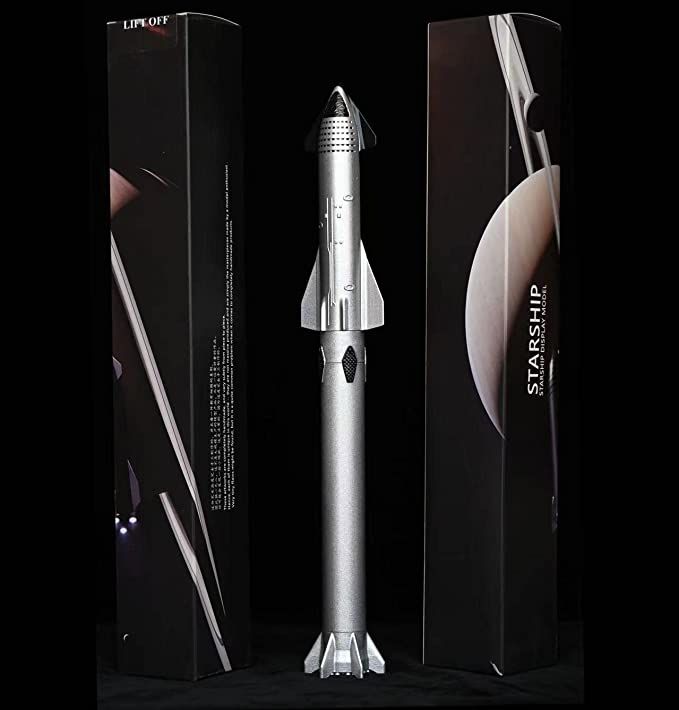
Starship Die Cast Rocket Model Was $47.99 Now $39.99 on Amazon.
Even if you can't see SpaceX's Starship in person, you can score a model of your own. Standing at 13.77 inches (35 cm), this is a 1:375 ratio of SpaceX's Starship as a desktop model. The materials here are alloy steel and it weighs just 225g.View Deal
To provide a little perspective about that vehicle's planned dimensions: The V4 Ship will be the same height as a fully stacked Falcon 9, SpaceX's workhorse two-stage rocket, and much broader: Ship is 30 feet (9 m) across, while the Falcon 9's payload fairing is 17.1 feet (5.2 m) wide.
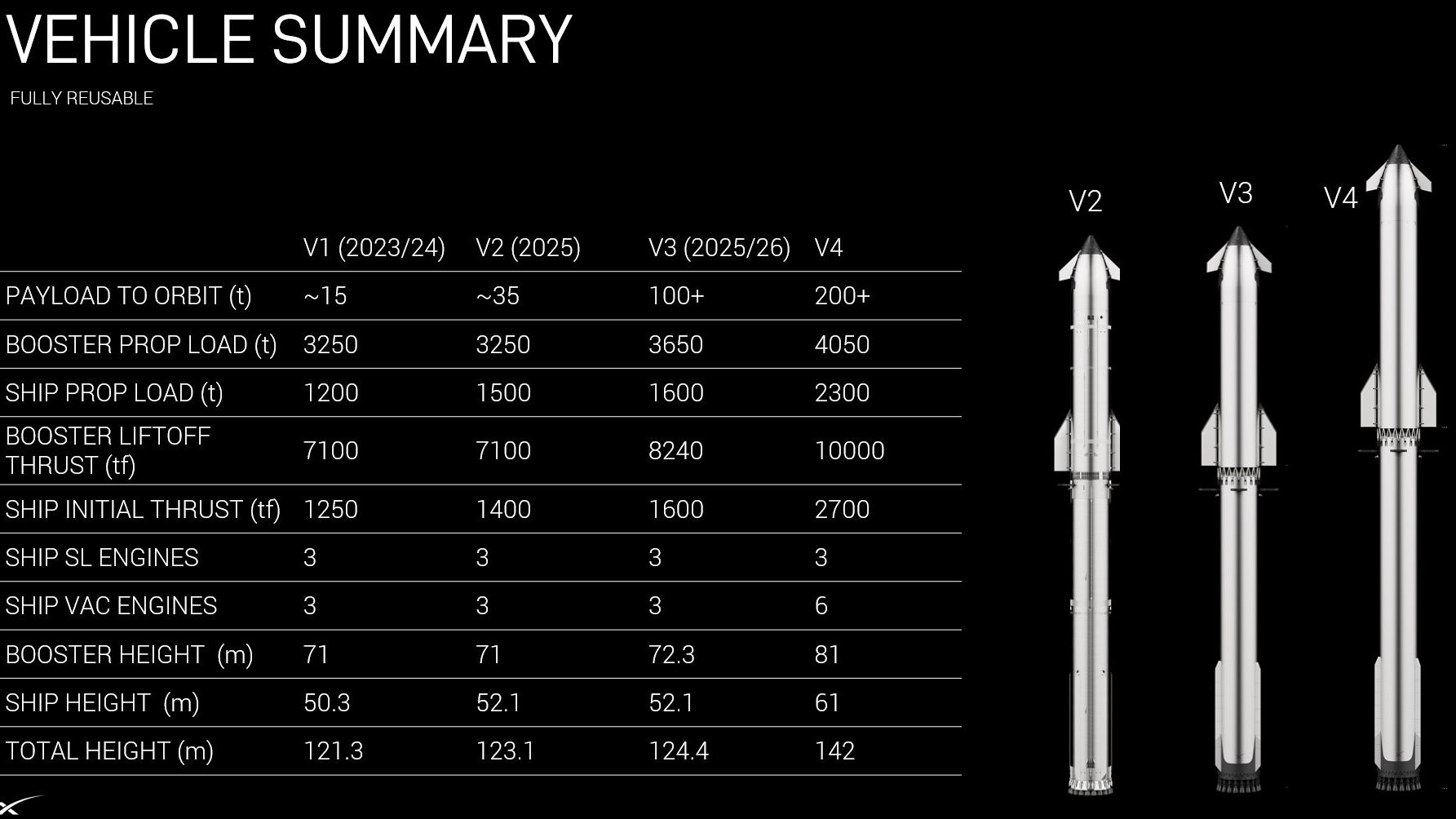
This isn't the first we've heard about a V4 Starship. Back in August 2025, for example, Musk posted a graphic showing Starship's planned progression from the V2 to the V3 to the V4, which he said is expected to debut in 2027.
That slide pegs the future Starship's total height at 466 feet (142 m), 200 feet (61 m) of which would be Ship. But those numbers are out of date, Musk stressed in the post, saying that V4 is "probably closer to 150m height."
So, yeah: If all goes according to plan, the next Starship will be nearly 500 feet tall.
Starship V4 will be ~70m long, which is roughly a 40% length increase and allows >60% more propellant load.Engine count will be raised to 9, with 3 more Raptor-Vacuum engines added, and these will be higher thrust V4 engines.November 16, 2026
The original Starship Flight 15 mission plan called for a double chopsticks catch, with both Super Heavy and Ship coming back to the launch tower for recovery.
This would have been feasible, as the catches were scheduled a day apart: Super Heavy would land just 6.5 minutes after launch, while Ship would circle Earth for 22.5 hours, and deploy a batch of SpaceX's Starlink V3 internet satellites, before coming home. (Ship ended up delivering the satellites as planned.)
The twofer didn't happen, however; Super Heavy experienced a low-fuel alarm and diverted to a Gulf of Mexico splashdown on Friday as a result. But that wasn't a huge deal, as SpaceX had already pulled off Super Heavy catches on three previous Starship flights.
The Ship catch was unprecedented, because it's been a taller order. Ship returns to Earth from orbit, so it comes in faster and hotter. SpaceX hadn't even tried the maneuver before Flight 15, so executing it was a very big deal.
"That was the missing link," SpaceX's Dan Huot said during the company's Ship-landing webcast on Saturday. "We caught a Starship, and now everything changes."