 BURST
BURST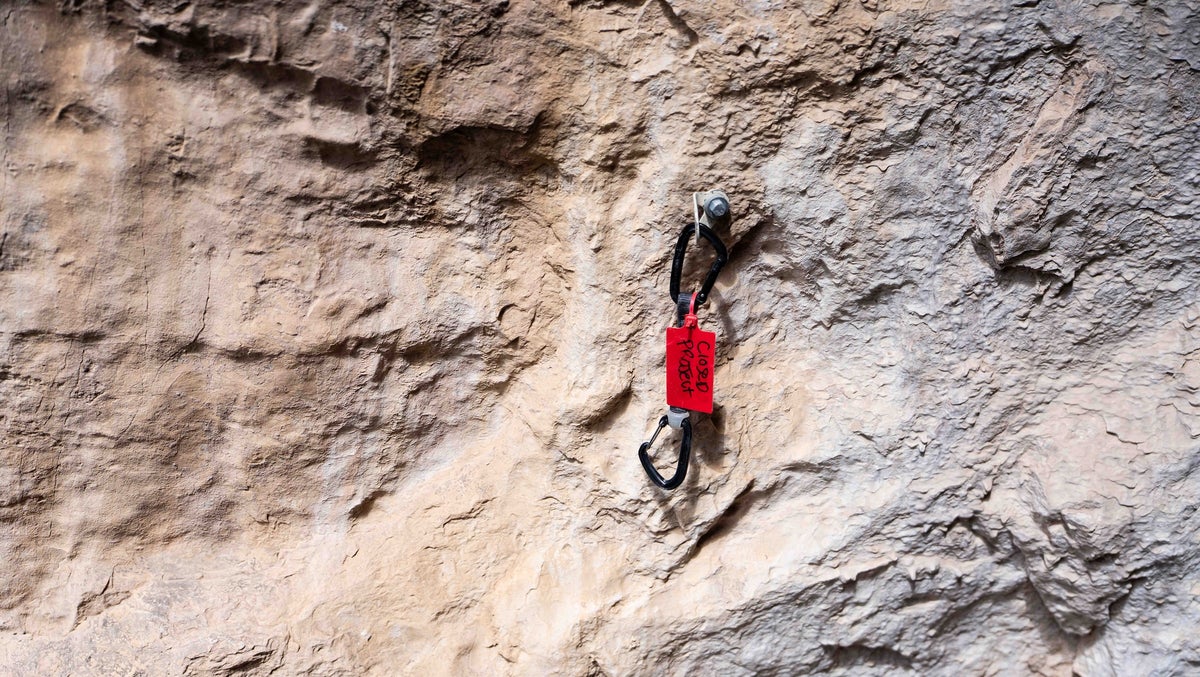
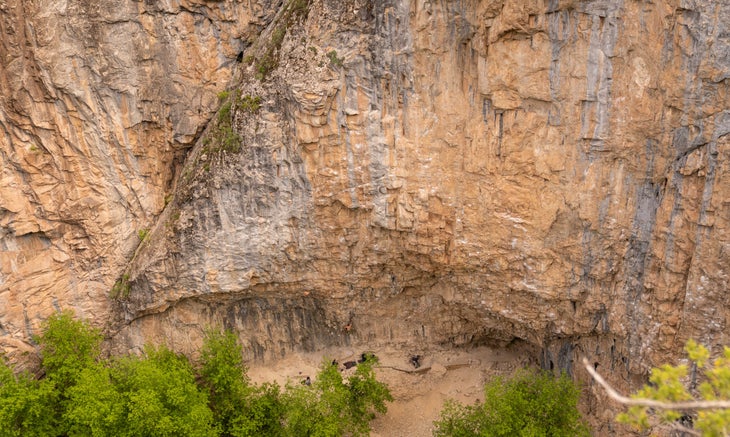
In early April, Jesse Franklin, a 28-year-old who works remotely as an accountant, stood below a vertical wall of limestone edges in Rifle Mountain Park’s Zone of Silence. He made a few high-tech, hard moves to the first bolt, which had a red tag—a small red piece of webbing—affixed to it. After committing to a hard toe hook sequence at the third bolt and then a slab dyno above, he punched it through the remaining 60 feet of sustained, pumpy climbing. He fought to the anchor and barely pulled off the first ascent of the route, creating a bit of controversy in the process.
What is red tagging? And how has the practice played out in Rifle?
In 2018, Darek ”Mayor of Rifle” Krol bolted a hard line to the right of his classic Effigy for a Silent King (5.12d). As he established other routes on the vertical panel, he put in work on the project, trying it with friends, including long-time local Stevie Damboise, pro climber Jonathan Siegrist, and Scott Franklin, the first American to send 5.14.
When Darek passed in 2020, the line sat dormant, though the 2021 edition of the Rifle guidebook listed it as a project, neither open nor closed. Then the controversy started. That year, 50-year-old Stevie moved a bolt on the line, cleaned some holds, red-tagged the route, and started working on connecting the crimps.
Developers often red-tag routes, placing a literal red tag—a piece of red cord or webbing—for two reasons. The red tag signifies that the route needs further construction, cleaning, and/or that the developer is reserving the right of the first ascent. In this case, Stevie red-tagged a route that he hadn’t truly developed.
Over the past six years, Stevie has continued to try the Zone of Silence route, attempting it when fickle conditions allowed. He needed it to be warm enough that he wouldn’t numb out, but cold enough that he could hang from the minuscule edges. He worked it with some strong climbers, including Sam Rothstein, who got close—until Stevie asked him not to climb on it anymore.
An avid chess player, Stevie often played with Scott Franklin’s son Jesse in fairly even matches. Stevie described the project to Jesse, speaking of the difficult moves to the first bolt, the delicate body positions, and hand-foot matches. Jesse’s climbing career got off to an early start. At three years old, he made the first free ascent of Rocker, a 15-foot Rifle route at the Project Wall, climbing low fifth-class terrain to the first bolt of Mouse Trap (5.12c). Four years later, he led his first Rifle route, Funny Face, a 5.7 in the Ice Caves area. In the decades since, he’s completed more area classics like Waka Flocka (5.14b), Zulu (5.14a), and Simply Read (5.13d).
Jesse also spent some time under the wing of former Vermonter and now Rifle local Pete Clark, who let him project some of his lines. He climbed on The Right to Bear Arms (5.13a), a line near Feline (5.11a) in Rifle that Pete had obtained the permit for, cleaned, and bolted. So Pete could still claim the first ascent, he sent, but stopped before clipping the anchor. Under Pete’s tutelage, Jesse also put in the first bolt of what became Michaela Kiersch’s Mad Lib (5.14d) at Lone Rock Point in Vermont. All in all, he has minimal development experience.
New gen vs. old guard

Though Jesse has now put in 25 years of climbing in Rifle, his resume of first ascents pales compared to Stevie’s larger contribution to the park.
“In terms of pure power, he is likely the strongest—and certainly the most ripped and muscly—climber of his age in the country,” wrote Dave Pegg of Stevie Damboise in the 2016 Rifle guidebook, cementing his status as a local legend. Starting in the 1990s, Stevie has established more than two dozen sport routes in Rifle, including Marry Me (5.13b), Foxhole Conversion (5.13b), and Never Enough (5.14a). A prolific first ascensionist, Stevie has gone through the arduous process of finding lines, applying for bolting permits, developing the lines, and cleaning them many times. However, despite his chiseled physique, he’s not nearly as strong as Jesse, who’s half his age.
Late this past fall, Jesse tried the unnamed Zone of Silence line. He one-hung the route, falling at the low crux over a roof and then linking through the consistent climbing above. He offered to belay Stevie on it whenever he wanted, excited to climb on it with him. Finally, at a party in the spring, Jesse asked Stevie if he could redpoint the route.
“He wasn’t super psyched,” Jesse admitted to me in an interview. Stevie had fallen two bolts from the anchor, but struggled to regain his high point with the conditions, especially while having to commute from the Front Range. Living in nearby New Castle, Jesse climbed more on the route, linking the compy crux into the sustained climbing above. “If you develop a route you can have the first burn,” says Jesse, believing routes should be open after that.
On April 9, Jesse made the first free ascent of the route, posting it on 8a.nu. He named it En Passant (5.13c)—a reference to chess, his other hobby. French for “in passing,” en passant describes a move that prevents pawns from jumping past an opponent’s threatening pawn.
Jesse later texted Stevie, “I’m sorry I swooped your route.” The text message suggested that his actions merited an apology and that the route belonged to Stevie’s—both contested concepts. The ascent set off drama across Colorado’s normally quiet Western Slope.
Some Front Range climbers feel like Jesse had stolen the route, neglecting to put in any of the work necessary to develop it. Western Slope locals seem apathetic to a New Castle climber on a dead man’s project, noting that Stevie shouldn’t have red-tagged Darek Krol’s line in the first place. Still others feel like red tags shouldn’t exist at all, believing that bolted routes should be immediately given to the community to try.
The ascent has sparked talk about the rules in the park. Some climbers suggest creating a statute of limitations dictating how long a route can be red-tagged. Rifle already has a permitting process, which requires developers to submit a proposal to a crew of climbers and legislators before the route can even be established. Other areas—like the Flatirons and Eldorado State Park in Boulder, and Staunton State Park in the South Platte—enforce similar bolting regulations.
With these rules in place, the person who gets the permit also usually makes the first ascent. Concerns have also surfaced that this bickering among climbers could cause unwanted attention from City Park officials.
The fine print of red-tagging
“Red tags are legit,” said Jonathan Siegrist, who established Shadow Boxing (5.14d) in Rifle, when I asked him about the subject. “But only if you bolted the route yourself and are actively trying it.” The crux of this statement comes in defining “active.”
Staying off red-tagged routes is in part about addressing safety concerns—the developer may still be cleaning and bolting a line. But the act of red tagging also belies a certain respect for the significant investment that developers make. “We should respect each other as climbers,” says Lee Sheftel, a board member of the Rifle Climbing Coalition.
Several notable examples of climbers bypassing red tags to get first ascents exist—with mixed results. During the second wave of development at Jailhouse in Sonora, California, in 2006, sport climber and coach Justen Sjong repeated most of the hard sport routes. Two steep lines bore faded red tags. When he asked around about who had tagged them, he learned that the developer hadn’t climbed there in years. So he got on the blocky basalt routes, quickly sending Gas Chamber (5.13b/c) and Enemy Combatant (5.13d). No drama emerged surrounding these ascents. The developer had moved on.
It’s not uncommon for the developer to drift off and another party to take over. At the Dungeon at Staunton State Park in Colorado, Dave Montgomery bolted a steep compression line in the middle of the wall. The line felt out of his league, so he told his friend Matt Samet that he could climb it. Then two other climbers asked Montgomery if they could try it as well. Feeling the heat on his heels, Samet put down the route in 2019, calling it Big Poppa (5.13c). The red tag came off with little issue.
Many more examples exist. At the vertical White Wall of Mount Potosi’s 5G area, active developer Nate Resnick bolted an amazing line of crimps. But two years and a knee injury later, he stopped working on the route and told Alex Honnold he could climb on it. The next day, Honnold made the first free ascent.
However, problems occur when the developer is still active on the line.
In late December in Las Vegas, a few locals, who wished to remain anonymous, went to New World, a recently developed limestone crag out in La Madre. One of the climbers had been to the crag before and sent a classic 12a, stopping below the red-tagged extension. He suggested his friend try the route, though the red tag now appeared on the first bolt. The leader started up the climb, intending to lower before the extension. That’s when the developer walked up to the crag, obviously upset at seeing people on the route.
“There’s a red tag,” the developer said. “You shouldn’t climb on it.” The leader backed off the route, but a physical exchange arose. The developer and a party member rolled down the hill in a tussle.
What does the debate over red-tagging look like today?
“What is your motivation—do you want to have done the route or do you wanna do the route? If you wanna do the route, it’s still there. You can still climb it,” says Jesse’s father, Scott.
As it turns out, climbing past red tag runs in the Franklin family. In the late `80s and `90s, Scott Franklin made the first ascent of Simply Read, a classic line of steep sidepull-wrestling out the belly of Rifle’s Project Wall. He named it after the red tag dilemma, suggesting that when climbers put red tags on a route, their intentions are “simply read.”
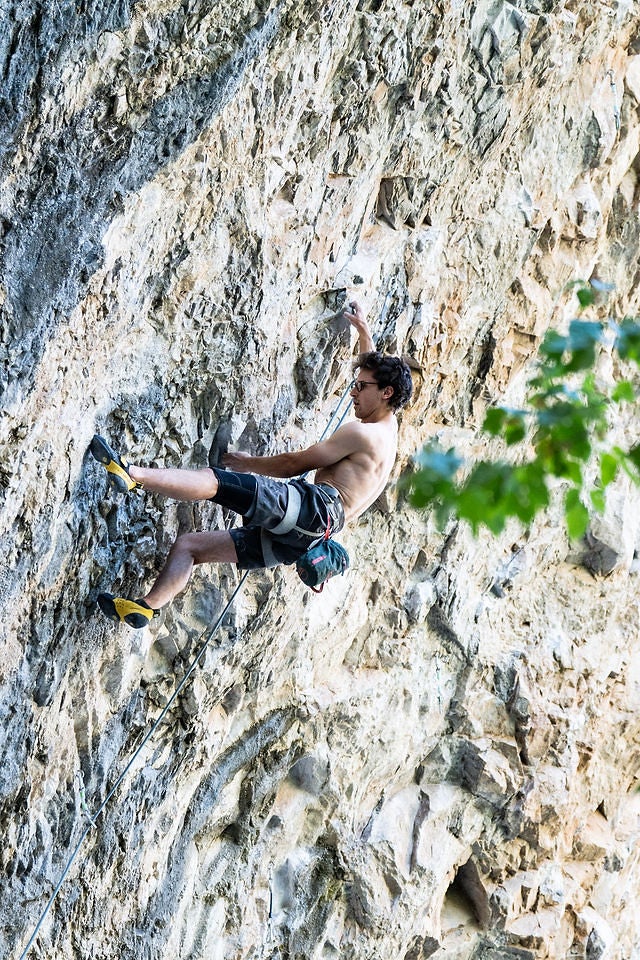
“He wasn’t active at all,” Scott told me of Erik Fedor, who had bolted the line, but hadn’t been climbing in the park in the past few years. A few locals told Scott he should try the route, so he began working it with Salt Lake City climber Jeff Webb. The pair went burn for burn; Scott did it first, naming it to make a moot point.
“Opening the routes and doing the first ascent don’t have to be the same person. Just because you put the bolts in, doesn’t give you a divine right or deed of trust to the route,” says Scott, espousing the popular “the rock isn’t anyone’s property” concept.
Scott, who bolted and sent Scarface (5.14a) at Smith Rock and Mango Tango (5.14a) at the New River Gorge, suggests that red tags should only exist on routes for safety reasons. Once properly equipped, the routes should be open. “First ascents are only meaningful if you do them before anyone else if you’re better,” Scott explains. It should be noted that both Franklins have done little development.
Yet that sentiment pushes towards a more competitive nature in climbing, ignoring the reward of a first ascent granted to developers for their efforts. If developers view the first ascent as a prize for their efforts and that prize becomes increasingly elusive, will the already dwindling number of developers continue to invest the time, money, and energy that benefits us all? Or will anti-red taggers go against the historical evidence and actually begin to develop routes?
As for Stevie, he plans to go for a repeat soon. “I’d hoped to name the route after Darek,” he says of the line. This summer, after finishing up more of his Clear Creek Canyon first ascents, he’ll head back to Rifle, hang his draws back up at the Zone of Silence, and continue working on the route.
James Lucas is the co-author of a guidebook to Yosemite bouldering and the author of a Bishop bouldering guidebook. He spends half his time inside obsessing over climbing and the other half outside obsessing about climbing. After his first trip to Rifle in 2004, he became an addict and has spent weekends driving from the Front Range, summer months staying in the campground, and seasons living on the Western Slope. Though he loves the blocky style of Rifle, the grey streak of The Eighth Day (5.13a) remains his favorite route.
The post Red Tagging in Rifle: The Debate Over ‘En Passant’ appeared first on Climbing.