 BURST
BURST
As an alpinist, I have always considered Chamonix Valley the most lenient place to call for a helicopter rescue. Not because the climbing there is particularly hard, or dangerous, or committing, but because free heli rides seem to be the de facto reflex for both competent and downright lazy alpinists. I’ve heard all kinds of “reasons” for heli rescues in the area, from climbers unwilling to climb a cruxy pitch to simply not wanting to experience the tediousness of rappelling. It also helps that the area’s well-funded rescue service is world renowned for its skill and speed.
Nevertheless, at a certain point, I began to assume that any reason for calling a rescue would be legitimate in Chamonix—even if it would never fly in wilder ranges like the Canadian Rockies, Patagonia, or Central Alaska. And so I was astounded to learn, earlier this week, that the mayor of Saint-Gervais-les-Bains, a gateway town to Chamonix and Mont Blanc, had made the unprecedented decision to deny a typically free helicopter rescue to 32 climbers who ignored grave safety warnings.
At least, that’s how the mayor’s decision has been presented to the public.
Why did the climbers ask for a rescue?
The shitshow began on August 11, when the mayor of Saint-Gervais, Jean-Marc Peillex, officially closed two key bivouac huts along the Goûter route of Mont Blanc. France was in the midst of a record-breakingly hot summer and the Alps were falling apart. Heat-induced rockfall was constant in a key section of the Goûter, a long rocky couloir that, ordinarily, should have been filled with snow and ice.
Peillex closed the Tête Rousse and Goûter huts to discourage climbers from attempting the mountain’s easiest route during such a dangerous period. But conflicting reports from Explorers Web, Alpin.De, and the Italian newspaper AostaSera paint a confusing picture of how and when those closures were communicated to the climbing parties already on the mountain.
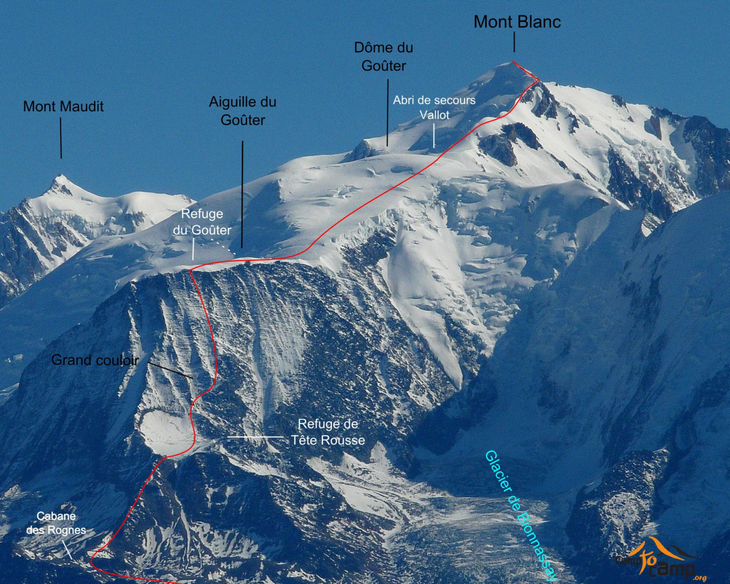
Everyone agrees that at least 32 climbers ascended the Goûter couloir to its top on August 11 and bedded down for the night at the mountain’s ridgecrest, in the Goûter hut. But some reports imply that all climbers eagerly ascended the Goûter couloir despite local guides urging them to bail. Other reports suggest that only a few climbers were warned by guides, but many were already midway up the couloir when the warnings and official hut closure were made.
While reviewing the articles above, I noticed that not one story had actually quoted a source close to the issue—except for the mayor himself. So I reached out to Philippe Batoux, a highly respected French IFMGA guide, instructor, and alpinist, for context.
“The problem is complex,” Batoux said of the huts’ closures and subsequent rescue debacle. Many local mountain guides decided to stop guiding the Goûter route in the days before August 11, which meant cancelling pre-existing hut reservations during the busy guiding season. “The [hut custodians] decided to resell those spaces to amateur climbers,” Batoux explained. “It was an opportunity for [the amateur climbers] because it’s difficult to have a space in this hut.”
These amateur climbers are not embedded in the climbing community the way a local mountain guide is. Many would not have access to up-to-date conditions, or are unable to interpret them, “so they decided to try the ascent,” said Batoux.
Some of the climbers learned only upon arriving at the hut that evening that it was now closed for future bookings.
On the morning of August 12, all climbers who had slept at the Goûter hut that night decided that conditions on Mont Blanc were not aligned for a safe, successful ascent. (The fact that the hut was closed would have served, for some, as the first obvious warning sign that mountain conditions were dangerous.)
Naturally, this being in the Chamonix Valley, the 32 climbers at the Goûter hut called for a rescue, given their descent would travel in equally risky terrain, since the mayor himself had effectively called the rocky couloir below too dangerous to travel in. But that call for a free rescue was denied. Instead, the mayor allowed for-hire helicopters to rescue any climber willing to pony up the cash.
What do the climbers have to say for themselves?
I was unable to get in touch with any of the 32 climbers up at the Goûter hut. However, one climber named Johanna identified themselves publicly in the Alpin.De article’s comment section as one person who called for a rescue.
“We reached the hut at noon,” Johanna wrote. “Around the same time, a massive rockfall occurred in the Grand Couloir. I assume this rockfall was the deciding factor in the mayor’s decision, because at 2 p.m. the staff at the hut informed us that both the huts and the routes to Mont Blanc were closed with immediate effect. All the climbers were already at the hut by this time, or at least on their way there.”
Johanna, along with all other climbers at the hut, were “forbidden” to continue up or down the mountain. Later that evening, hut custodians told the group that an action-plan was being developed and they should all remain put until 7:40 a.m. the following morning.
“Ultimately, we were told to … wait until late morning, only to learn that there was no solution for us,” Johanna wrote. “The [privately chartered] helicopter was then organized at the insistence of the hut staff, as it would have been completely irresponsible to send almost 40 people into the Grand Couloir at that hour. Some people nevertheless descended… This action by the authorities exposed them to an unnecessary additional risk, as crossing the Grand Couloir is usually done in cooler temperatures (very early in the morning, when temperatures are as cool as possible).”
Was the mayor’s decision the right one?
“For me, it was a good decision of the mayor,” said Batoux. “It’s not up to the community to pay for rescuing people making crazy decisions. Nobody should have gone on Mont Blanc with those conditions.” But Batoux also acknowledged that these climbers were not necessarily experts, and may not have known just how dangerous current conditions were. Batoux said the onus should be on the huts’ custodians to inform climbers of conditions when they pre-book their bed.
If hut custodians can’t be relied upon to relay important mountain conditions to customers—and recreational climbers cannot accurately assess conditions themselves—perhaps it’s time to mandate a Mont Blanc permit and orientation to educate visiting climbers.
If you create a pro-rescue culture, expect to honor it
When I first saw this rescue-refusal headline plastered about, I assumed the 32 climbers were irresponsible or ignorant, and deserved every ounce of criticism they’d be given. But as I dug deeper into the story, I was unsettled with how easily the mayor received praise for his cost-saving measures. It doesn’t seem like these climbers elbowed pleading guides out of the way on their trek up to the Goûter hut. Many likely had a bit of midsummer free time available and wanted to climb one of the most famous peaks in Europe. They didn’t intend to put themselves in an especially dangerous position. And after they booked a night at either hut, they could have expected the custodian to, you know, casually mention if their climbing itinerary amounted to a death wish. Especially if professional mountain guides had cancelled their trips for those very concerns.
I think we can—and should—have a healthy discussion about what makes a helicopter rescue “legitimate.” But we can all agree that the service is most deserved when honest mistakes are made. For an expert climber, that might be a brief lapse of judgement that leads to a catastrophic fall. For a bumbling newer alpinist, that might be a series of missteps that leads you to be partway up a very large mountain when it is a totally inappropriate time to be there. Sure, some of the 32 climbers probably knew better than to be up on a glaciated mountain during a heatwave. But from what I gather from my conversation with Philippe Batoux, perhaps an equal number of climbers did not. And for those climbers, faced with a potentially lethal downclimb through a melted-out couloir, I think calling for a rescue was the right call.
The post A Mayor Just Denied 32 Climbers a Free Rescue for Ignoring Safety Warnings appeared first on Climbing.