 BURST
BURST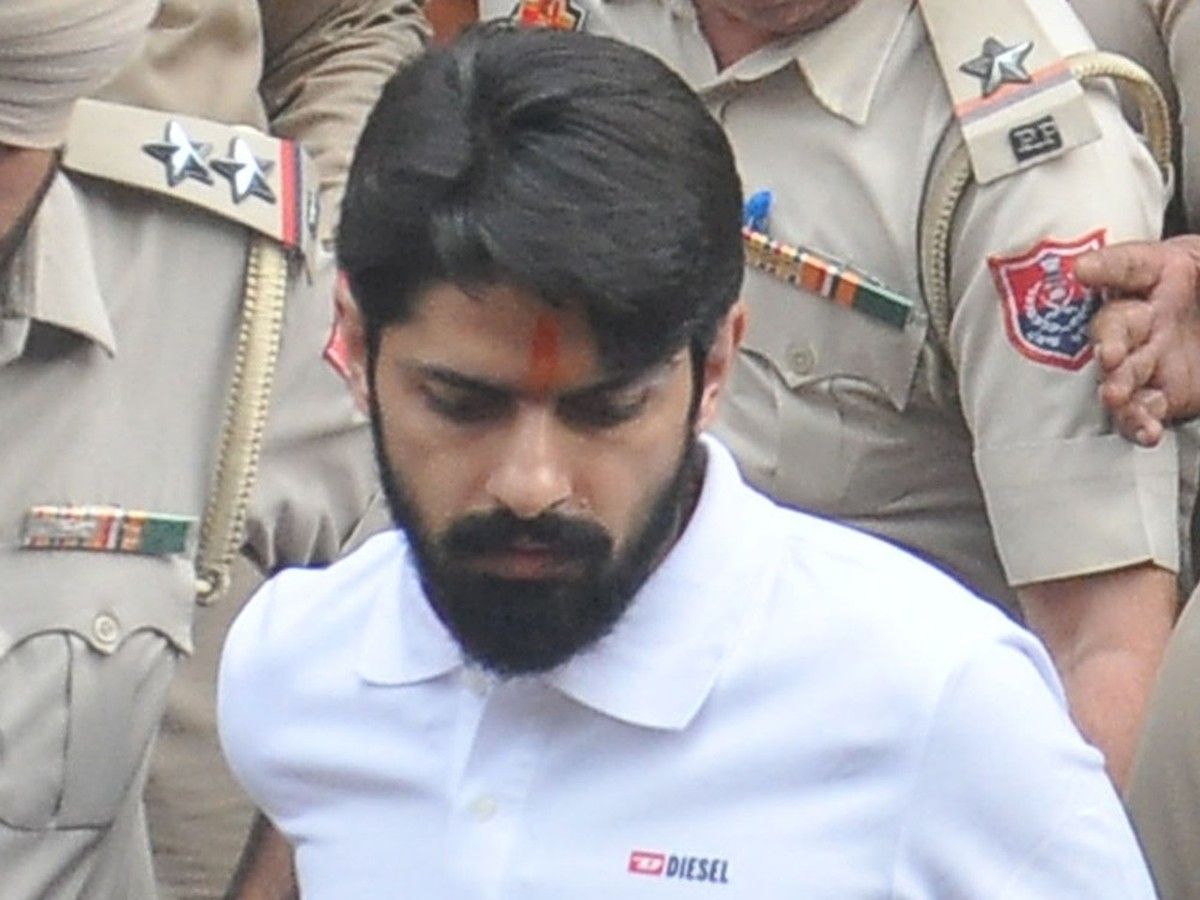
Being in prison in India for more than a decade hasn’t curbed Lawrence Bishnoi’s expanding global footprint of high-profile murders, brazen violence, and frightening threats from spreading across Canada, authorities allege.
For Bishnoi, a 33-year-old Indian gangster with an unexpected background, the captivating propaganda of apparent impunity while allegedly orchestrating an army of soldiers in campaigns of violence seemed only to boost his influence.
Bishnoi’s name, even though his physical presence has long been absent from the streets, has spread widely, making him an almost legendary underworld figure — an ominous ghost — not only in the crowded streets of his homeland but into the sprawling suburbs of Canada, where murder, extortions, shootings, arsons and threats have frustrated Canadian police and stoked community fear.
Bishnoi’s impunity, power, and glamour, however, now face a significant test.
On Tuesday, he was the centrepiece of a sweeping international law enforcement operation led by the U.S. that included Canadian and European police agencies.
Bishnoi now faces serious charges, including being accused of ordering one of Canada’s highest-profile recent murders.
It’s a startling twist for a man whose past seemed to be sending him down an entirely different path in life.
Born in Punjab, a state in northwestern India, Bishnoi’s father was a former policeman in the neighbouring Indian state of Haryana.
In 2010 he enrolled at Panjab University where he became involved in student politics, which were significantly more rough-and-tumble than most Canadian experiences; violence and dramatic action were key attributes to success. Bishnoi continued at university to obtain a law degree. As a student council leader, his police file grew. His first significant criminal complaint was torching a student leadership rival’s car.
That lesson of intimidation bringing success by way of violence seemed to take hold of the young Bishnoi and never leave him.
Several of those who joined Bishnoi in his student power struggles stayed with him, forming the spine of a growing network that had ambitions that no campus could satisfy.
Bishnoi “traded campus politics for criminal activity and refashioned his associates and followers into a criminal organization,” the U.S. criminal indictment says.
Bishnoi was imprisoned in India in 2015 on charges for which various trials and hearings were always pending, and cycling through the Indian legal system — keeping him in custody but not convicted despite serious charges.
It was while he was incarcerated that his network developed into a transnational criminal syndicate, authorities allege, with members moving abroad and victimizing the Indian diaspora wherever they settled, particularly members of India’s Sikh minority. While the Bishnoi organization was headquartered in India, thousands of its members and associates moved to cities and towns across the United States, Canada, the United Kingdom, Europe, Australia and elsewhere.
“He’s basically run a transnational criminal empire from inside a high-security Indian prison, and that is something that should be reminiscent of Pablo Escobar,” said Robert Huish, a professor of international development studies at Dalhousie University in Halifax, comparing Bishnoi to the infamous Colombian narco.
“After he graduated, the violent activities, and the boldness of political intimidation in particular, became part of his brand,” Huish said.
With his handsome, brooding looks, verbal prowess and keen fashion sense, Bishnoi’s pronouncements and provocations from prison fuelled recruitment, and stories of killings, threats and attacks linked to him and his followers became enormously popular media fodder in India and within the Indian expat communities. Many of the attacks were acknowledged and boasted of in social media.
Bishnoi threatened politicians and beefed with rappers and other gangsters, and afterwards many of his verbal targets were attacked, some fatally.
“In public, Bishnoi projected an image of himself as a ‘patriot,’ ‘nationalist,’ and deeply religious individual through social media posts and interviews with news organizations and used this public image to recruit members and associates to his crime syndicate in India, the United States, and elsewhere,” the U.S. Department of Justice said in a statement.
“In private, Bishnoi presided over a sweeping criminal enterprise that spanned multiple continents. Using contraband cellphones and other voice-over internet protocol devices smuggled into his jail cell, Bishnoi personally directed political assassinations, murders, shootings, extortions, kidnappings, drug trafficking, human smuggling, and other crimes committed by members and associates of the Bishnoi enterprise worldwide.”
U.S. authorities allege that Bishnoi was at the top of the hierarchy of a sprawling organization, with underbosses managing day-to-day operations in different parts of the world.
Satinderjeet Singh, 32, better known as Goldy Brar, also from India’s Punjab, is accused in a U.S. indictment of being the North American leader of the Bishnoi enterprise. He was a childhood friend of Bishnoi’s and an associate from their university days, before Brar moved to Canada. Rohit Godara, 37, also known as Guru, of Rajasthan, India, is named as Bishnoi’s European leader, and Sukhraj Singh Kang, 58, as a leader remaining in India.
According to the indictment, Bishnoi empowered Brar and Godara to speak for him while he was jailed and to direct Bishnoi’s soldiers worldwide.
Canadian officials — from the federal government down to local mayors and police chiefs — have been enraged for years by waves of violent extortions pinned on the Bishnoi gang, primarily targeting South Asian expats in B.C., Ontario, Manitoba and Alberta.
Canada was not alone.
The U.S. indictment claims the Lawrence Bishnoi Organized Crime Group (OCG) ”used violence to cultivate a climate of fear, in particular in India and among Indian diaspora communities outside of India, that the Bishnoi OCG exploited to extort victims around the world. These acts of violence included political assassinations, murders, shootings, kidnappings, maimings, and assaults.”
While extortion was profitable, it doesn’t seem to have been enough. Befitting a man of Bishnoi’s past, his ambition and confidence seems boundless and his many claimed, alleged, and suspected crimes appear to have a broad mix of motivations: financial, religious, political and personal.
That unusual profile has led to his current predicament.
The U.S. indictment accuses Bishnoi and Brar of ordering the 2023 killing of Hardeep Singh Nijjar, who was ambushed by gunmen as he left a Sikh temple in Surrey, B.C.. The assassination seemed deeply political: Nijjar, a Canadian citizen, was an outspoken critic of the Indian government and a leader in the Khalistan movement, which seeks to create an independent homeland for Sikhs in India’s Punjab region.
Bishnoi’s name really penetrated the mainstream in Canada in October 2024 at Canada’s foreign interference commission hearings, when then-prime minister Justin Trudeau directly named him as a criminal connection between the Indian government and violence in Canada. That testimony followed Trudeau’s explosive comments in the House of Commons in 2023 alleging that agents of India’s government were involved in Nijjar’s murder, which decidedly soured Canada’s relations with India.
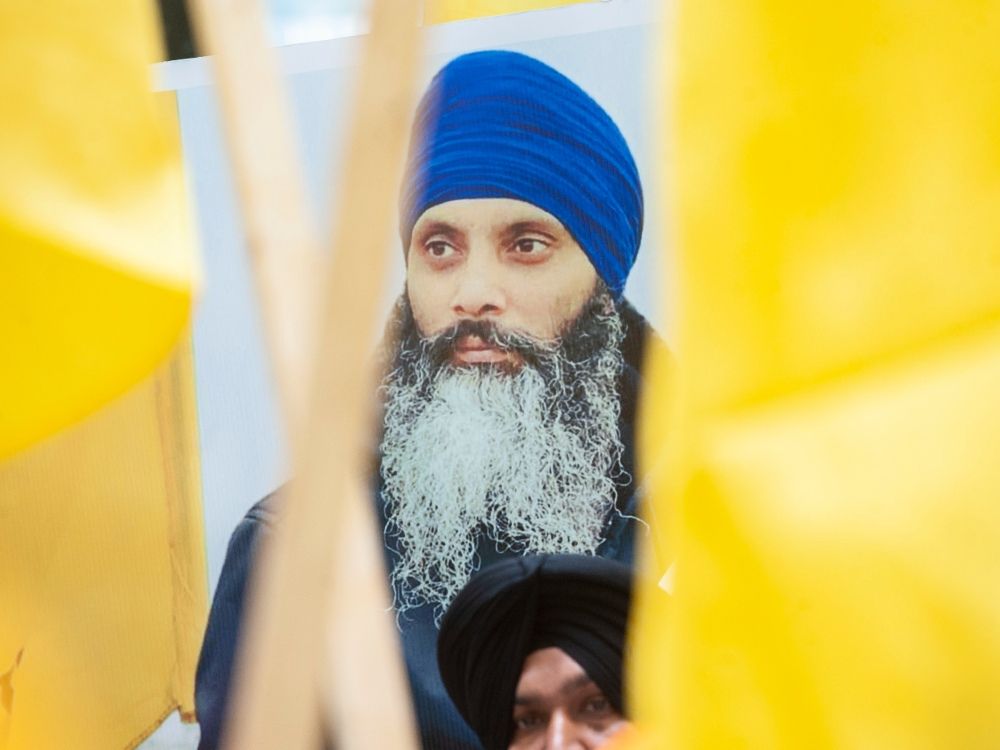
Despite strong denials by Indian officials, Trudeau’s allegations placed Bishnoi’s influence in a different light, beyond having a hodgepodge of thugs, crooks and gunmen at his beck and call, it elevated him to be seen as having shadowy ties to the Indian government, and his followers seen not as run-of-the-mill gangsters but being finger-on-the-trigger proxies engaging in foreign interference and transnational repression.
The allegations contributed to the Bishnoi gang being added last year to Canada’s terrorist entity list, a list originally meant to red-flag global terrorist groups like Al Qaeda and the Islamic State.
While the indictment in the U.S. accuses Bishnoi of being behind the Nijjar murder, it does not extend the allegations to include Indian government involvement. The indictment does says that Bishnoi has “deep connections within India,” without specifying the nature of those links.
Under immense pressure, joint federal and local taskforces were set up in Canada to tackle the extortion campaigns pinned on Bishnoi and the Bishnoi gang.
Last summer, the Canada Border Services Agency (CBSA) started specific tracking of immigration enforcement cases with links to extortion in B.C. and the Prairies and by November the tracking was extended to the Toronto area.
As of last month, CBSA had opened 484 immigration investigations, 139 removal orders had been issued, with 81 people so far being removed from Canada, according to the agency.
The indictment unsealed Tuesday in California will no doubt complicate life for Bishnoi and anyone affiliated with the Bishnoi gang. Called Operation Hard Ball, the FBI-led investigations targeted the Bishnoi organization as well as two other India-linked crime groups, named in indictments as the Bhagwanpuria gang and the Dhanda gang.
Among the overt alleged acts against Bishnoi and his co-accused are a shooting of a house and an extortion in Vancouver against a prominent Indian actor and singer; an extortion in Brampton, Ont; another in Surrey, B.C.; and the hauling of cocaine and methamphetamine from the United States into Canada.
Bishnoi remains in an Indian prison but now has pending extradition requests to add to his legal burden. His alleged Canadian lieutenant Brar was named as a wanted fugitive with the FBI offering a US$50,000 bounty for his capture.
• Email: ahumphreys@postmedia.com | X: AD_Humphreys
National Post, with additional reporting by Gabriela Panza-Beltrandi
Our website is the place for the latest breaking news, exclusive scoops, longreads and provocative commentary. Please bookmark nationalpost.com and sign up for our daily newsletter, Posted, here.