 BURST
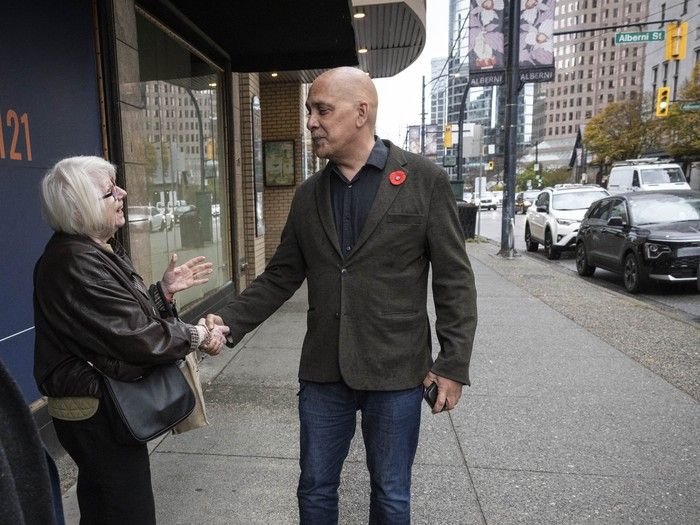
Shortly after Vancouver’s municipal election, a passerby stopped Pete Fry on the sidewalk to tell him she had just cast her ballot — for another candidate.
“I didn’t vote for you. But I’m really, really hoping!” Christina Modonese, a smiling 60-year resident of Vancouver’s West End, told Fry, the new mayor-elect. “I wanted to say good luck!”
Standing in the rain on Burrard Street, Fry stopped to shake Modonese’s hand, thank her for the well wishes, and have a little chat.
Just a week earlier, at an election-night party just a few blocks away from this spot, Fry was celebrating his big win as Vancouver’s first Green mayor. There, he was surrounded by fellow Greens, family, longtime friends, and supporters.
But now, as Fry prepares to oversee a mixed council during a challenging time for a divided city, he’ll need to win over the support of those, like Modonese, who preferred someone else to lead.
One of the new mayor’s chief tasks will be getting different people and groups to row in the same direction for the sake of the city at large. Fry, and those who know him, think his personality and personal story make him well-suited for that job in this moment.
‘That’s very Pete’
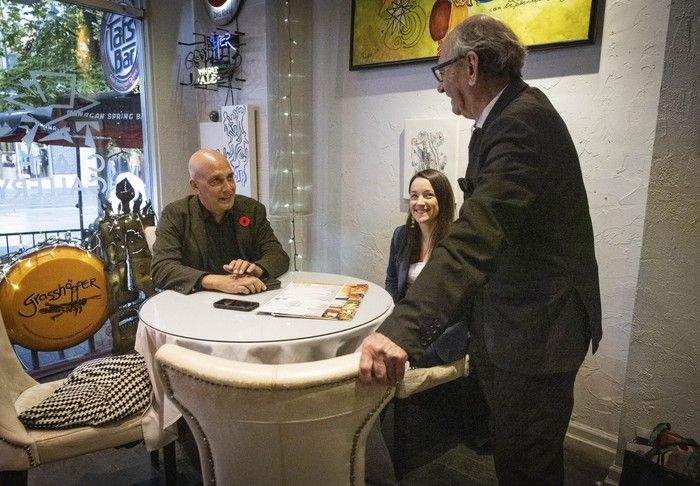
Fry is sipping a latte in Taf’s, a café on the Granville strip he describes as “a big part of my story.”
His story is quintessentially Vancouver in many ways: A young immigrant born to parents from different countries and backgrounds, his tale is peppered with names, institutions, and events that are important to many Vancouverites of a certain vintage.
But the elements come together for a pretty idiosyncratic biography that’s not standard for a politician.

Fry was born in Dublin in 1969, where his Trinidadian mother and English father were both attending medical school. (Fry’s election last month was hailed by the Consulate General of Ireland in Vancouver with an announcement congratulating Vancouver’s first Irish-born mayor since Robert Alexander Anderson, who was born in Armagh in 1856).
When Fry was two, the family immigrated to Canada and settled in Vancouver, which he says “has always been home.” His parents were doctors. Although his mother, Hedy Fry, became a well-known Liberal member of Parliament in 1993, he says he didn’t grow up in a particularly political household.
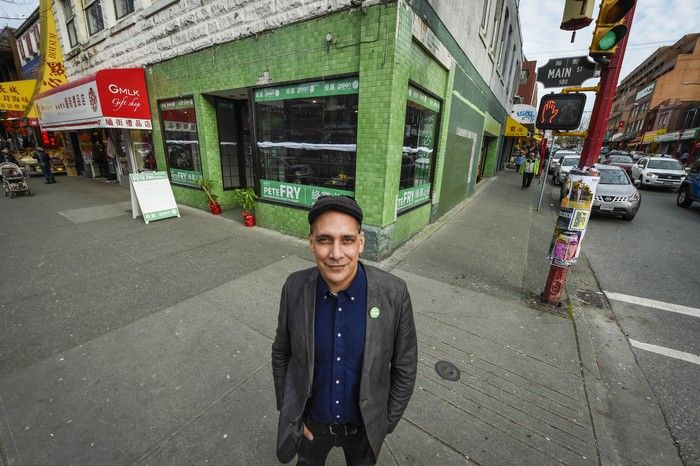
Fry grew up in Dunbar on the city’s west side. A creative kid, he put on his first art show at Taf’s Cafe in 1986, as a 17-year-old high school student, just as Expo 86 was transforming his hometown in what would turn out to be profound and lasting ways.
He briefly attended Simon Fraser University, but dropped out and started his own publishing company in a third-floor office upstairs from Taf’s Cafe, which became his group’s regular hangout.
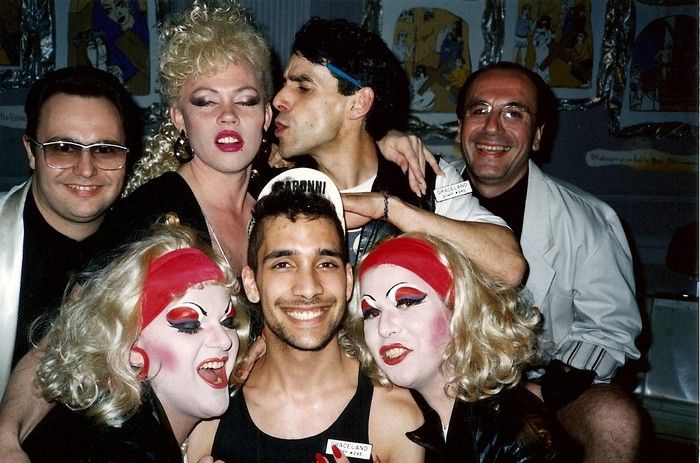
Through his late teens and early 20s, Fry worked a colourful variety of “side hustles.” He imported and decorated leather jackets to sell to punk rockers. He worked the graveyard shift at Doll & Penny’s , the 24-hour Davie Street diner and beloved institution for the gay community. He did extra work, including appearing in the background of kung fu films and the locally shot TV show Neon Rider. He served drinks at the Richards Street nightclub Graceland. He painted movie sets.
Then, in 1992, came the first of two car crashes that changed the direction of Fry’s life.
He was a 23-year-old riding on the back of a friend’s motorcycle through downtown. A car struck them at Seymour and Davie. He went flying, and wiped out in front of a horrified crowd gathered outside Did’s Pizza , the late-night by-the-slice institution.
His leg was shattered. He couldn’t walk properly for almost a year. His fast-paced lifestyle slowed right down.
“My whole life fell apart,” says Fry “I couldn’t wait tables, I definitely couldn’t paint movie sets.”
But what he could do, he found, was graphic design.
An early adopter of computer-assisted graphics, Fry ran his own design and layout business. Under the moniker “Digiboy” (as in “digital”), he produced graphics for corporate and cultural clients.
He designed concert posters and album art for local bands, which wasn’t big money, but it was fun work — or it was mostly fun, except for one local rock band in the mid-90s called Nickelback, with whom Fry decided to cut ties because “they were such prima donnas, super-demanding.” (The liner notes of Nickelback’s 1996 debut album include a design credit for “Pete Digiboy.”)
Fry also worked as the in-house artist for Terminal City , an alternative weekly magazine that also had its offices above Taf’s. It was in those offices in the mid-1990s that Fry first met a Terminal City writer named Mike Klassen, an East Van native who’d displayed a keen interest in politics since serving on student council at Killarney Secondary.

Klassen, now a Vancouver councillor just re-elected to a second term, remembers “there was kind of a punk rock ethos” at the time around Terminal City.
The publication folded in 2005.
“A little bit rebellious, but nothing radical,” Klassen says. “Very DIY (do-it-yourself). … There’s that sort of connecting value we both have from our younger years.”
On Vancouver’s new council, Klassen is the only representative of ABC Vancouver, the centre-right party that dominated the 2022 election and governed the city last term with a council majority.
Although Fry was a frequent, vocal critic of ABC over the last four years, he says he wants to work across party lines this term and involve Klassen, whom the new mayor has already appointed as a representative to Metro Vancouver’s regional government.
During this week’s inaugural council meeting, Fry delivered brief personalized messages to each of the 10 councillors. When it came to Klassen, Fry commented that when he first considered running for local office, “You were the first person whose advice I sought.”
“You may be the lone representative of your party at this table, but you are not alone,” Fry said.
Later that week, Klassen said, “Mayor Fry has, in all of his language so far — in his inaugural speech, his comments, the first council meeting — he’s really expressing a tone of collaboration. And that’s very Pete in nature.”
“I’ve talked to others who, and they all seem to agree that they like the tone and the sound of it,” Klassen said. “But it’s not a grand vision for the city — yet.”
In addition to appointing Klassen as a Metro representative, Fry has placed members of other parties in key roles. He appointed COPE Coun. Sean Orr as deputy mayor and hired former councillor Rebecca Bligh, who ran for mayor against Fry this year with Vote Vancouver, to lead the transition team. For his chief of staff, Fry chose Dominique Damian-Wallace, a neighbour who he met during their daily visits to a dog park.
Damian-Wallace was working toward a career as a labour lawyer at a firm she loved, when the opportunity arose to work on Fry’s campaign, she said.
“We realized a lot of our values aligned,” Damian-Wallace said. “I faced a crossroads, to jump at this opportunity with Pete or keep practising law. … I decided to just take a chance.”
‘I guess I’m speaking for the neighbourhood’
The second car crash that changed Fry’s life came in 2009. Fry was not in the accident, but his close friend and Strathcona neighbour, Paul Tynes, was hit by a speeding minivan while walking across Prior Street.
Tynes sustained serious injuries, which eventually claimed his life, and the tragedy pushed Fry into community activism. At that time, the city was considering removing the nearby Georgia and Dunsmuir viaducts, and many Strathcona residents worried about impacts to car traffic and safety, especially along Prior, where Tynes was struck.
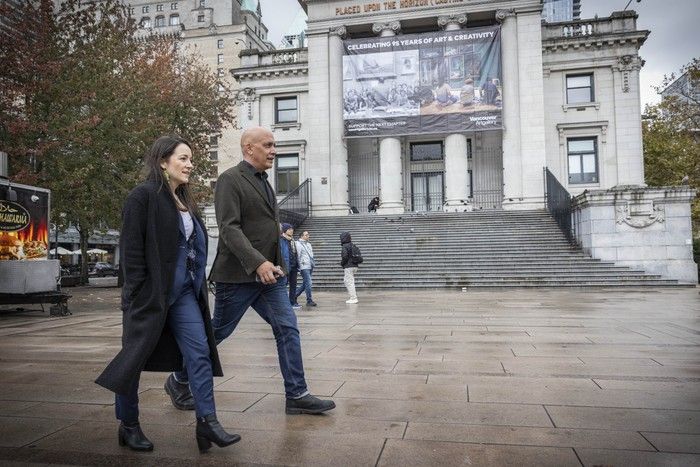
Fry attended a city-led open house related to the viaducts’ removal at the Vancouver Public Library’s main branch, and started speaking with some of the city planners, eager to learn more.
At the open house, Fry recalls asking a planner questions about viaducts and traffic management plans, and he was surprised to notice the man started shrinking away from him. The planner’s reaction confused and surprised Fry, who didn’t think he was coming off as threatening or imposing.
Then he turned around.
“I looked behind me, and all my neighbours were standing there,” Fry remembers. “They were like: ‘Yeah, Pete! You tell him!’ And I was like: ‘ … I guess I’m speaking for the neighbourhood.'”
Fry got involved with the residents’ association in Strathcona, where he and his wife have lived for decades. Around 2012, he started appearing in local news stories, pushing city hall for traffic-calming measures along Prior.

His activism got him on the radar of Adriane Carr, then Vancouver council’s only Green. Carr. The Greens were looking to recruit council candidates for the next municipal election. Carr asked Fry to consider a run, and although he wasn’t initially sure, he eventually agreed and ran alongside her in 2014. Carr was re-elected that year, but Fry finished 19th, about 10,000 votes short of a council seat.
Fry ran for the B.C. Greens in a 2016 provincial byelection. He lost again.
Fry’s third run for office came in 2017, as the Green candidate in a Vancouver council byelection. He lost again.
The fourth time was the charm, as Fry was elected to council, alongside Carr, in 2018, and again in 2022.
‘A people person’
Nick Poppell, the Greens’ 2026 campaign director, remembers volunteering with the Greens on Fry’s 2017 byelection run.
Poppell was dismayed by Donald Trump’s win in the 2016 U.S. presidential election, and decided late that year to get involved, for the first time, in local politics.
Fry ended up third in a crowded race in 2017 . Vancouver’s left-leaning parties — the Greens, OneCity, COPE, and Vision — all endorsed candidates for that one council seat, which allowed the Non-Partisan Association’s Hector Bremner, the race’s only right-of-centre candidate, to win with just 27 per cent of the vote.
“I remember that moment, that result,” Poppell said. “I was like, man, the left is eating itself alive, and Hector Bremner just slipped up the middle.”
That 2017 result was often on Poppell’s mind over the past year, when, as the Greens’ executive director, he helped represent the party in negotiations with COPE and OneCity as they attempted to hammer out a plan to avoid splitting the progressive vote too much in the 2026 election.
The process was, at times, painful, Poppell said. “I lost years of my life at that negotiating table, and what black hair I had in my beard is probably gone now.”
Sometimes during those tense meetings, the parties reminded each other of that 2017 byelection result. At times, Poppell would recite an axiom from the Klingons, the alien warriors from the 1960s sci-fi show Star Trek .
“‘Only a fool fights in a burning house,’ is what I would often say to start meetings,” Poppell said. “And I’d say: ‘Our house is burning, guys. And we are separate parties, but we have far more in common than we don’t, and we need to focus on that.'”
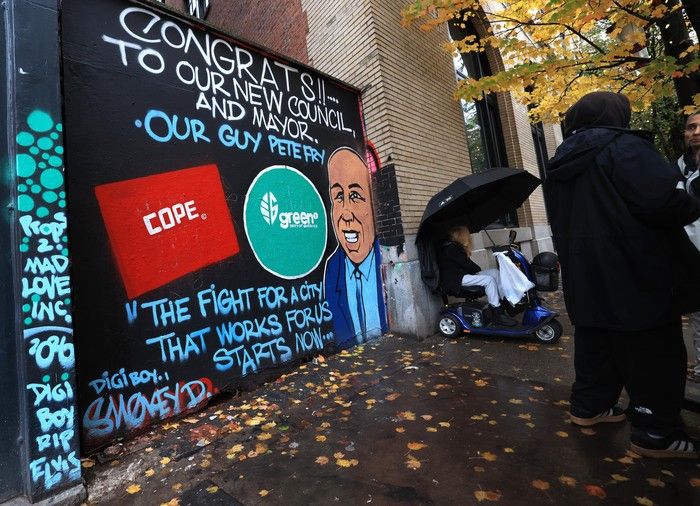
Eventually, those tripartite discussions produced an accord in April of this year, with the parties agreeing to limit the number of council, school and park board candidates they would each run. The parties also agreed to keep talking about potentially backing a unity mayoral candidate, which ended up being Fry after COPE’s Stephanie Allen and OneCity’s William Azaroff withdrew in September to clear a path for the Green contender.

The strategy worked. The Greens and COPE elected every one of their candidates elected across council, school, and park board. OneCity’s incumbent Coun. Lucy Maloney was elected, plus three school trustees, the party’s best electoral result.
Standing under the ornate domed ceiling of the Orpheum Theatre at this week’s inauguration ceremony, Poppell said it all felt “definitely surreal.” He remembered being in the same venue for the 2022 inauguration, thinking that ABC’s rise had been so fast and its triumph that year so dominant, it seemed like the party could be in power for a decade or more.
“But I think we saw that you’ve got to be careful as well. When you come in with that kind of mandate, you can lose it quickly, too, if you lose connection with the people, the voters, and the city you’re working for,” Poppell said. “I think we saw that happen.”
Carr, who is proud to consider Fry something of a protégé, does not worry about him losing touch with the people.
“He’s always been a people person. He really loves people,” Carr said. “He’s great in conversation. He doesn’t talk at, he listens to.”
“He’s a people’s mayor.”

A look at where and who supported Fry and the Greens
For much of the 20th century, there was an east-west divide in Vancouver politics, with the more affluent west side largely supporting the Non-Partisan Association — the centrist, establishment party — and the working-class east side backing the left-wing COPE. It was not always entirely the case, but for decades, electoral maps largely reflected that trend.
Vancouver’s 2026 electoral map clearly illustrates a shift that has been developing for years now: the change from an east-west divide to a north-south divide.
Andy Yan, director of Simon Fraser University’s City program, analyzed polling station data from the 2026 election and mapped it. (Voters are allowed to cast ballots at any station, but most people tend to vote close to home).
In recent decades, Vancouver has added far more new homes and density north of 16th Avenue than the southern half, which has seen far less physical change and, in some neighbourhoods, population decreases, Yan says. Now, many of these northern neighbourhoods have more voters.
The city’s northern half also includes areas with more rental homes and people under 55 — populations that were key to this year’s success of the Greens, COPE and OneCity. Vancouver’s southern neighbourhoods tend to have higher proportions of seniors and homeowners.
The map shows that Fry and Sim both won neighbourhoods on the east and west sides. The difference was largely north and south.
Sim bested Fry in neighbourhoods like Dunbar-Southlands, Kerrisdale, Shaughnessy, Victoria-Fraserview, Sunset, Oakridge and Killarney — all places where homeowners make up 60 per cent or more of households in the most recent available data.
Renters make up about 55 per cent of all Vancouver households, but the proportion varies widely by neighbourhood.
Meanwhile, Fry outperformed Sim in areas where renters make up more than 55 per cent of households, like Grandview-Woodland, Mount Pleasant, Kitsilano, the West End and Strathcona.
“What got Pete into the mayor’s office was both a youth-quake and a renter’s renaissance,” Yan said.