 BURST
BURST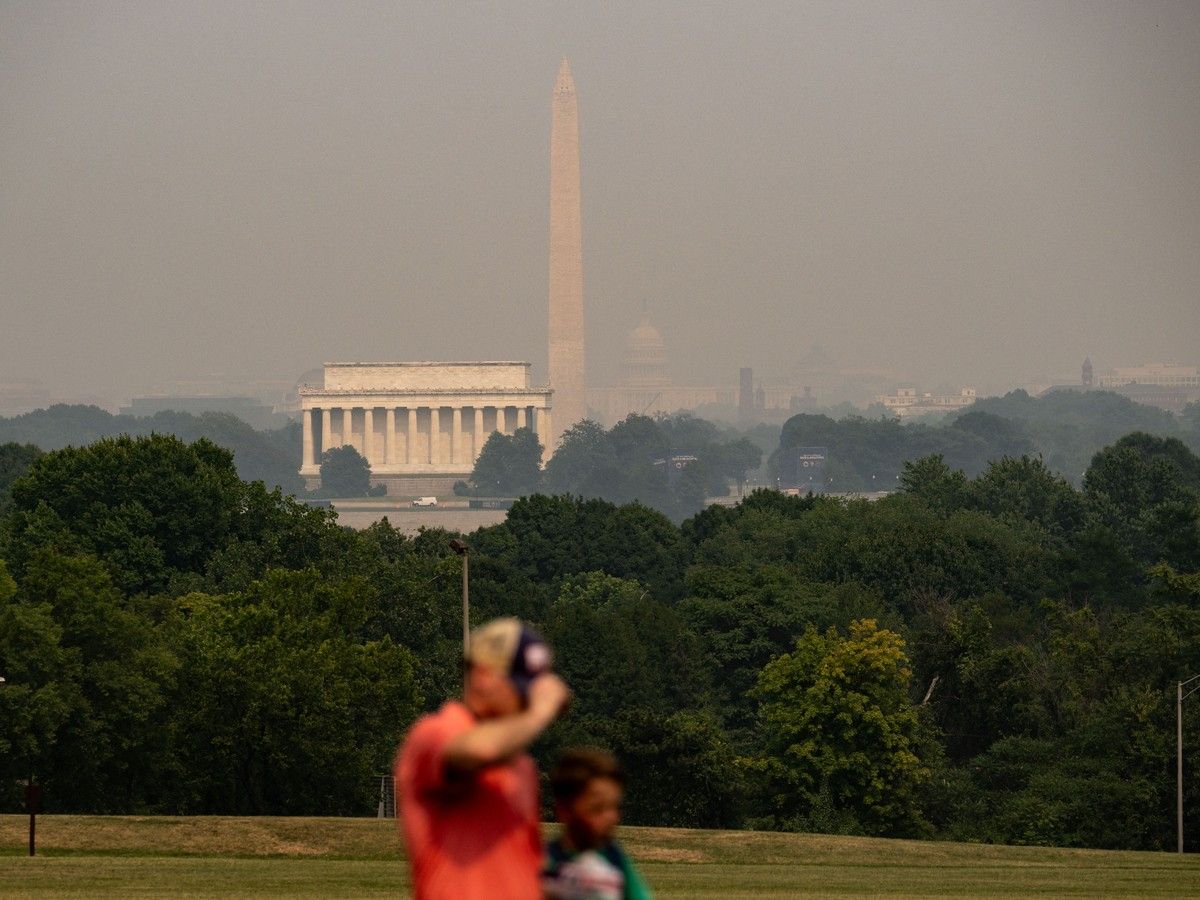
WASHINGTON, D.C. — Hundreds of wildfires are burning across North America, putting communities, buildings, and firefighters at risk.
With blazes in Washington state, Oregon, Idaho, Montana, California, Utah, and in Canada, especially in British Columbia, Ontario , and the Northwest Territories, there have been plenty of headlines about the devastation.
Last month, smoke from Canadian boreal forest fires poured into the United States, triggering air quality alerts for more than 120 million Americans. Influencers and media outlets shared dramatic footage and discussed the air quality in cities like New York and Chicago as smog blanketed their regions.
Four Republican lawmakers accused Canada of failing to do enough to prevent wildfire smoke from hitting the United States, claiming that “continued inaction” was “unacceptable.”
President Donald Trump also expressed frustration.
“The United States is being unnecessarily invaded by filthy, polluted, and unhealthy air,” he said, claiming it was “willful negligence” and that Canada is “not properly maintaining” its forests. Trump threatened to impose new levies over it, and his administration has since introduced new tariffs against Canada, citing retaliatory tariffs and forced labour practices — not wildfires — in doing so.
But Trump said on Sunday that he now has a finalized plan to punish Canada for the smoke. He refused to share details, simply saying, “you’ll find out.”
Forest management experts say Trump is oversimplifying a much more complicated problem.
The U.S. and Canada have forests that are different in structure, but both now face many of the same fire pressures, says Lori Daniels, a professor of forest and conservation sciences at the University of British Columbia.
Canada’s forests are mostly public lands managed by provinces and territories, while the U.S. has far more private forestland and a fragmented federal-state system. Both countries, Daniels explained, use the same broad suppression tools, but Canada has a scale problem: it has far more forest, fewer people, and remote boreal areas where lightning-started fires can be nearly impossible to reach.
Robert Bonnie, co-founder of Sage Agronomics and the former under secretary for Farm Production and Conservation at the U.S. Department of Agriculture, likened forest management and wildfire to a debt that has grown over time. “There are ways that we’re having to pay that debt: We’re getting bigger fires, more extreme fires, a lot of smoke.”
“If we want to pay down the debt, we have to invest in restoration,” he said, referring to the need to thin smaller trees, use prescribed fires, reintroduce fire where appropriate, and manage stands so they’re more resilient and less likely to carry crown fires.
John Bailey, an associate forestry professor at Oregon State University, says thinning and prescribed burns are fundamentally about fuel management, which means reducing ladder and surface fuels so fires are less likely to climb into the crowns of trees, where they often burn catastrophically.
“Thinning and prescribed burning helps us with some particularly problematic components of that fuel equation,” he said.
He says the U.S. has known of this need for decades but has been slow to do it at the needed pace and scale, largely because of budgets, a lack of commercial markets for small-diameter wood (clearing them brings no profit), local and state smoke rules, liability concerns, and not having enough trained professionals.
So, instead of doing what’s needed, he said, “the fuels have just continued to accumulate.”
Daniels said both countries need to move away from the postwar mindset of fire suppression and commercial-timber forestry where possible, and toward management that reflects today’s hotter, drier conditions.
“In Canada, temperatures have increased by more than one degree Celsius, and in the north, where those fires are having huge consequences, many of those areas have warmed more than two degrees Celsius,” she said.
Those areas have also experienced multi-year droughts, while forests grew denser after Indigenous burning practices were banned and suppression became the dominant policy, Daniels noted.
Even doing everything right won’t stop fires, she explained.
“Doing those improvements isn’t going to stop wildfires,” she said. “We are going to be living with more and more fire on our landscape.”
Bonnie also noted that the old ways won’t be enough.
“Even if Canada was doing everything right with climate change, there are things that are going to burn hotter and more aggressively than they used to,” he said.
Jonathan Boucher, researcher at the Canadian Forest Service, agrees that thinning trees, adding fuel breaks, conducting prescribed burning, and setting up defensible spaces near communities can help, but they cannot stop every fire.
“I don’t think the problem is forest management. I think the problem is climate.”
Bonnie also made it clear that Trump’s comments were not just wrong, but counterproductive.
The U.S. has underinvested in fire prevention and restoration, Bonnie said, and Trump has made the problem worse by cutting Forest Service capacity and resources.
Meanwhile, climate change is making forests drier faster, worsening fires, and forcing new management approaches.
“If you’re going to complain about your neighbors, then maybe you shouldn’t be part of the problem that’s causing climate change and making this problem worse,” he said.
“Our agencies work together. We’re going to throw smoke your way. You’re going to throw smoke our way. Let’s work together to make sure we can restore our forests in a way that we can contain this problem going forward.”
National Post
Our website is the place for the latest breaking news, exclusive scoops, longreads and provocative commentary. Please bookmark nationalpost.com and sign up for our newsletters here.