 BURST
BURST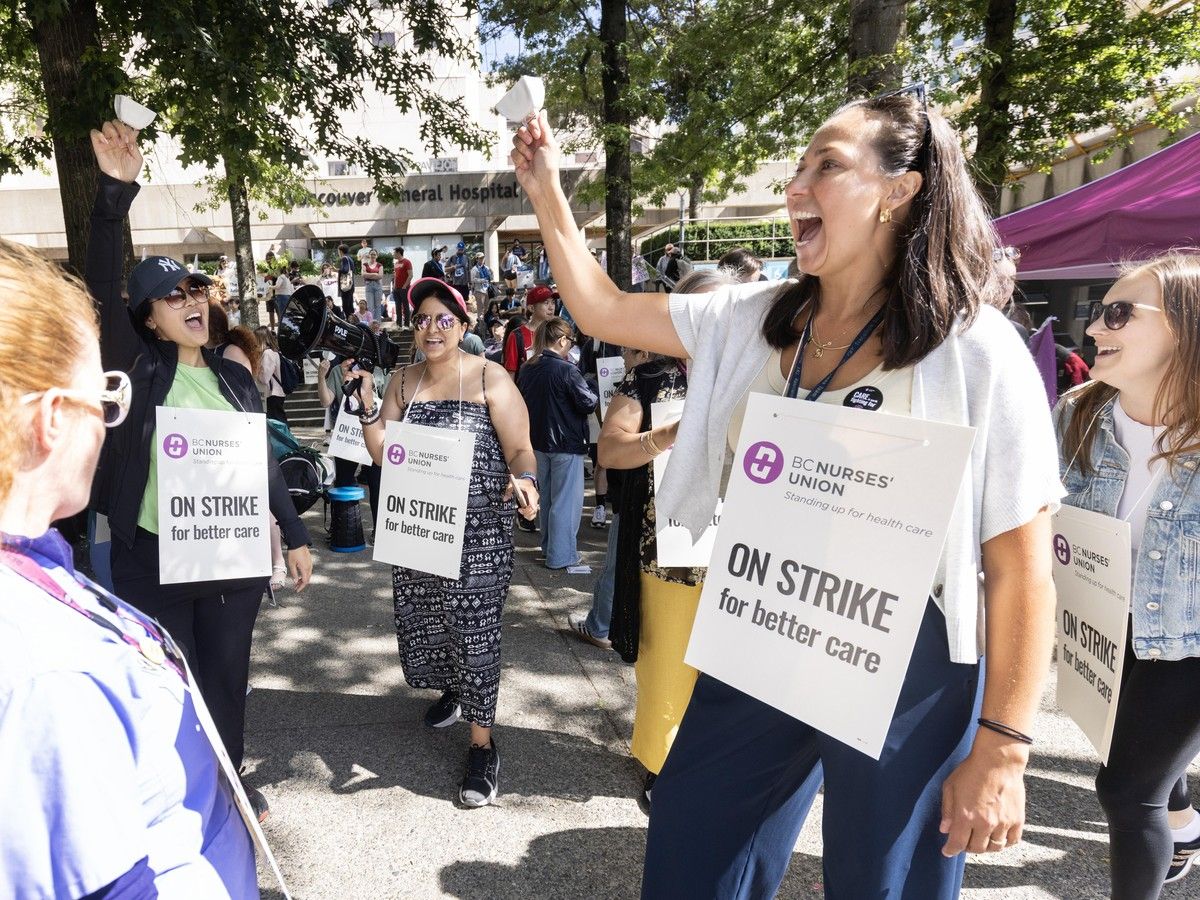
The B.C. Nurses’ Union hasn’t been on strike since 1989 and labour relations experts say it’s going to take the provincial government opening the purse strings to come up with a lasting solution to the current job action.
Currently in mediation under the direction of veteran mediators Vince Ready and Amanda Rogers, the B.C. Nurses’ Union and the Health Employers Association of B.C. appear to still be far apart on everything from benefits to the implementation of nurse-to-patient ratios promised by the province in 2022.
Farinaz Havaei, an associate professor at the University of B.C.’s School of Nursing, said the issue of understaffing and burnout among nurses stems from the early 2000s when there were cuts to provincial funding, and COVID-19 exacerbated those problems.
She said that as much as the government feels like it can’t spend more money on public sector unions, the costs of not addressing the crisis facing the health-care system could be even higher.
“The stakes here … extend beyond this round of bargaining. They’re also about the long-term stability of our workforce and ultimately the sustainability of the health system,” said Havaei.
BCNU president Adriane Gear has said the province is pleading that it has no more money for the union, amid a $13.3 billion deficit and following a 12 per cent over four years settlement with the B.C. General Employees’ Union that cost the government more than it originally intended to spend.
If the nurses were to get mediators or the government to agree to a collective agreement with higher wage increases, then all other unions would get the same amount and costs would balloon further.
“It was made very clear that they cannot go beyond mandate, and so here we are. So read into that how you will,” said Gear last week before the start of mediation. “There’s substantive challenges that we weren’t able to overcome, and the government has maintained that they cannot manoeuvre.”
Among the concerns from the union are a potential loss of benefits including physiotherapy, and the understaffing that has left between 4,500 and 6,000 nursing positions unfilled.
In a 2023 study, Havaei and her colleagues found that 32.8 per cent of nurses planned to leave their jobs for a different profession post-pandemic, while a further 12.4 per cent planned on leaving in four years. This study was a followup from research in 2015, before the pandemic and other strains on the health-care system. Even then, 50 per cent of nurses said they were likely to leave their jobs over the next year. Of those nurses, 75 per cent cited workload as a key factor, while up to 67 per cent also reported the physical demands of nursing.
Barry Eidlin, an associate sociology professor at McGill University in Montreal, says nurses across the country have been voicing their displeasure with understaffing and poor working conditions.
“With labour in general, we’ve had a period, like the nurses, where there’s been relative quiescence over the past few decades, with some exceptions, and we haven’t seen a lot of strikes. And then, coming out of the pandemic, we’ve had a sort of series of factors that have caused an uptick,” said Eidlin. “We had an erosion of job quality. We had sort of stagnating wages, eroding job security, benefits going away, more unpredictable hours, all different things, and then the pandemic kind of shone a light on that, and brought a lot of those problems to the fore .”
He said that, while the province can’t ignore the deficit, the problem of nurses’ pay is a political problem to be solved and that if the government wants to fix the current health-care crisis then it can find the money, potentially with the help of the federal government.
Rod Mickleburgh, a former labour reporter and the author of On The Line: A History of the British Columbia Labour Movement, said there are a few similarities between the current strike and the previous in 1989, including the union recommending the government’s offer and the union membership shooting it down. In 1989, roughly 65 per cent of nurses rejected the proposed deal, while this year, it was 67 per cent.
In the previous strike the government ended up giving the nurses a much larger wage increase after Ready’s mediation, but Mickleburgh isn’t sure that the government can afford an expansion of the mandate this time.
“The expectations of the nurses are quite high, and that can sometimes be a dangerous situation because it gets too high, and then it’s very hard to settle it,” said Mickleburgh. “I think it would be a disaster for the government if, given their deficit, the basic mandate was breached, and because the other unions, as I say, have me-too clauses that are pretty strong, and the original settlement of 12 per cent over four years was pretty generous.”