 BURST
BURSTToday’s monopoly round-up is chock full of news, as usual. In a historic first, big pharma cut prices for popular drugs. There’s a march for billionaires in San Francisco next week. And Netflix co-CEO Ted Sarandos is set to testify in the Senate on behalf of his company’s attempt to buy Warner.
Before getting to all of that, I want to focus on two seemingly unrelated stories that happened this week. The first is the release of more Epstein files, the second is a shocking state Senate upset in Texas, where a union Democrat without a college education beat a Republican by 15 points in a blood red district despite being dramatically outspent. While these stories don’t look connected, they are. The Epstein class represents a group of perverted political and economic elites running the world and running it badly, and this special election shows how ordinary people are rebelling with their votes.
It’s not the first time America has experienced such problems. Periodically, American elites go out of control. The Great Gatsby was a story written in the 1920s about such elites, and it’s not a coincidence that today, people are using phrases from that book to express how they see modern big tech oligarchs.
Justice Louis Brandeis described the commercial elites of his time, those titans of big business and finance whose holding company schemes had brought America to the brink of despair. In 1932, he observed “widespread suffering,” as well as “economic helplessness and general dejection.” Yet there was an “absence of any sense of shame on the part of those primarily responsible for existing conditions.” Shamelessness, apparently, is something that today’s American elites share with those of the 1920s.
With that in mind, yesterday, the Department of Justice released a series of new emails related to Jeff Epstein, the notorious social fixer and sex trafficker who sits in the middle of the political and economic world of baby boom elites, spanning institutions from MIT to Harvard to the Obama White House to Google to Donald Trump himself. There are new revelations about Bill Gates, Elon Musk, Richard Branson, Larry Summers, Kathy Ruemmler, Steve Tisch, Mike Lee, Chuck Schumer, Howard Lutnick, Bari Weiss and many other notable figures.
Often the stories coming out are horrible and gross, confirming or at least mostly confirming the worst conspiracies you might imagine. There are bits of evidence pointing to something behind the scenes we can’t quite see, like intense involvement by Epstein in early bitcoin development, through his links with MIT and Reid Hoffman. Or meetings with big law firm Paul Weiss chair Brad Karp and Goldman Sachs legal counsel Kathryn Ruemmler around the time Facebook was finalizing sensitive settlements with the FTC and SEC.
Some of what has come out is funny, like Larry Summers upset his own kids like Bernie Sanders.
There are too many threads to follow, and this batch of documents may be followed by more, since one member of Congress who forced the release, Ro Khanna, thinks the DOJ hasn’t published them all.
One important part of this story are the legal consequences resulting from the publication of these documents. Namely, there don’t seem to be any. Already, Trump Associate Attorney General Todd Blanche has said that the Department of Justice will not bring any more charges against anyone involved in the Epstein affair. There is one exception - Congressman Thomas Massie, who helped force the release of these documents, said his staff had been threatened with criminal investigations by the Trump FBI because of their work on releasing the files. So there’s that.
The Epstein network ensnares so many powerful people that it is causing logistical problems for elite discourse. Take a New York Times-hosted discussion on Friday with three economists on the appointment of GOP lawyer and socialite Kevin Warsh to be the next Chair of the Federal Reserve. The discussants were Obama advisor Jason Furman, Larry Summers’ protege Natasha Sarin, and conservative Oren Cass. Warsh, Furman, and Sarin were all in the Epstein files. Of course, they all act like central banking is a technocratic subject immune from anything as impolite as the Epstein files, despite the intense importance of public trust in the Federal Reserve.
The sordid elites on both sides are being hit, and hit hard, by these documents. Though Donald Trump campaigned on releasing the files, a few months ago, he reversed course. He said there were no government files worth releasing around Epstein, and the idea of such files was a Democratic party plot. Of course, it turns out his name is all over the files, in many different contexts, none of them flattering. As another example, Elon Musk said publicly he adamantly refused to visit Epstein as a matter of principle. It turns out that Musk emailed Epstein and asked about coming to visit, with the question, “What day/night will be the wildest party on your island?”
Even important commenters are finding it embarrassing. New York Times podcaster and Democratic party operative Ezra Klein, in 2025, mocked the idea of a conspiracy, and said “I think this guy had a lot of powerful friends, and that he was a predator and a pedophile, and those sides of his life were mostly separate.” To acknowledge a tight-knit network of insiders wielding power, cuts at the core of a lot of powerful people, who want to keep up a pretense of meritocracy.
But it’s the shamelessness of those caught up I find most interesting. Take billionaire and LinkedIn founder Reid Hoffman, a donor to Kamala Harris who in 2024 demanded she fire Lina Khan. He was in the Epstein files and exposed as a visitor to the island, as well as having given a replica of a playful MIT award, the ‘Disobedience Award’ to Epstein.

Here’s Epstein saying to Hoffman, “Come to island, ranch… let’s play.” And he did!
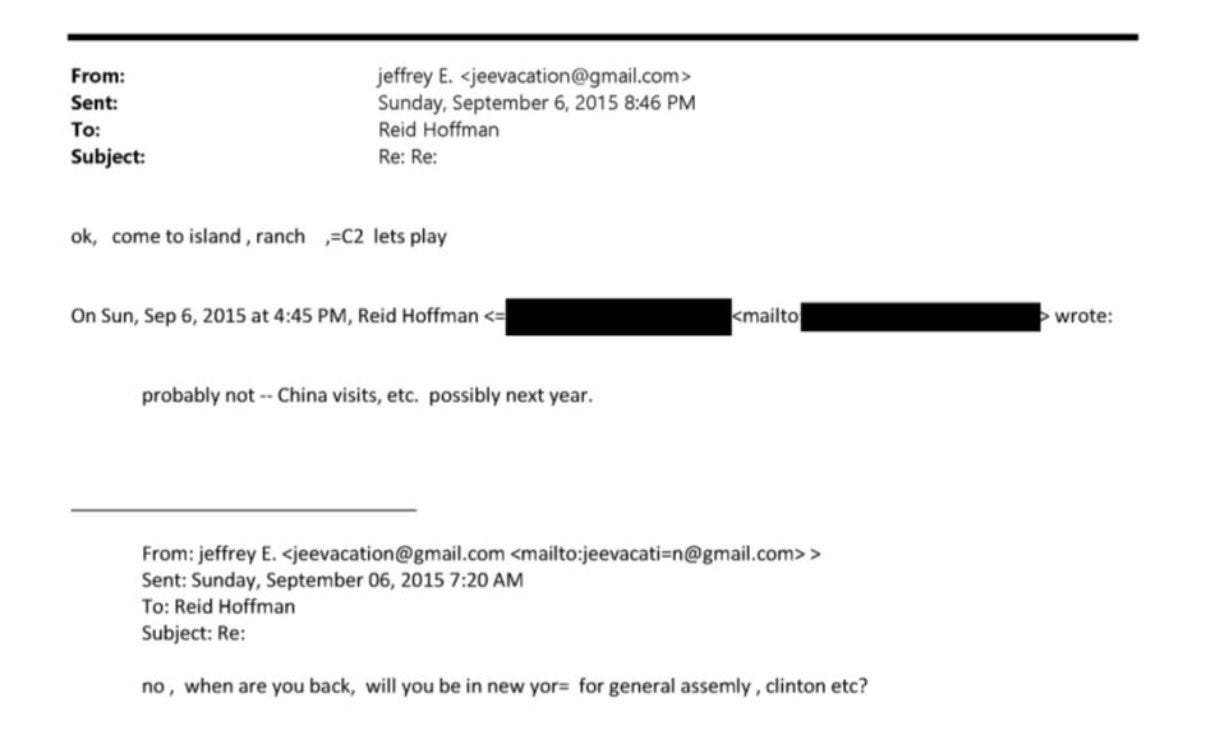
And yet, Hoffman’s response to the release of this new batch of files yesterday was to pretend he had nothing to do with any of it.
Such shamelessness by a man who should avoid showing himself in public does get us to the levels of the 1920s, or worse.
Now, while it’s true that both parties are implicated, it’s Trump and the GOP who are in more trouble. And the reason is simple. They are in charge. Here’s Steve Bannon, himself a close Epstein associate, making that point a few months ago.
“For this to go away,” said Steve Bannon, “you’re going to lose 10 percent of the MAGA movement. If we lose 10 percent of the MAGA movement right now, we’re going to lose 40 seats in ’26, we’re going to lose the presidency. They don’t even have to steal it.”
Yesterday there was a political upset that suggests Bannon was onto something. A Democrat in Texas named Taylor Rehmet beat conservative activist Republican Leigh Wambsganss by 15 points in a state Senate district around Fort Worth that Trump won by 18 points in 2024.
Rehmet is an interesting candidate, a mechanic who never went to college and became head of his union. He ran on a platform of higher taxes on corporations, a crackdown on corporate landlords, support for public schools, and standard New Deal Democrat policies. He was also outspent 10-1. Someone like Rehmet usually runs as a sacrificial lamb, just to have a name on the ballot. But now he’s the youngest state Senator in Texas.
The data on this race is suggesting that it wasn’t a result of poor turnout on the right, a lot of Republican voters just picked Rehmet. It’s unmistakeable sign of how unpopular the GOP has become in just over a year of governance. Here’s Florida Republican Governor Ron DeSantis making that point.
If the shift in the midterms is similar to what we just saw, the Republicans in the House would shrink from 218 seats to somewhere in the 80s. That level of political destruction won’t happen, but voters are extremely angry. And if Democrat picked up a lot of unexpected seats, it won’t just affect the GOP. Non-establishment people like Rehmet would flood into the Democratic caucus, and upend the traditional hierarchy.
Of course, this past special election didn’t happen because of the Epstein Files. When Brandeis noted the shamelessness of his era’s titans of business, he was observing the ugly consequences of a severe economic downturn. Today, by official metrics, we are in a period of growth. As I noted yesterday in my piece on a “boomcession,” however, voters do not feel prosperous.
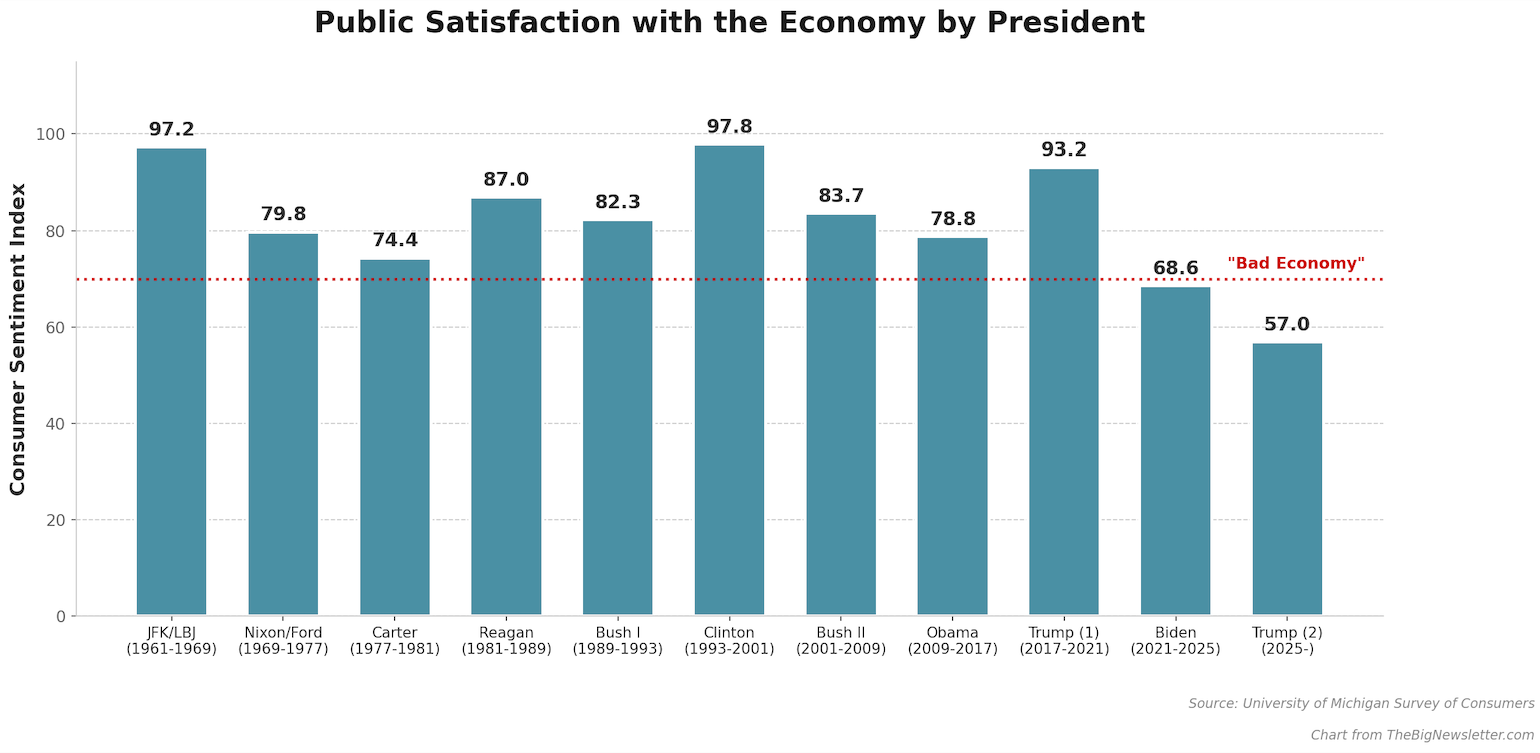
Trump’s first term was the third best period since 1960, but his second is the worst performance ever recorded. As with the 1930s, the voters are in a simmering rage. And they are going to remain extremely angry, until the powerful are held accountable for what they have done, and they start sharing in the wealth.
And now after the paywall, the full monopoly round-up. Some remarkable stories, like the Federal Trade Commission accusing Jeff Bezos of destroying chats during an investigation over antitrust violations, RFK Jr slashing UnitedHealth Group’s rates and causing the stock to crater by 20%, TikTok censorship, and defense contractors ignoring Trump’s demand they stop buying back stock. For that and more, read on.