 BURST
BURST
In search of a summer job, Chilliwack teen Olivia Nicholson tried fast-food restaurants, grocery stores and coffee shops. But it wasn’t until she dropped off her resume at a small business that she got her first interview.
“Most places didn’t even reply,” she said.
Nicholson, 16, now has a quintessentially summer job selling Chilliwack corn at a roadside stand. She gets decent pay for a high-school student, reliable hours and works with a team of teens. With steady employment, she has what thousands of other young British Columbians want, but are struggling to find.
The number of B.C. youth participating in the labour market has fallen to its lowest level in a quarter century, according to a recent analysis by the B.C. Business Council. There are about 51,000 fewer young people between the ages of 15 and 24 working across B.C. than in 2019, despite a jump in population.
But where young job-hunters are finding some success is with small businesses, experts said. While the economic slowdown has also hit the private sector, it may still be the best place for teens to look.
Molly MacCormack, policy analyst with the Canadian Federation of Independent Business, said many small businesses pride themselves on hiring young people.
“They know that’s a role they play in their communities,” she said.
While large corporations and franchises encourage teens to apply online, many small businesses respond best to someone who drops off their resume in person, she said.
That’s how Brynna Dow found her first job at Sparkes Corn Barn, where like Nicholson, she serves customers in the Chilliwack company’s distinctive green-and-yellow drive-thru stands. She wanted a job so she could have her own spending money and start saving for a car.
“I’ve learned so much about corn,” she said with a laugh. “The different types, how much it used to cost, and how much it costs now. I think this job sets you up well because you deal with so many different people.”
Dow, 16, gets full-time hours at one of the company’s busiest stands, where her favourite part of the job is talking to customers. She also enjoys the unique “tips” she receives, like a box of cherries or a bag of beef jerky.

MacCormack said that as small businesses have had to focus on “keeping the lights on,” some have had to reduce hiring. That impacts not only on teens, but their families, employers and the broader B.C. economy.
For teens, the summer job has long been a rite of passage. A way to make some spending money, save for college and learn skills outside the classroom, including communication, time management and problem-solving.
For parents, who might struggle to keep kids off screens when school is out, the situation can be frustrating. Some have started posting on community Facebook groups asking for tips to help their kids find work.
And experts say B.C. employers and the economy also suffer when youth are unemployed.
“You don’t have to be an economist to know this,” said Jairo Yunis, policy director with the BCBC. “You hear it when you talk to a parent whose kid can’t find a job or a young person who has spent six months job-hunting and they’re still searching.”
He said teens are missing out on lessons and experience that can impact their future work, including how to show up on time, take direction from a boss and money management.
“But the hole gets deeper, not only for them, but for all British Columbians,” he said.
Young people contribute more in taxes than they use in services. Their energy and new ideas, as well as digital literacy, benefit businesses. They’re also more likely to start their own business if they’ve worked for one where they’re given more responsibility and opportunities.
Emma Dow, the human resources manager for Sparkes, also co-ordinates corn deliveries to dozens of stands and works as a foreman. It’s the 20-year-old student’s seventh summer with the company, where she began working in a roadside stand. When she was asked to take over hiring, scheduling and other duties, she ran with it.
“It’s fast-paced work and the days fly by,” she said.

Dow said young people are open-minded and coachable, and they usually come with a positive outlook that is desirable for a small business.
Owner Ian Sparkes said he’s willing to give young people a chance as long as they bring in their resumes themselves. If their dad or mom asks for a job for their kids, it’s a red flag. He’s proud of several former employees who have gone on to become lawyers and doctors, but also those who haven’t had the opportunity to go to post-secondary school and have a strong work ethic.
“You can build a hell of a team by focusing on people and encouraging their strengths,” he said.
Sparkes said he struggles to find people to work in his warehouse where more than 100,000 cobs of picked corn arrive every morning starting at 3 a.m. for sorting, washing and packing. He employs migrant workers whose work ethic and professionalism are impressive, he said.
Sparkes, whose parents farmed beans, peas and corn before the market became global and profits shrank, used to sell pumpkins as a kid. He started his corn farm on rented land and built much of his production line himself.
“Is been a lot of hard work,” he said.
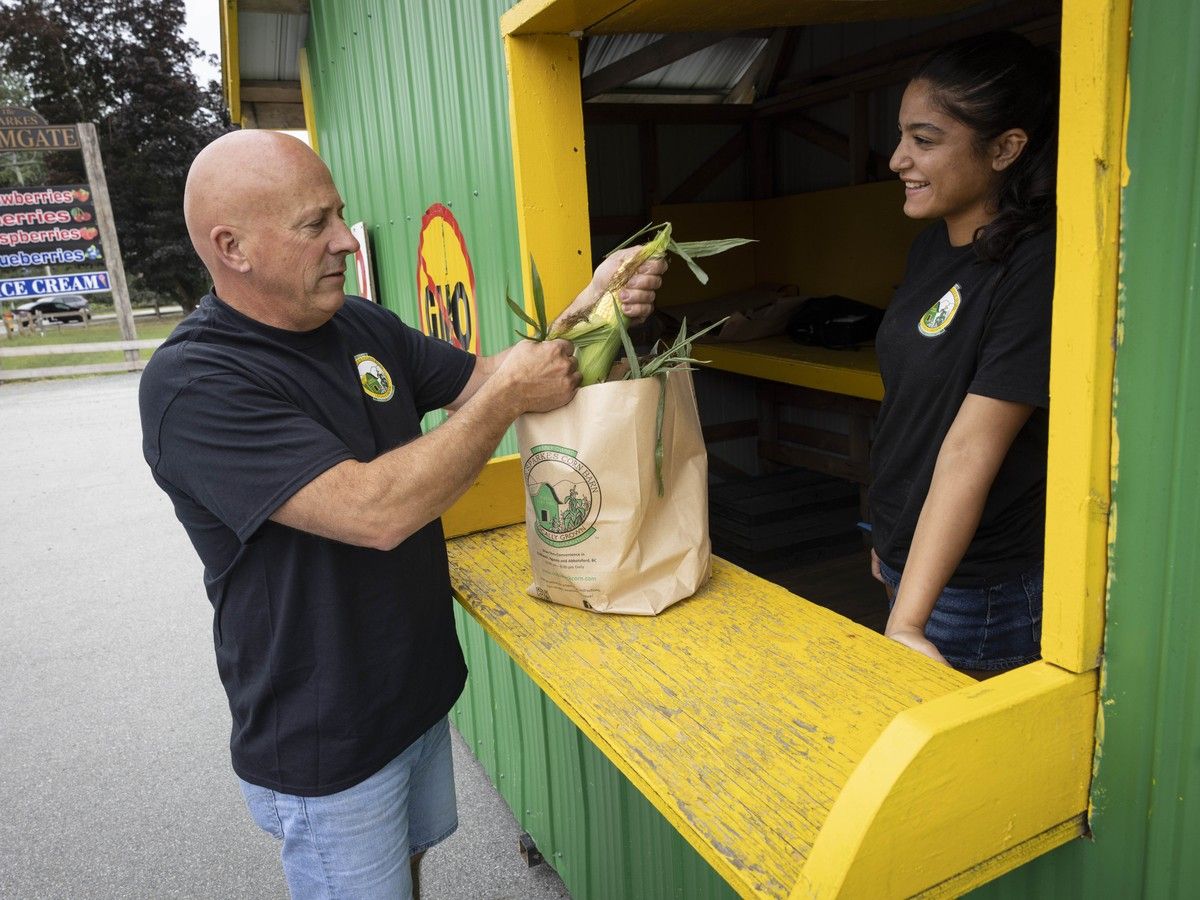
In places where small businesses are thriving, it seems like young people are too. At a produce store in Chilliwack recently, two youth stocked cherries, apricots and blueberries. On a road that visitors use to get to Cultus Lake, two teen girls scooped ice-cream at a kiosk. A teen boy mowed the lawn outside a small farm business. And at a small amusement park nearby, youth took tickets, kept the park clean and served food.
Yunis said the province’s stagnant private-sector job growth plays a big role in youth unemployment. The post-COVID-19 increase in temporary residents and international students also increased competition for entry-level jobs, while the high cost of doing business in B.C., from payroll taxes, to insurance, to red tape, has also had a chilling effect.
While June job numbers showed a slight rebound in youth employment, possibly due to immigration policy changes and the World Cup, the economist isn’t convinced it is part of a lasting trend.
“It’s still very dire,” he said.