 BURST
BURST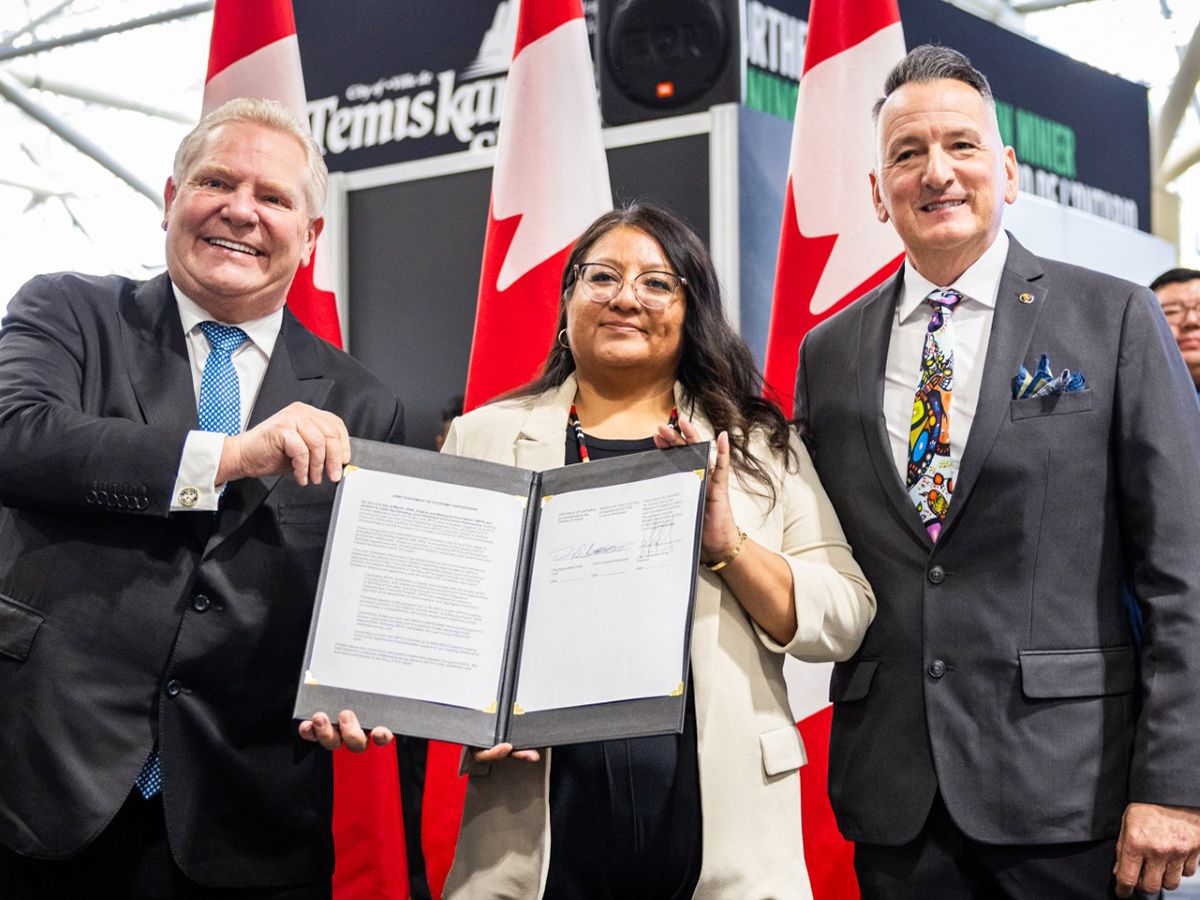
Meet Greg Rickford, Ontario’s Minister of Indigenous Affairs (and the guy basically running point on Ring of Fire economic and community partnerships). If ever a politician was custom-built for the job, it’s Greg — he’s like the Swiss Army knife of northern development.
Check out this resume: He starts out as a nurse in Brantford, Ont., and heads north to deliver frontline healthcare in remote First Nations communities. Then he studies law at McGill, earns an MBA from Laval, and dives deep into Indigenous governance, health, and economic development. By 2008, he’s in federal politics representing Kenora, eventually landing as minister of natural resources in Stephen Harper’s cabinet. Fast-forward to 2018: he flips to provincial politics, and wins Kenora-Rainy River for the PCs.
Greg’s eclectic background might just be the secret sauce the Ontario government needs to accelerate progress on the Ring of Fire. Located roughly 500 kilometres northeast of Thunder Bay, this mineral-rich region holds significant deposits of critical minerals, vital for EV batteries, and has the potential to create 70,000-plus jobs. After two decades of talk and delays, things are finally revving up.
The Ring of Fire isn’t on the feds’ shiny “Major Projects” shortlist yet (the one featuring mines like McIlvenna Bay or Sisson, or energy plays like Darlington nuclear). But there’s momentum. Last December, Prime Minister Mark Carney and Premier Doug Ford inked a co-operation deal to get approvals moving with a “one project, one process, one decision” approach.
Then came the March announcement from Ford: an accelerated road plan. Shovels could hit the dirt as early as June this year, with all-season roads opening by 2030–31 — five years ahead of the old timeline. The Webequie Supply Road, Marten Falls Community Access Road, and other upgrades, will connect this remote, mineral-packed region to the rest of Ontario.
Greg’s been pushing for this kind of development for years. As Harper’s minister of natural resources, he tried to work with the Wynne Liberals, but he explains, there were all kinds of ‘hide-and-seek” exercises. The province will put up a billion dollars if the feds put up a billion dollars, sort of thing — he says — that weren’t materially benefiting the region, First Nations or municipalities.
“I never believed that the previous (provincial) government had any real substantive designs or intention to develop that region,” Greg reports.
“The regional framework (the Wynne government) had in place,” he adds, “became intractable, to the point where communities could agree to meet under a framework agreement, but accomplish nothing.” Proposed projects fell flat on their face, Greg laments, because “there was no consensus on legacy infrastructure.”
“At the front end of (Ford’s) government,” he explains, “we took down the regional framework agreement, with the intention of trying to understand which communities in the region were serious about the two activities that we saw as fundamental.” Namely, electrification of remote communities operating exclusively on diesel, and the construction of all-season-access roads to replace unreliable winter roads.
“One of our first orders of business,” Greg reports, was the signing of the “Watay Power Connection, farther west of the Ring of Fire,” a transmission project connecting 24 First Nations in northwestern Ontario to a provincial grid. Near the small town of Geraldton, north of Thunder Bay, he continues, Greenstone Gold built their own gas-fired plant to generate electricity, “not just for the gold mine, but for the surrounding communities.” As of January, he adds, “the Greenstone transmission line is going to fortify the electrification all the way up to Aroland First Nation.”
“These communities aren’t just business partners in the mine, they’re also equity partners in that transmission line,” Greg asserts. Then he asks, pointedly, “Do you see a trend here?” Of course, I get it; the relationships being cultivated with First Nations aren’t just cheque-writing exercises.
“We’re shifting the paradigm from impact benefit agreements — and getting money to stand there and watch all these things go on without any meaningful participation, economically or otherwise — to risk and reward,” he says.
“I have been working closely with my cabinet,” Greg confides, “to say, ‘Look, here’s what we’ve accomplished. We have First Nations-led environmental assessments that took a couple of years, about to … be completed and approved by the province.’”
“We need a road in there,” he continues. “For time immemorial, nobody has really disputed that, right?” An access road “wouldn’t just serve our interests for the Ring of Fire,” he says, “but would also provide road connectivity to those First Nation communities that need it most … for health, economic and social reasons.”
Greg would prefer we call that road a “corridor to prosperity,” a term he coined, more than a decade ago, he says, when he was making best efforts as a federal minster who didn’t have the required jurisdiction constitutionally to develop some of these ideas. He does admit, “the market wasn’t necessarily ready either.”
But it is now. “It’s the conversation of every country in the free world, right?” he asks, rhetorically. “Outside of China and Russia, who’s gonna bring these (critical minerals) to market?”
I tell Greg: “The idea of combining your First Nations ministerial portfolio with Ring of Fire economic development was a masterstroke.” Greg says he pitched the idea to Premier Ford in the wake of the last election, and “he was only too happy to frame it that way.”
“Keep in mind,” he cautions, “the mining activity is a couple of years down the road and employs a static group of people. But the construction of a corridor roughly the size of Toronto to Montreal, the ability to provide economic, real businesses that First Nations can participate in through the years … position us to say to the premier, who was only too willing to get on board, let’s do this economic and community partnership model.”
“Ford’s not keen on ‘rip and ship,’” I point out, “Do you expect to see these critical minerals smelted and refined in northern Ontario?”
“Absolutely, yes,” Greg enthusiastically responds. Ford envisions northern Ontario as a destination, not just for extraction, but the processing of critical minerals. And, he adds, there are First Nations saying they would love to be involved in building the load capacities of rail lines, so their communities can be potential destinations for processing.
Greg’s commitment to consensus-building is unusual, and his ambition to bring modernity to northern Ontario unrelenting. Yet, I can’t help but wince, thinking about the resistance this project has yet to face, and the support needed from all quarters, to fend off well-funded opponents who frame resource development as an infringement on inherent rights, even casting non-Indigenous Canadians as outsiders in their own country.
The late Jim Prentice — another Harper minister and lawyer with a track record of protecting Indigenous rights, and widely regarded as “uniquely suited” for the job of rescuing Enbridge’s Northern Gateway pipeline project — failed. It was a different project, and arguably, a different time. But the consequences live on.
Our website is the place for the latest breaking news, exclusive scoops, longreads and provocative commentary. Please bookmark nationalpost.com and sign up for our newsletters here.