 BURST
BURST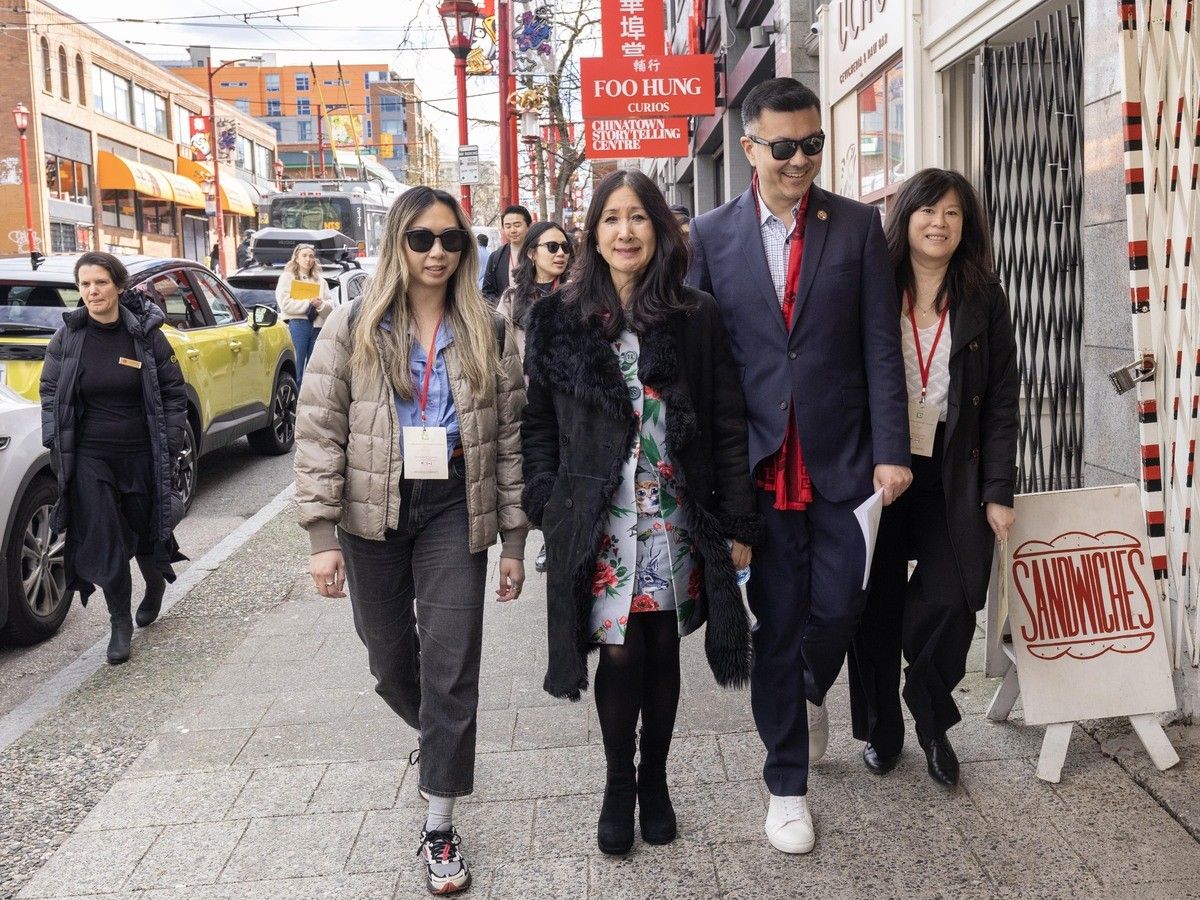
Dozens of leaders from 22 Chinatowns across North America spent time Tuesday on walking tours of Vancouver’s historic Chinatown, dropping by long-running storefronts as well as a recently opened affordable-housing complex.
They were here as part of a three-day summit — the third in the last four years — intended to find ways to preserve the cultural heritage and revitalize the economies of such neighbourhoods, which, leaders say, are “at risk of disappearing.”
While Chinatowns face unique challenges, they also face common ones, a previous summit report found , including rising rents, displacement, and inequitable planning processes.
“What we want to do is make sure we’re modernizing Chinatowns, and when you talk about revitalization efforts, it’s also about making Chinatown appealing. It started off as a safe haven, but now it’s also a destination, and we want to ensure that continues,” said Vancouver-based Brian Pang, co-lead of the Chinatown Solidarity Summit.
Vic Lee, co-founder and executive director of a non-profit that supports Manhattan’s Chinatown, was among the 65 Canadian and American Chinatown leaders on the tour Tuesday. New York hosted the last summit in 2024.
Lee and others spoke of the importance of honouring the history of Chinatowns as places that once served working-class immigrants who had few rights but also of the importance that Chinatowns evolve in order to stay relevant.
“You have to have some original tie to the concept of being a ‘safe haven,’ but you can’t approach it by thinking that, because of the way Chinatowns were started, that things can’t change. We have to be able to embrace change, but alongside history,” she said.
Participants visited Bob & Michael’s Place, a 10-storey residential building with 231 units at 32 West Hastings St., opened by the Vancouver Chinatown Foundation in 2024 with microsuites, studios, one- and two-bedroom suites to address community housing needs in the area.
They also stopped by long-standing retailers that have worked with the foundation in recent years to use government funds to spruce up storefronts and launch social media marketing campaigns to attract and keep customers.
The City of Vancouver keeps track of storefront vacancies. While vacancy rates in the Hastings Crossing, Strathcona and Chinatown BIAs did improve in 2025, they were all well over the 10 per cent threshold for what is considered unhealthy, with Hastings Crossing at 26.8 per cent, Strathcona at 18.4 per cent and Chinatown at 16.2 per cent.

Leaders acknowledged there are a variety of metrics that can be used to measure how Chinatowns are faring — from the number of residents, visitors and legacy businesses to the number of heritage buildings preserved to the level of crime — and there is no standard approach.
“Every city and every Chinatown will have different metrics and different ways to measure,” Pang said. “We do want to take a more data-driven approach. (It) is key to direct change, and it’s something that’s a great idea because we don’t have standards and it’s something we should look into and discuss.”
Lee said that her organization has partnered with New York University’s Stern School of Business to come up with longer-term metrics.
“I think there’s a lot of short-term metrics that are measured when it comes to small business economic development, thinking about how many small businesses you serve, if you’re able to get data, such as how many sales and how many employees.”
But understanding traffic over time and leveraging this around, for example, transit ridership information is a way to extend revitalization goals, she said.
“We have invested in electronic door counters to measure traffic and understand the seasonality and identify patterns. We are looking at the diversity of residents. In Manhattan Chinatown, we are losing (our) Asian population, but also we’re losing families because the infrastructure makes it really challenging to raise families. So, what does that look like as a measured trend of the community over time?”
She said her organization is thinking about how wealth is transferred in a neighbourhood, especially with aging properties and aging small business owners.
“We are in the midst of building an archive right now where we can look at property ownership data and small business data and look at those transitions and trends over time too,” said Lee. “Are we starting to see larger corporation ownership and less community ownership? How do we foster actually allowing people to experiment and go back to that side of Chinatown?”
In many cites with a Chinatown, it’s not uncommon to find newer clusters of Asian grocery stores, restaurants and other businesses in the suburbs. But it would be improper to suggest that they are competing with older Chinatowns, said Andy Yan, an urban studies professor and director of the City Program at Simon Fraser University, who took part in Tuesday’s tour.
“It’s a total misnomer to think of Chinatowns as competing in some way with these other areas because there is cultural and social infrastructure in Chinatowns that is for all Canadians,” he said, referring to society buildings that provide low-income housing for seniors and run language and arts programs as well as settlement services.
Chinatowns are also places of grassroots community and culture that need to exist in order to drive policy changes, according to Thu Nguyen, executive director of OCA-Asian Pacific American Advocates, based in Washington, D.C.
The group is one of the oldest Asian-American and Pacific-Islander civil rights organizations in the U.S., with 35 chapters in 24 states and many original offices are located in the Chinatowns of major cities.
“I’m Vietnamese-American, a daughter of refugees who came to the U.S., and to me, grassroots community work of preservation, investment and solidarity is important for government accountability and the leveraging of civic power.”