 BURST
BURST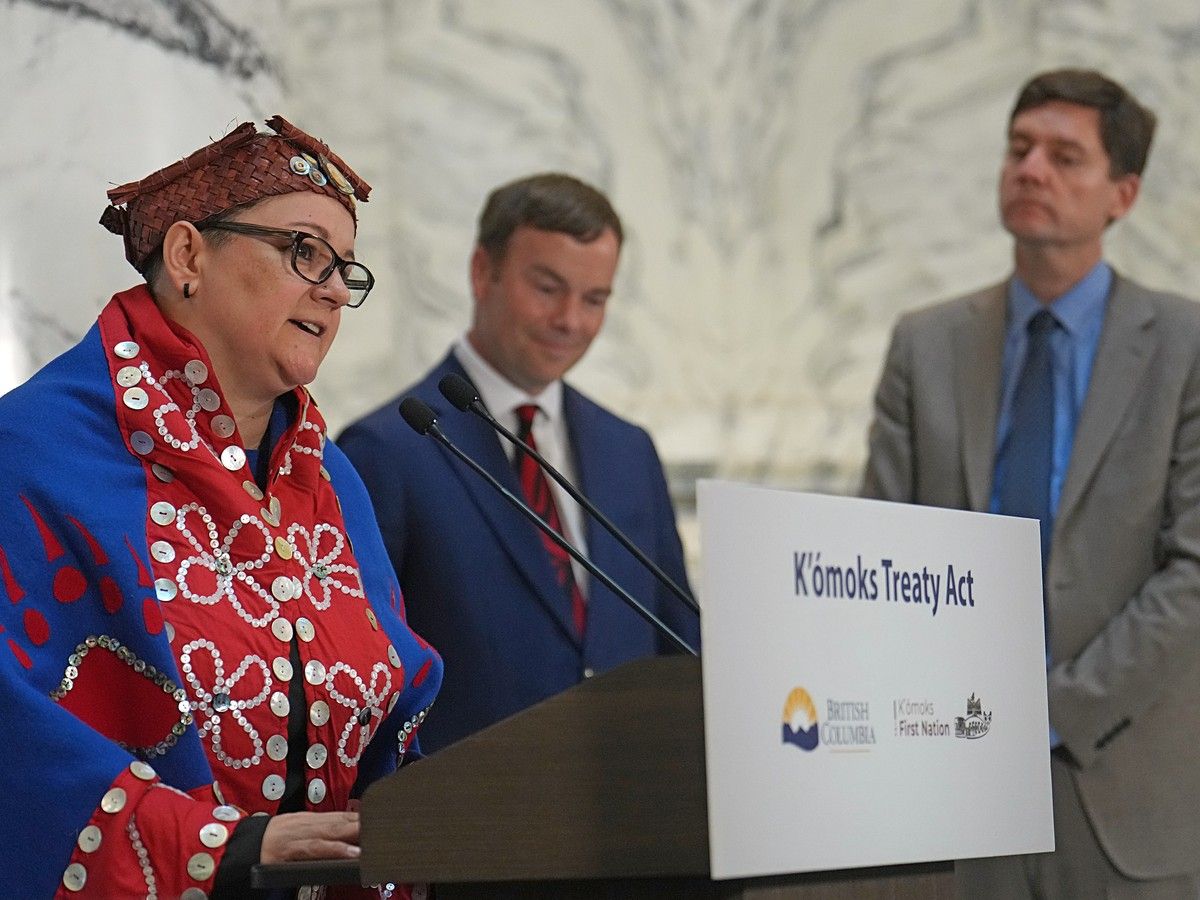
The K’ómoks First Nation will receive ownership of more than 34 square kilometres of land on Vancouver Island, self-government over those lands, and $56 million, in the fifth modern treaty to be reached in B.C.
It has been more than 30 years since negotiations started, but a milestone was reached Tuesday when the B.C. government introduced legislation to implement the treaty.
The K’ómoks voted last year in favour of the treaty , and the federal government is expected to start the ratification process this fall.
The treaty, which will provide the First Nation’s 351 members sweeping powers over their lands, could become effective by 2028.
It’s the first treaty to reach the finish line in B.C. in more than 10 years.
“Today is not the end of the journey. It’s a meaningful step forward and an important step in implementation toward a future where our nation can fully realize its potential,” K’ómoks Chief Nicole Rempel said during a short ceremony with Premier David Eby just before the legislation was tabled.
Eby said the work carried out to reach the treaty reflects a choice between conflict and refusal to recognize rights, and co-operating and finding a path forward with First Nations.
“There are those that would have us walk away from trying to find this path of co-operation, but we will continue as a government to prioritize that work with our Indigenous partners across the province, because when we do this work, we know that there are so many benefits for First Nations communities,” said Eby.
The B.C. government will introduce legislation Wednesday to implement another treaty, with the Kitselas First Nation in the Terrace areas.
Eby has come under criticism for his handling of First Nations issues , including how the United Nations Declaration on the Rights of Indigenous Peoples has been implemented in B.C.
Recently, Eby promised to suspend key sections of B.C.’s Declaration on the Rights of Indigenous Peoples Act for three years to address legal uncertainty, which has angered First Nations leaders.
The near completion of the K’ómoks treaty also comes as there has been an increase in public anxiety about reconciliation and legal uncertainty over Aboriginal land title following a 2025 B.C. Supreme Court decision that found the Cowichan Tribes held Aboriginal title to land in the City of Richmond, including privately held homes, farms and commercial lands. It was the first time a court had included private land as a remedy.
The land provided to the K’ómoks First Nation is made up of provincial land, some private land purchased by the province, and existing First Nation reserve lands.
The treaty lands will be owned in fee-simple by the K’ómoks and will no longer be subject to the Indian Act.
The First Nation noted it is receiving only 0.02 per cent of its claimed traditional territory. It’s existing reserve lands cover less than three square kilometres, an area smaller than Stanley Park.
The treaty land parcels are in and around the Comox-Courtenay area on the eastern, mid-coast of Vancouver Island, some containing forests and parks.
Public access to parks — including Williams Beach and Wood Mountain — will continue.
Scott McInnis, the B.C. Conservative Opposition critic for Indigenous relations, called the treaty a “remarkable” achievement and added his caucus is looked forward to digging into its details. His party has called for the Indigenous rights declaration act to be repealed.
The treaty also gives the K’ómoks the option to purchase another nearly 16 square kilometres of land already identified, largely woodlots, which are managed to harvest timber.
The neighbouring Wei Wai Kum First Nation opposes the treaty, saying it partly overlaps on its territory. Spencer Chandra Herbert, B.C.’s minister of Indigenous relations and reconciliation, said conversations will continue with the Wei Wai Kum and noted there are other neighbouring First Nations that support the K’ómoks treaty.
The K’ómoks First Nationwill have broad law-making authorities over its lands, including for resources, child protection, health services, family and social services and education. But provincial and federal laws are generally applicable on treaty lands.
For the first time, as part of a treaty, a First Nation is being given authority to make laws for the administration of justice, which includes fines and policing, and the establishment and operation of a court.
B.C. and Canada have also implemented a significant change in how they settle treaties, which now do not extinguish existing Aboriginal rights but instead define how those rights will be implemented through the treaty. The treaties are considered living documents and contain 10-year renewal provisions that allow for changes to be made.
The treaty also provides the K’ómoks forestry and fishing rights, and establishes two tribal parks, including on Sandy Island and Seal Islets, and in Wildwood forest. The First Nation will also be provided rights in the K’ómoks estuary at the mouth of the Courtenay River.
With files from Alec Lazenby