 BURST
BURST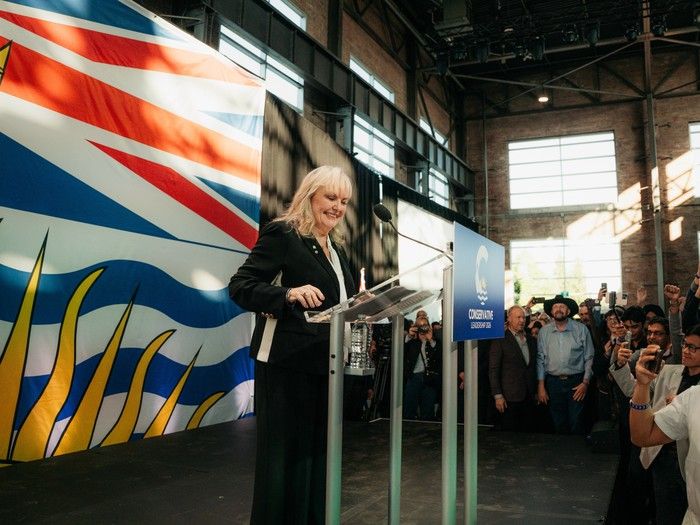
The B.C. Conservatives’ new leader appears poised to take the party in a more right-wing, populist direction, political experts say, and away from the more centrist, big-tent approach of the B.C. Liberals, the party that for many years was the province’s main right-of-centre force.
The victory of Kerry-Lynne Findlay, who B.C. Tory members chose over the weekend as their new leader, is seen as a break from the B.C. Grits and B.C. United, the parties associated with defeated leadership candidates Caroline Elliott, Iain Black and Peter Milobar.
On Monday, Findlay said she is confident that her messaging will appeal to past supporters of the B.C. Liberals, and other parties, as she aims to defeat the B.C. NDP and form B.C.’s first Conservative government in a century.
“My view of the future is that anyone who believes in building opportunity and prosperity in B.C. will like our messaging and join in,” said Findlay, a former longtime federal Tory member of Parliament. “It really doesn’t matter where people have seen themselves before, they could be old-time Socreds, or B.C. Liberals, or B.C. United, or voted Conservative, or even NDP. Do they want to see progress in terms of our economic situation?”
Findlay said that Milobar, a former B.C. Liberal MLA, has already told her that he looks forward to working with her as the new party leader, and she told him the same. During the leadership race, Milobar and Findlay traded harsh words when Findlay suggested the MLA could find himself in a conflict of interest on First Nations issues because his wife and children are Indigenous. Her statement was widely condemned at the time, including by some federal Conservative MPs with whom Findlay worked in Ottawa.
But Findlay said Monday: “It’s about the future, it’s not about the past … It’s about getting on with a future vision. I’m open to talking to anyone who sees that as a future vision they can get behind.”
Simon Fraser University political scientist Sanjay Jeram thinks it’s unlikely that Findlay, as the leader of the Opposition, will fundamentally change from the populist style that won her the role.
If Findlay tries to “reshape her image” too much, in the interest of appealing to more middle-of-the-road voters, it could hurt her and the party, Jeram said, considering the party’s recent internal tumult.
And, he predicted, the Tories could still find success in the next provincial election even without courting those more centrist voters, by riding a wave of public dissatisfaction with the B.C. NDP and Premier David Eby.
By the time of the next general B.C. election, scheduled for 2028, the B.C. NDP will have been in power for more than a decade. It’s common for voter dissatisfaction to increase the longer a party is in office, Jeram said, and recent polls haven’t been favourable for Eby and his party.
“Some centre-right voters who may find her not their most appealing candidate will just hold their noses to vote (for the Conservatives) anyway,” Jeram said.
It will be important to see in the coming days and weeks to see whether Findlay can successfully bring back any of the sitting MLAs who left the Tories while John Rustad was leader, Jeram said.
Two of those now-Independent former Conservative MLAs, Jordan Kealy from Peace River North, and Tara Armstrong from Kelowna-Lake Country-Coldstream, endorsed Findlay in her leadership bid, so it might not be surprising to see them rejoin the Tories.
Two other former Conservatives, Elenore Sturko from Surrey-Cloverdale, and Amelia Boultbee from Penticton-Summerland, wrote on social media after Findlay’s victory that they’re not looking at rejoining the Tories under her leadership.
Sturko wrote that the results of the Conservative leadership race “have left a void in the political landscape for those who are looking for an alternative to NDP incompetence.”
Conversative Party of B.C. executive director Angelo Isidorou said Findlay had a “very successful” meeting Sunday with the Conservative caucus, and “she’s already in the process of uniting the party.”
“She’s run in several elections before, and she understands fundamentally that you need to be as inclusive as possible of everyone, while not abdicating your principles,” Isidorou said.
The B.C. NDP wasted no time in attacking Findlay, issuing a statement Saturday declaring: “Findlay’s racist campaign hands control of B.C. Conservatives to pro-Trump faction.”
The NDP will likely spend a lot of time comparing Findlay with Donald Trump and trying to portray her as a racist extremist, said Nicolas Kenny, an SFU political analyst. The Conservatives will likely respond by saying the NDP is merely desperate to deflect from its poor performance on key issues like the economy.
University of B.C. political scientist Stewart Prest said he expects “the next couple of years will be bruising and quite divisive in B.C. politics.”
“I hope that we can find ways to have constructive conversations about the direction of the province, but the last few months do make me worried on that front, that we’re going to end up with contrasting, simplistic characterizations of the problems we’re facing,” Prest said. “I think we need a more nuanced debate, but I’m not sure we’re gonna get it.”
Conservative Party of B.C. leadership vote results by round: May 30
Round 1
Kerry-Lynne FINDLAY 30.5%
Caroline ELLIOTT 25.8%
Iain BLACK 20.3%
Yuri FULMER 13%
Peter MILOBAR 10.5%
Round 2
Kerry-Lynne FINDLAY 32.2%
Caroline ELLIOTT 28.6%
Iain BLACK 25.3%
Yuri FULMER 13.9%
Round 3
Kerry-Lynne FINDLAY 38.6%
Caroline ELLIOTT 31.3%
Iain BLACK 30%
Round 4
Kerry-Lynne FINDLAY 51%
Caroline ELLIOTT 49%