 BURST
BURST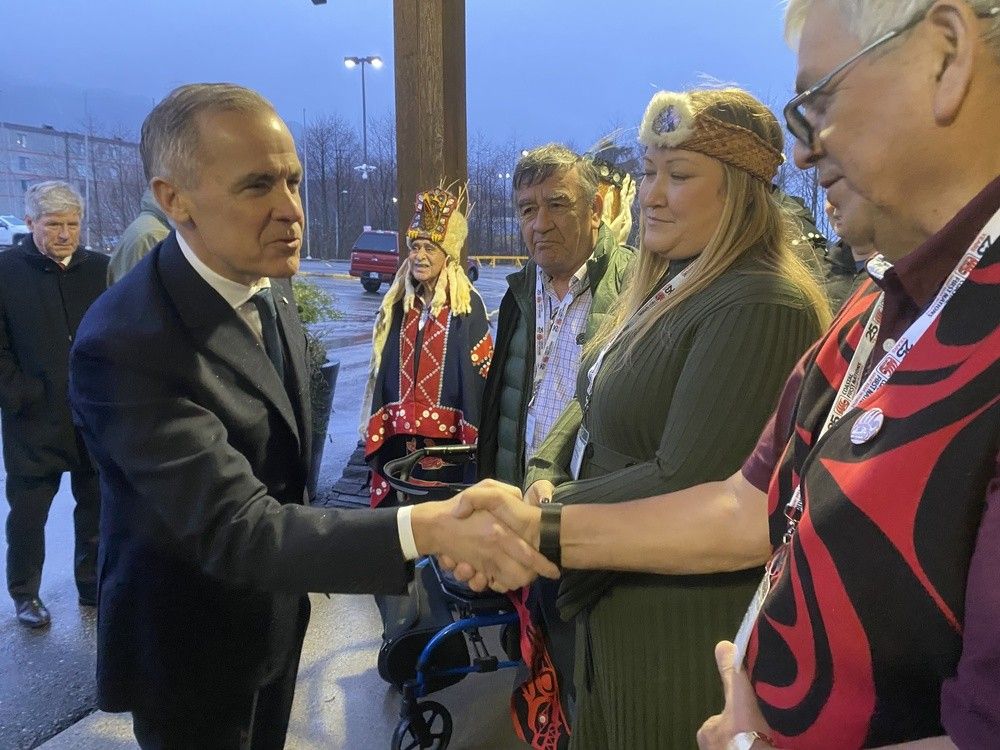
Coastal First Nations leaders viewed Tuesday’s meeting with Prime Minister Mark Carney in Prince Rupert as a respectful start to building a relationship with government on advancing economic development in the northwest, but they were clear in their opposition to a new bitumen pipeline in the region.
“Coastal First Nations, along with the Lax Kw’alaams and the Haisla Nation oppose any project that proposes to bring oil tankers to the North Coast,” said Marilyn Slett, president of the Coastal First Nations group and chief councillor of the Heiltsuk Nation.
“We reiterated that there is no technology that can clean up an oil spill at sea, and that it would take just one spill to destroy our way of life,” she told reporters following the meeting.
Carney travelled to Prince Rupert at the invitation of the Coastal First Nations and, in a clip from a Global News report, said the occasion was “not a day for big announcements, (but) for dialogue, for listening and working.”
The potential for a new pipeline being pushed by Alberta Premier Danielle Smith as a “nation-building project” to diversify Canada’s oil exports formed the backdrop for Tuesday’s meeting. Coastal First Nations were angered at being excluded from discussions about the possibility of building one.
Last November, Ottawa and Alberta signed an agreement setting out conditions under which the federal government’s major projects office would consider a new pipeline to B.C.’s North Coast as a nation-building project to diversify Canada’s oil exports owing to uncertain trade relations with the U.S.
Public opinion about another bitumen pipeline appears to have softened in B.C. since the strained trade relationship. An Angus Reid Institute poll released Nov. 29 found that 53 per cent of respondents leaned in favour of the idea.
The poll, however, did not show a clear consensus on whether the public would be OK with lifting Canada’s moratorium on oil tanker traffic off the North Coast that has been in place for more than 50 years and was formalized in law in 2019.
Slett, however, said Coastal First Nations would use “every tool in the tool box, whether it’s legal, whether it’s other tools,” to oppose a new pipeline proposal.
“There is an alternative to oil,” Slett said, referring to liquefied natural gas developments such as LNG Canada’s Phase 2 proposal. “(LNG projects) also cause concern, but they are something that we’re able to sit down and talk about in terms of how we want to address our concerns going forward.”
The Coastal First Nations are an alliance of eight First Nations with territories within the collection of mountainous coastal inlets and river valleys known as the Great Bear Rainforest, and includes the Haida Nation.
The group’s leadership was joined Tuesday by representatives of the Lax Kw’alaams of Port Simpson whose territory includes potential terminal locations in the Port of Prince Rupert and Haisla Nation near Kitimat, which was slated to be the end point of the failed Northern Gateway pipeline proposal.
After Tuesday’s meeting with Carney’s delegation, which included Energy and Natural Resources Minister Tim Hodgson, Housing and Infrastructure Minister Gregor Robertson and Vancouver Quadra MP Wade Grant, First Nation Leaders felt they had been listened to.
“He’s got a big job and we feel like he showed respect today by making time to come here and see us face to face as we asked,” said Jason Alsop, who goes by his traditional name Gaagwiis and is president of the Council of the Haida Nation and vice-president of Coastal First Nations.
Slett added that Carney repeated his commitment to abiding by the requirements of the United Nations Declaration of Rights of Indigenous Peoples and “that his government will seek our free, prior and informed consent regarding any proposed projects in our territories.”
“And that we will co-develop a transparent process,” Slett said.
Gaagwiis said First Nations and government need to work out improved environmental protections and marine emergency response capabilities within the region for major projects that have already been approved and have the capability to increase shipping traffic in North Coast waters by more than 200 per cent.
His bottom line is to protect Indigenous sustenance and food security in coastal waters within an existing North Coast economy he valued at $3 billion and employs some 30 per cent of the region’s residents.