 BURST
BURST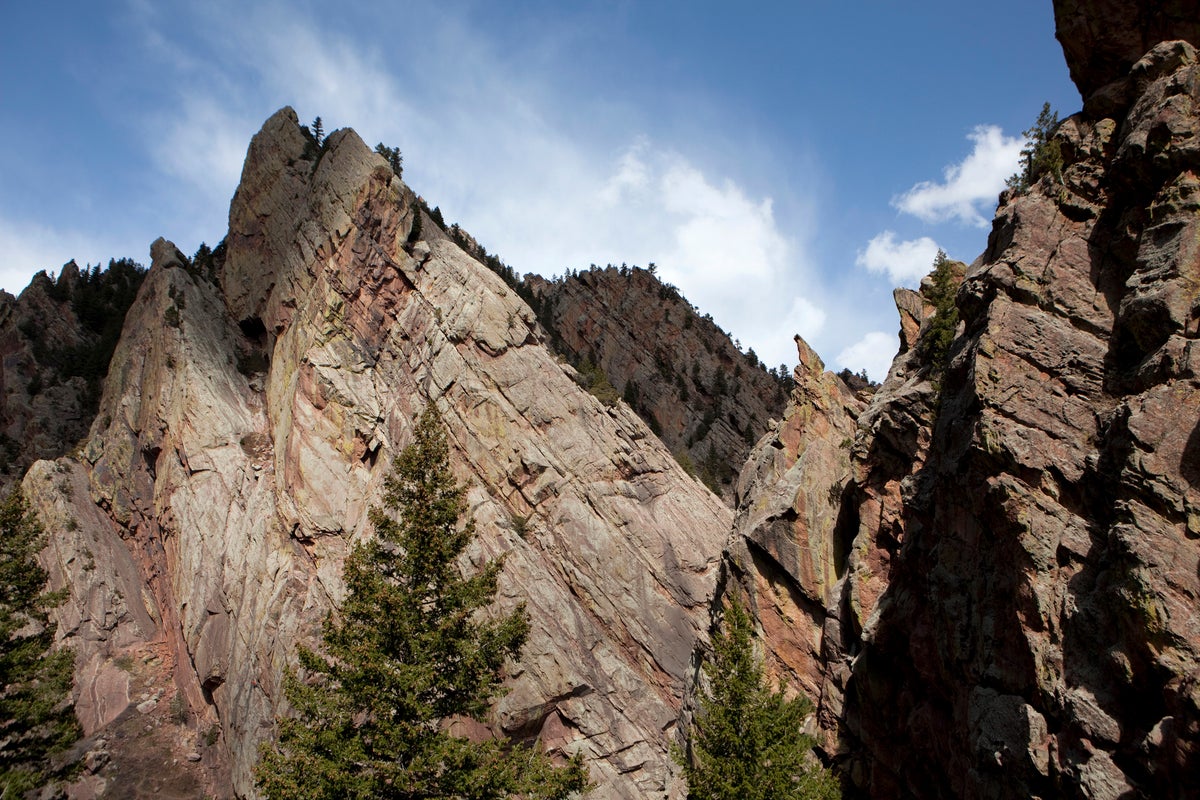
On Sunday, November 2, Greg “Grug” Cameron and Dean Brubaker hiked to the West Ridge in Eldorado Canyon State Park for a day of trad climbing. After climbing and descending Xanadu (5.10a), the pair racked up below the popular three-pitch route Chockstone (5.10a). Brubaker led the first pitch and Cameron, a 69-year-old climber with first ascents across North America, led the second. Cameron took a fall early on the pitch, his gear held, and he continued to the anchor.
As he neared the top of the pitch, around 2:18 p.m., he moved over an arete feature, stepping right toward the anchor. Then Cameron fell. When he whipped, his rope grated against the arete and completely severed. Cameron crashed through a 15-foot pine tree, taking an approximately 70-foot ground fall. Broken branches and a couple of feet of rope laid over him with a cut sheath and core fibers exposed.
Karl Manteuffel heard the fall while leading Xanadu, 100 feet away. Manteuffel’s partner yelled at him to place gear and lower. The pair ran over to help with the triage. They called 911 at 2:23 p.m. A party of three other climbers who had been climbing on the closer Purple Haze (5.9) were already helping at the scene, propping Cameron up. As per the 911 officer’s instructions, they began administering CPR to help Cameron’s labored breathing. Within 34 minutes, Search and Rescue personnel arrived to help evacuate Cameron, who was taken to Boulder Community Hospital and then to the Surgical Intensive Care Unit at Denver Hospital to treat his broken femur, fractured pelvis, and brain bleeds. The community has rallied to support Cameron in his recovery.
“The accident showed me that climbers, including myself, don’t often think about their rope getting cut, but under the right forces it can happen,” said Manteuffel.
Analysis
Cut ropes are rare, but they do happen. This isn’t the first time a rope has cut on Eldorado Canyon’s rough conglomerate sandstone. In 2010, Joe Miller fell on the second pitch of the Yellow Spur (5.9). A couple of Miller’s pieces pulled and he pendulumed, causing his rope to drag over a knife edge. The rope severed and Miller took a deadly ground fall. Rocky Mountain Rescue Group (RMRG) did an extensive analysis of the accident in March 2011, testing falls in a lab as well as attempting to recreate the fall on the route. RMRG came to the following conclusion at the time:
First, lead climbers should attempt to visualize the geometry of a potential fall past a ledge. They should also consider whether a potential pendulum effect may result in a tensioned rope moving laterally across the edge. Second, climbers should consider how that geometry could differ given the failure of any piece(s) of protection along the route, possibly leading to the rope coming in contact with nearby sharp edges that may not be directly in line with the initial fall. In some cases, hazardous situations might best be managed by altering the route in order to avoid the area or even by backing off the route.
The RMRG analysis provides helpful insight. Many first ascentionists consider where the rope lies when bolts are clipped but often in traditional areas, features are climbed over and ropes can be cut even on relatively smooth rock.
In 2013, while laybacking the outside of the Harding Slot on Yosemite’s Astroman (5.11c), I fell and my rope grated over the relatively rounded edge of the crack, wearing through the sheath, exposing and abrading the core. A few days later, I fell laybacking the Scotty Burke Offwidth on The Freerider (5.13a). The rope grated against the rounded edge of the crack, wore through the sheath, exposing and abraded the core. To avoid the rope cutting, I started climbing inside of offwidths. Better to grovel than to die. But changing climbing style isn’t always a possibility. In 2017, Michele Caminati fell on the Gritstone testpiece Elder Statesman (HXS 7a), severing his rope on the sharp arete.
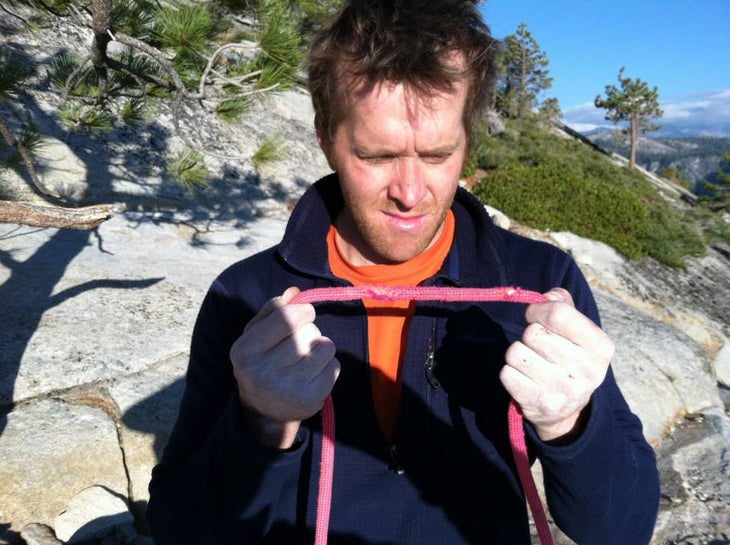
In 2015, during a Swiss guide training, two climbers were lowered on a single 8.7mm rope. The rope slid sideways on an edge and cut. The climbers survived, but the accident prompted criticism from other guides and rope companies. Edelrid began testing how ropes could cut in a fall over an edge.
In an article about the cut resistance of ropes, Edelrid noted that, since 1963, no recorded accident occurred when “a rope failed due to too many taken falls.” They came to the conclusion that rope diameter makes less of a difference than the loaded weight on the rope. Altering your weight as a lead climber is an unlikely and not-recommended solution for increasing your rope’s lifespan. A better idea may be what Steve McClure did on the first ascent of Elder Statesman’s rope-cutting prow: Use multiple ropes. (In McClure’s case, he used three.)
Ropes rarely break, but they do cut. Edelrid and Mammut have both invested in creating ropes with greater abrasion resistance, which should in theory reduce the odds of complete rope failure. However, like the RMRG suggested, awareness of sharp edges on the wall is most important.
The post Analysis: Colorado Climber Survives 70-Foot Ground Fall After Rope Cuts appeared first on Climbing.