 BURST
BURST
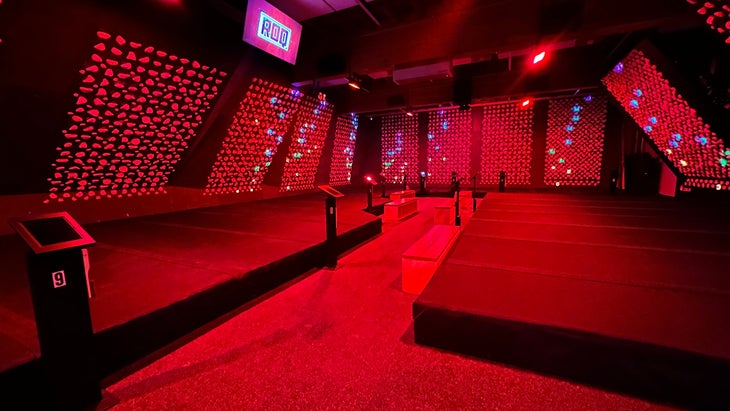
As the lights dim, the glow of multi-colored LEDs from 14 Kilter Boards illuminates the room. With the music bumping, a coach counts down through her headset: 3-2-1. Two other climbers and I hop off the Kilter Boards, as the next group of three jumps on.
This might sound like climbing competition meets nightclub, but in fact, it’s a gym called ROQ that’s reimagining the training experience for climbers. Inside this Seattle-based gym, Kilter Boards fill two-thirds of the 4,500-square-foot space. Training equipment fills the rest of the gym. Established this past January, ROQ offers climbing-focused workout classes.
What does a HIIT climbing class look like?
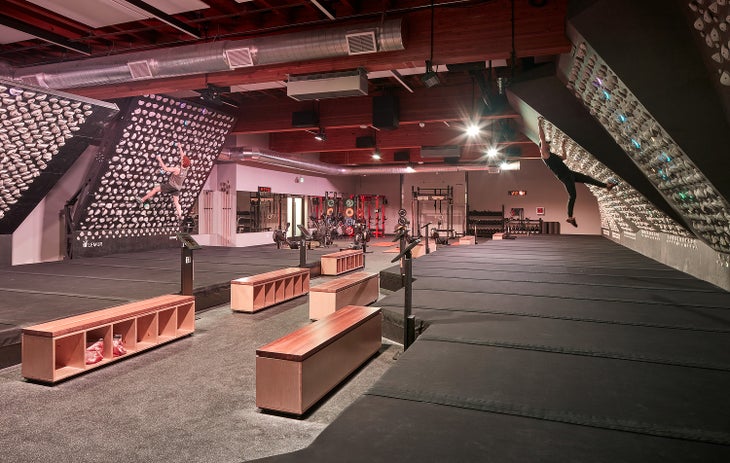
Founder Michael Hauss’ idea to combine climbing with HIIT was inspired by boutique gyms, like Orangetheory Fitness and Barry’s, which are popular for their instructor-led workouts that foster motivation, accountability, and community. ROQ’s hour-long Flagship Class includes 40 minutes of climbing, 10 minutes of rowing, and 10 minutes of strength training.
As an experienced climber himself, Hauss created ROQ HIIT climbing classes to fill the gaps that he saw in traditional climbing gyms. Newer climbers may feel overwhelmed with the vague and self-directed nature of climbing gyms. Meanwhile, he felt that more experienced climbers struggle to stay consistent with their own training plans without adequate space and motivation.
Developed by professional climber and coach Matt Fultz, the training program focuses on climbing-specific High-Intensity Interval Training (HIIT). The workouts are designed to build capacity, or the ability “to recover between intense efforts.” In his decade and a half of coaching, Fultz has seen how interval training leads to “a lot more quality attempts on your project,” and ultimately more sends.
My experience with a ROQ HIIT climbing class
After hearing about the structured coach-led classes at ROQ on the Climbing Business Journal podcast, I wanted to try it out. I’ve been climbing for nearly 10 years, progressing from indoor toproping to outdoor sport and trad climbing. But admittedly, I have little experience in training plans aside from the Power Company’s “Climb 5.12” e-book.
Knowing that my climbing would benefit from board training, I’ve tried various boards, including Kilter, but have never found a way to stay engaged with this type of climbing. Could a ROQ class get me stoked on Kilter Boarding?

Last month, I tried two Flagship classes: one focused on “Capacity and Technique” and the other on “Power and Strength.” Before each class, the coach helped us select a Kilter Board angle (ranging from 0-70 degrees) and a curated playlist of problems that matched our climbing ability.
We started and ended the class with 20 minutes on the boards, alternating between one minute climbing and one minute resting. The climbing drill was determined by the focus of the class—either climbing slowly on easier grades, or explosive movement on harder grades. In between the two blocks of climbing, we rotated through rowing and floor exercises, such as overhead press, seated leg lifts, and push-ups.
In the three ROQ classes that I’ve taken so far, I’ve tried more Kilter problems than I have in the past six months. It’s hard to say whether my climbing capacity or technique have improved. However, I can definitely see the appeal of showing up to a class and bashing out 15 problems in an hour. I found the strength and rowing portions particularly useful, since I often neglect these types of exercises. The coaches were great at creating an environment where I felt motivated to try hard. That said, I was hoping for more feedback on my climbing than what the ROQ coaches offered.
What climbers think about ROQ classes so far
Since opening, ROQ has seen the most interest from “people who have some climbing experience, but whose max V grade is V1 to V3,” Hauss told me. There’s also a significant portion of people trying out ROQ who have never climbed before. Nicole Zielinski, who has tried climbing, but doesn’t climb consistently, said the ROQ class felt less intimidating than visiting other climbing gyms.
More experienced climbers thought the classes were fun, but had no plans to trade their traditional climbing gym membership for one at ROQ. Christian Owen, who has been climbing indoors and outdoors for eight years, thought the “HIIT cross-training could benefit [his] overall routine.” But Owen didn’t want to give up aspects of a traditional climbing gym that ROQ doesn’t provide, such as corner climbing or the mental aspect of lead climbing.
Another climber with 20 years of experience in everything from alpine routes to indoor board climbing appreciated not having to plan her own workout or compete for space on the wall. But she observed: “I’m not really sure it is that effective for training the type of outdoor climbing I want to do.”
For both of these more experienced climbers, the cost of ROQ classes was difficult to justify on top of their existing gym membership. A drop-in class at ROQ costs $39 and memberships range from $119 to $299 a month. In addition to classes, visitors and members have access to open gyms, where they can use the Kilter Boards outside of class hours, and saunas located in each locker room.
ROQ also provides a free intro class for everyone to learn the format, and to teach new climbers how to use the boards safely. After that, you can opt for the “Foundations” class, which follows the same format as the Flagship but with longer transitions and more demonstrations. Or you can choose from three types of Flagship classes: Strength and Power, Capacity and Technique, and Power Endurance.
Some climbers have criticized ROQ for being an example of the increased corporatization of climbing, but Hauss disagrees, calling his gym “the definition of [a] small business.” His goal with ROQ is to experiment, innovate, and “bring climbing forward,” and he hopes that climbers will be more curious to try out the new concept.
As the sport continues to expand beyond its outdoor roots, many climbers these days have no intention of climbing outdoors. By creating a boutique fitness climbing experience, Hauss hopes to bring climbing to new people. Nearly 40 years ago, people were certainly dubious when two climbers glued rocks onto plywood and created Vertical World, the first indoor climbing gym in the U.S. right here in Seattle. In the same city, ROQ is now exploring what the next evolution of indoor climbing could look like.
The post In a Training Rut? These New HIIT Climbing Classes Are a Game-Changer. appeared first on Climbing.