 BURST
BURST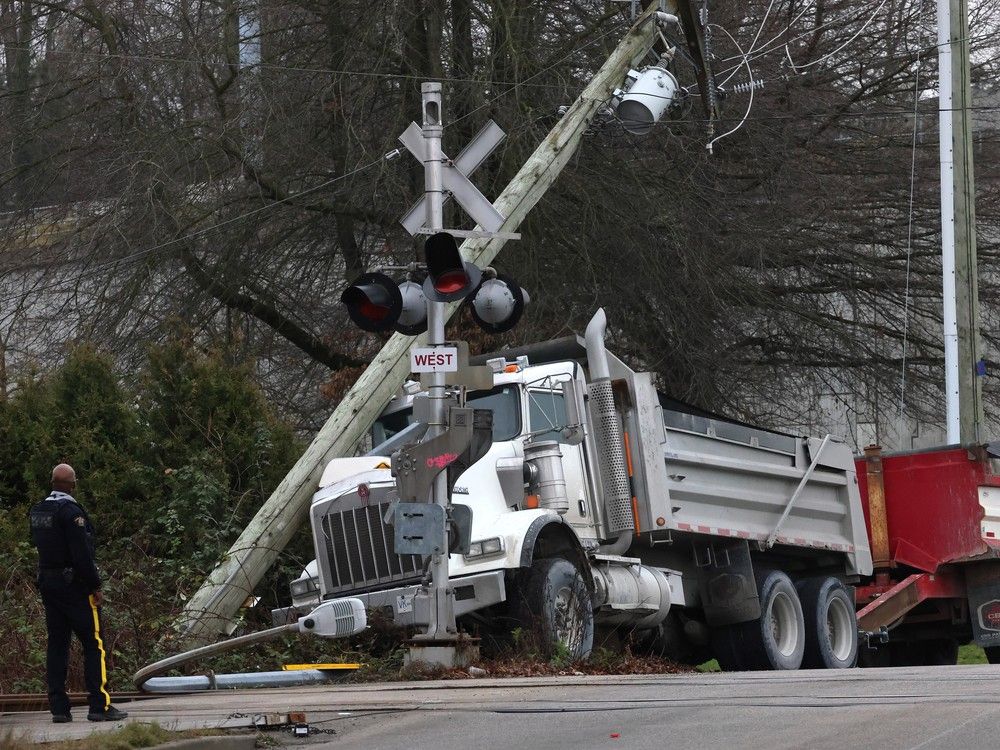
On Jan. 13, 2025, just after 1 p.m., a dump truck crashed into a lamp post and a telephone pole on Boundary Road near Myrtle Street, just after passing underneath Highway 1.
The day was cool and cloudy, with no rain.
The steel lamp post was bent at a 90-degree angle and the wooden telephone pole was leaning into the hood and cab of the dump truck, which was carrying another dump box on a trailer.
RCMP said it was extremely lucky nobody was hurt as the truck was travelling downhill with ineffective brakes.
The driver was handed 10 motor vehicle violation tickets and the dump truck and trailer were issued a notice ordering the equipment off the road until it was fixed and met Motor Vehicle Act standards.
The driver’s violations included failing to ensure the vehicle was in safe operating condition, failing to comply with trip inspection requirements, and exceeding the axle weight of both the truck and the trailer.
The violations typify those that the RCMP, municipal police forces and the province’s commercial vehicle safety enforcement officers find in road-side inspections.
In the past several years, these road-side operations have put more than half of the trucks checked off the road because their safety and mechanical violations were significant.
Annual numbers for 2025 posted recently by the Burnaby RCMP for the Lower Mainland showed that of 2,901 trucks inspected, 1,610 were ordered off the road . They found 3,661 violations.
Normally, the drivers and companies are handed fines, which can run into the thousands of dollars.
But truckers who follow the rules say that B.C. needs to do more than that, including taking away licences and seizing vehicles of bad operators.
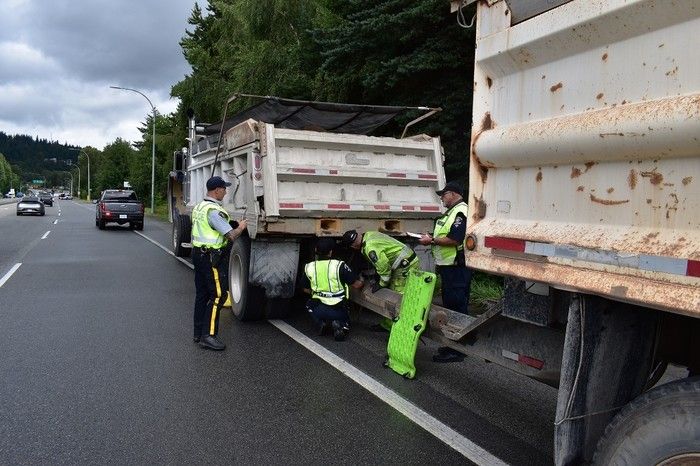
Dave Earle, president and CEO of the B.C. Trucking Association, says B.C. has among the most onerous heavy commercial vehicle regulations in the country, mandating inspections every six months for heavy commercial vehicles at an approved facility. That includes vehicles such as dump trucks and large trucks and trailer rigs.
“How is it possible that a dump truck shows up at a spot inspection and it’s rusted through? That didn’t happen three weeks before. How do you have a truck that shows up on bald tires? How does it happen? I can tell you how it happens. They’re not being inspected,” asserted Earle.
He said that at the same time that commercial vehicle inspectors can be sticklers on items such as measuring the width of dual tires and ordering a truck off the road if it is a little bit out, they are not going after bad operators that fold one company and start another, that hire temporary foreign workers and put them into “forced servitude,” or that run two or three different electronic logging devices to falsify working hours.
He also pointed to a model being used by some trucking outfits known as Driver Inc. , which involves misclassifying drivers as personal services businesses to avoid payroll taxes, and which leads to safety failures.
“Until we get serious and prevent these idiots from running, this is what we’re stuck with,” said Earle. “I’m beyond frustrated.”
Trucks ordered off roads in Lower Mainland
The number of trucks that were ordered off the road in the past five years in the Lower Mainland for issues such as unsecured loads, inadequate brakes or poor tires is eye-popping.
Just over 10,700 commercial vehicles were pulled off the road — everything from smaller box trucks to big rigs — with more than 6,100 of them ordered out of service, according to RCMP figures compiled by Postmedia.
That’s a 57 per cent rate over the five years.
The picture for road-side inspections carried out by the province’s commercial vehicle safety enforcement officers is also stark.
In 2025, of the 29,500 commercial vehicles pulled over for a closer look in B.C., only 1,800 passed inspection, according to figures from the B.C. Ministry of Transportation provided to Postmedia.
That’s just six per cent.
Of the commercial vehicles pulled over, 10,800 were taken out of service until repairs could be made, and another 16,900 vehicles were identified with less-serious violations requiring repairs.
But the ministry said those numbers don’t reflect the performance of the entire trucking sector because officers intentionally pull over vehicles with signs that show they may require closer inspection.
There are about 37,000 carriers who hold an active safety certificate in B.C., operating approximately 160,000 commercial vehicles, according to the ministry.
But not all of those are heavy vehicles such as tractors pulling trailers, flat-decks, dump trucks or buses.
Those account for about 70,000 trucks in B.C., according to ICBC data .
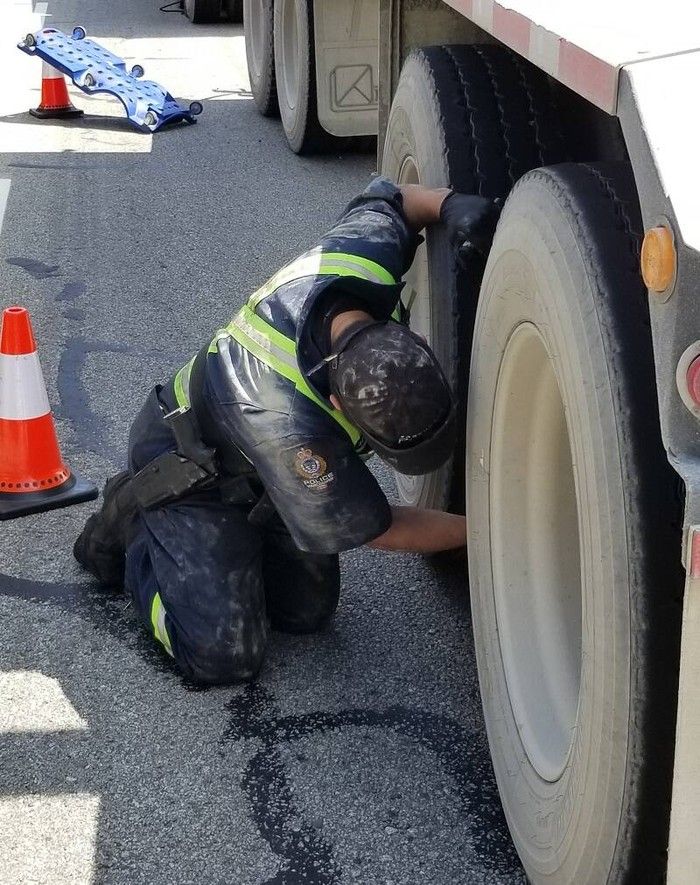
“The Ministry of Transportation and Transit does have concerns when enforcement activities result in a high number of failed inspections. However, (the commercial vehicle safety enforcement division) knows that statistics resulting from these targeted enforcement operations are not representative of the whole industry,” said the ministry in an email sent by public affairs officer Murray Sinclair.
The ministry did not make anyone available for an interview.
The ministry noted there is a range of actions they can take besides fines that include warning letters, safety-plan self-assessment letters, compliance reviews, or audits. Those steps may lead to further enforcement actions, including a suspension or cancelled national safety certificate halting the trucking company from operating in B.C.
Provincial figures show that between 2023 and 2025, 58 commercial trucking firms had their certificates cancelled for cause .
The province doesn’t list the specific reason why the certificates were cancelled.
The ministry also pointed to stiffer fines it has introduced, partly in response to trucks with higher than normal loads crashing into 90 bridges and overpasses in the last four years. That includes penalties as high as $100,000 for commercial truck drivers involved in the bridge and overpass crashes, and up to 18 months imprisonment.
The transport ministry also said it monitors inspection facilities — and pulls their designations if they find problems such as repeatedly not meeting inspections standards or “integrity” issues such as knowingly approving unsafe vehicles.
B.C. has about 2,100 licensed private commercial vehicle inspection facilities , of which about 1,200 can carry out heavy vehicle inspections.
Typically, these are auto repair shops.
Between 2021 and 2025, 116 inspection facilities that deal with heavy trucks lost their designations, according to ministry figures provided to Postmedia.
Wheels come off dump truck
Still, commercial vehicles continue to fail road-side inspections.
The number of vehicles being ordered off the road for issues like insecure cargo and inadequate brakes was so high that police forces in the Lower Mainland started banding together five years ago to coordinate their enforcement efforts and beef-up specialized training.
“It was a seriously concerning trend for such a dense urban area,” said Burnaby RCMP Cst. Kevin Connolly, the city’s designated commercial vehicle inspector, who helps lead the effort in the Lower Mainland.
There are now 12 policing, bylaw and provincial agencies involved, up from four in 2021, he noted.
Why the number of failed road-side inspections remains so high is difficult to pinpoint, although Connolly believes it is starting to come down, and will continued to do so slowly over time.
He said it is difficult to draw conclusions on the larger trucking population based on their spot checks, but he noted they do pull vehicles over randomly.
Connolly has been tracking the top reasons why commercial vehicles are put out of service in Burnaby, and No. 5 is because the vehicles have not kept up with their required annual or semi-annual inspections at designated facilities.
He said they saw one truck last year that hadn’t been inspected for four years.
And some are getting into the industry and simply not getting inspected as required, said Connolly.
The other top issues include, at No. 1, a defective motor vehicle because of issues such as inoperative breaks, burned-out rear-turn signals and brake lights, tires that are close to rupturing, and other equipment issues such as steering, noted Connolly.
The second-most frequent issue is insecure cargo, and the third is moving violations such as disobeying signs, running a light or unsafe lane changes.
The fourth-most frequent issue is related to pre-trip inspections that must be filled out in a log.
Connolly remembers the incident from 2025 when the dump truck crashed into the telephone pole on Boundary Road.
He said if the driver had carried out the required proper pre-trip inspection, the safety issues could have been identified.
The pre-trip inspections include checking brakes, lights and tires.
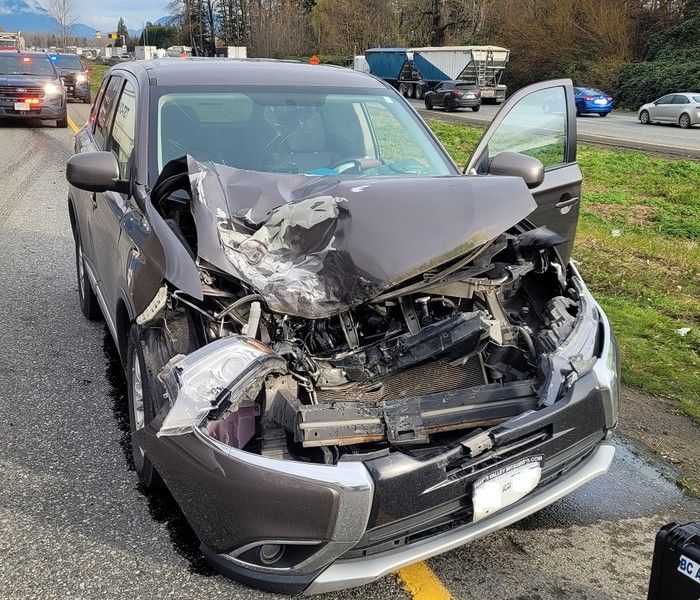
The work to increase trucking safety came as little comfort to a woman whose SUV, in 2024, was hit on the passenger side by one of two tires that came off a dump truck on Highway 1 in Abbotsford.
RCMP-led road-side checks outside the Lower Mainland also show high numbers of commercial vehicles being ordered off the road for issues such as inadequate brakes, badly worn tires, leaking fluids, burned-out lights, problems with break-away cables that secure loads in emergencies, expired commercial inspection labels, and inadequate or falsified log books that track working hours and rest time.
“The driver of the SUV was really shaken up, as you can imagine, and that’s not something that we can allow to happen without serious consequences,” said Cpl. Michael McLaughlin, a spokesman for an RCMP unit that polices provincial highways.
The driver of the truck that lost its two wheels was handed a $707 fine.
Neither the driver nor the company was named — and so it is not possible to know if the trucking company or driver were subject to further consequences.
That’s the same for the dump truck that crashed into the telephone pole in 2025, as well as for an investigation in 2024 that took down a facility that was handing out fraudulent commercial vehicle inspection certificates in Chilliwack.
The RCMP said they could not release the names of the companies or people involved.
The investigation in Chilliwack led to 250 orders and 750 violation tickets issued, 1.5 kilograms of fentanyl and methamphetamine seized, $100,000 in stolen property recovered, and two firearms seized and traced to trafficking operations.
Two Chilliwack RCMP officers and a provincial commercial vehicle safety enforcement officer were recognized in 2025 for the investigation , receiving the B.C. Association of Chiefs of Police traffic safety team award.
Earle, the president of the B.C. Trucking Association, would like more information to be released to the public on trucking safety records.
“We’ve been asking for over a decade that the detailed carrier profiles be available online,” said Earle. “It gives every inspection, every interaction, every violation, every ticket, all of it, right across North America.”