 BURST
BURSTThe former head of NASA is questioning the agency's plans to return astronauts to the moon, asking whether the crewed landers selected for the Artemis program are the right vehicles to get the job done.
Jim Bridenstine, who served as NASA administrator during President Donald Trump's first term, joined Space.com's Tariq Malik and co-host Rod Pyle on the This Week in Space podcast on June 12 to discuss his recently appointed position as CEO of Quantum Space and current events in the space industry. During the show, Bridenstine voiced skepticism about the architecture of NASA's Artemis moon landers, both of which are trailing in development compared to the Orion spacecraft with which they're being designed to fly.
"The architecture is extraordinarily complicated," Bridenstine said. He compared the Artemis plan unfavorably to NASA's approach during the Apollo program, which he argued was much less complex.
"They designed that thing to be as simple as you could possibly make it, and because of that they were able to land on the moon eight years after John F. Kennedy declared that we were doing it," Bridenstine said of the Apollo architecture.
NASA has contracted both SpaceX's Starship and Blue Origin's Blue Moon to be the crewed lunar landers for the Artemis program, and plans to use one of them to perform the first Artemis moon landing in 2028, on the Artemis 4 mission. That's a tight timeline for SpaceX and Blue Origin, whose spacecraft have faced ongoing delays in their development.
Neither lander has managed to make it to orbit yet, and both have a number of qualification tests to accomplish before NASA will certify the vehicles to fly with astronauts aboard, including uncrewed lunar landing demonstrations. For some development perspective, Bridenstine brought up NASA's Space Launch System (SLS) rocket, which, though also severely delayed for years leading up to its debut, managed a completely successful mission right out of the gate. "The first time SLS launched, it was rated for crew, and it was ready to go to the moon on the first launch. That's hard to do, and yet it did it," he said.
"This is the challenge," Bridenstine said. "We still don't have a lander, and without a lander, you can't land on the moon. It's really that simple, and I worry that over time that's going to come back and bite us."
During NASA's Apollo missions to the lunar surface in the 1960s and '70s, the Saturn V rocket launched the astronauts aboard their return capsule, with their moon landing vehicle stowed beneath. In contrast, NASA's Artemis missions, which launch Orion on SLS, require separate launches on different launch vehicles to get the moon landers off Earth.
"The genius of Apollo was its simplicity," Bridenstine said.
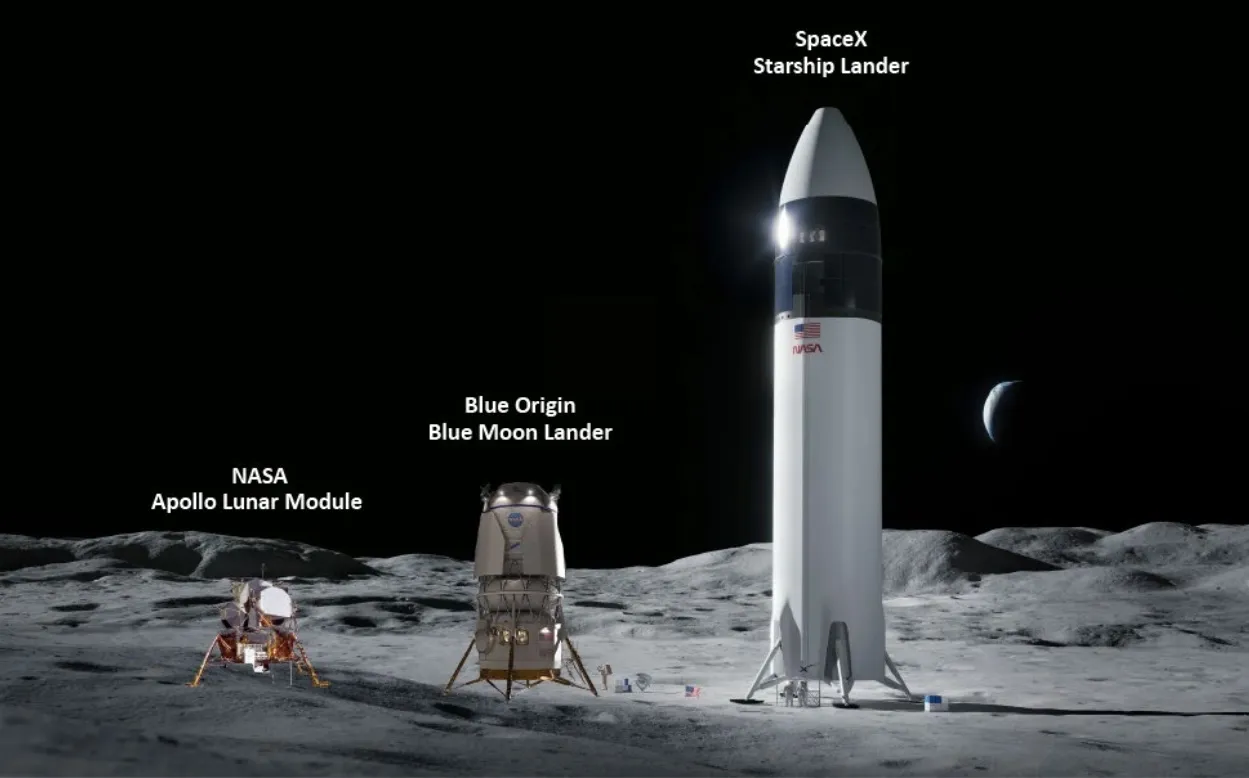
The architecture for the Artemis missions is much more complex. Starship and Blue Moon will both require refueling flights in order to land astronauts on the lunar surface and then launch them back to orbit around the moon to rendezvous with Orion. The exact number of refueling flights for each lander is unknown, but a recent report from NASA's Office of Inspector General estimated Starship will need at least 15 additional launches to replenish its tanks enough for a full lunar landing mission.
Ahead of the planned Artemis 4 landing, NASA will launch a practice run with Orion and both of the two landers in low Earth orbit (LEO) in mid-to-late 2027. That mission, Artemis 3, will see the astronauts rendezvous and dock with both landers over the course of about two weeks. According to NASA's current plan, Artemis 3 astronauts will have the opportunity to board Blue Moon during their mission, but Starship will fly with a docking adapter only, and not a functional crew cabin — a likely sign of Starship's development progress, and what NASA expects of the spacecraft's capabilities within the next year.
NASA had previously tapped Starship as the lunar lander for Artemis 4, but its performance, as well as Blue Moon's, during Artemis 3 could possibly spur a change in that decision. The agency already voiced dissatisfaction with Starship's development last year, when it announced the possible reopening of the Artemis 3 lander contract due to SpaceX delays. "They're behind," Sean Duffy, who was then NASA's acting administrator, said at the time. "They've pushed their timelines out, and we're in a race against China."
Bridenstine voiced a similar sentiment. "Whatever it takes to build a lander soonest is what we ought to be doing as a country," he said.