 BURST
BURST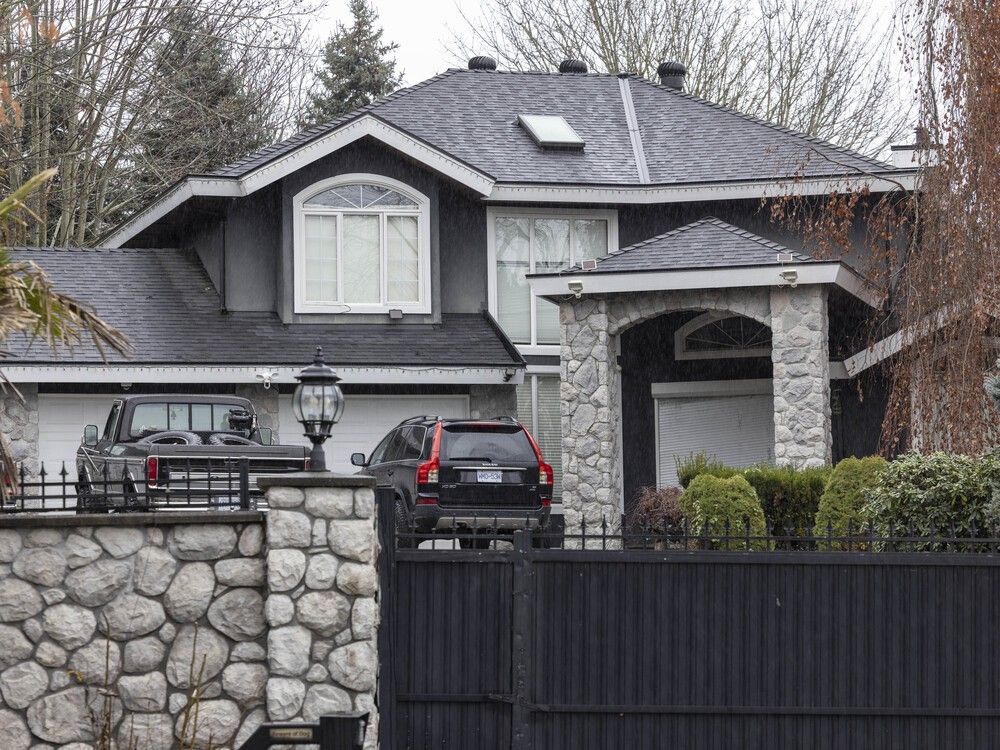
A Surrey man who police allege has links to former Sinaloa cartel boss Ismael (El Mayo) Zambada wants to delay the civil forfeiture trial brought by the B.C. government, slated to start in two weeks.
James Sclater said in his application for an adjournment that the director of civil forfeiture expanded the allegations against him in an amended statement of claim filed just last month.
The new claim not only alleges that Sclater and associates Hector Chavez-Anchondo and John Whalen made arrangements with Zambada to smuggle cocaine to Canada, but also says that police were intercepting their communications and watching them.
The government wants two Surrey houses owned by Sclater, worth almost $4 million, forfeited as proceeds of illicit activity.
Sclater, Chavez-Anchondo and Whalen were arrested in September 2024 at one of Sclater’s residences, in the 16700-block of 77th Avenue. The RCMP announced at the time that officers seized 23 firearms, ketamine, methamphetamine, fake Xanax pills and 810 oxycodone pills inside the house.
None of the three men have been charged and Sclater denied all the allegations in his statement of defence.
Sclater’s lawyer, Joshua Wandler, said in his July 15 adjournment application that the director added “material facts” about the RCMP investigation, known as Eprotest, on the eve of the trial.
Wandler said that he unsuccessfully requested the forfeiture agency director to get the RCMP’s “authorizations through which the private communications were intercepted, the intercepted communications themselves and the balance of the investigative materials relating to the Eprotest investigation, without requiring a production application, given the proximity of the amendment to the scheduled trial.”
Sclater’s July 15 filing also said that earlier in the month the director “indicated for the first time … that they intend to call an undercover officer” who is expected to testify about “interactions with the defendant Sclater between the end of 2021 and the middle of 2024, which includes Sclater’s participation in illicit activity.”
Without additional disclosure, Sclater “has no meaningful way to determine whether his private communications were obtained in breach of his Charter rights,” Wandler said. “Likewise, without the intercepted communications themselves and the balance of investigative materials related to Eprotest, the applicant has no meaningful way of testing the viva voce evidence given by the director’s police witnesses.”
Sclater’s application is set to be heard in B.C. Supreme Court on July 28.
Zambada, who founded the Sinaloa cartel with Joaquin (El Chapo) Guzman, was arrested in July 2024 by U.S. authorities. On Monday, Zambada was sentenced in a New York courtroom to life in prison after pleading guilty. He was also ordered to forfeit $15 billion U.S. in drug profits.
His arrest disrupted the cocaine importation plans of Sclater’s drug gang, the B.C. forfeiture director’s statement of claim alleged.
“Mr. Sclater and his drug trafficking organization renegotiated the importation and transportation of cocaine into Canada with other unidentified parties that are only known to Mr. Sclater,” it said.
“Over the three-year investigation, Mr. Sclater and his drug trafficking organization sought to import upwards of 1,000 kilograms of cocaine from the Sinaloa cartel.”
Sclater was also a target of an earlier drug trafficking investigation dubbed Eprobang, which began in 2014, the statement also said.
While Sclater was not charged, some of his alleged associates were both charged and convicted.
Police searched the 77th Avenue house in 2016 and found 12 rifles, four shotguns, a deactivated grenade and other weapons, as well as “various pills containing fentanyl,” score sheets of alleged drug transactions, a money counter, a vacuum sealer and a wiretap detection kit, the director said.
Blueksy: @kimbolan.bsky.social
Related
