 BURST
BURST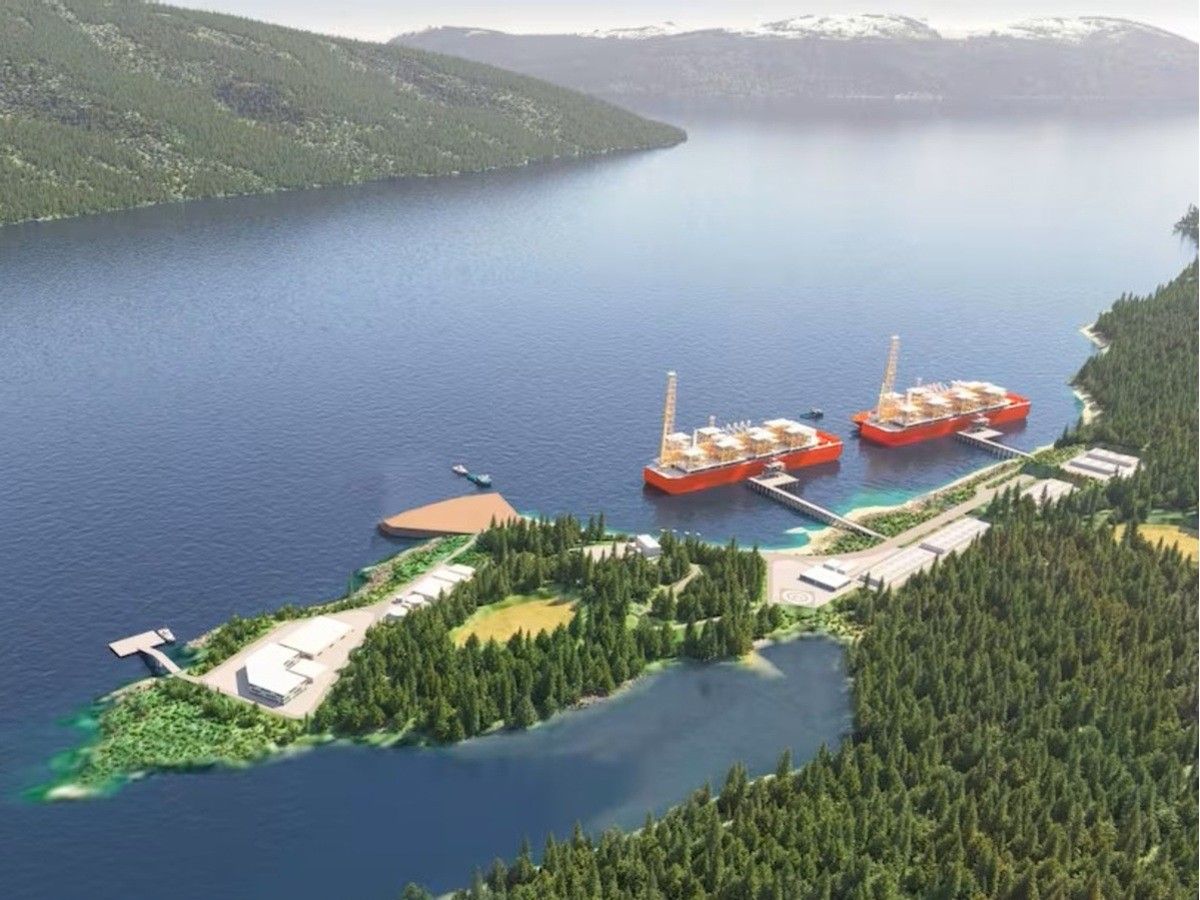
An initial agreement between the Ksi Lisims liquefied natural gas project to supply a German state-owned gas utility signed Wednesday was a first for the B.C. development, but likely won’t be the only one between it and a European customer.
European customers would not likely take direct delivery of LNG, but use it to trade with Asian importers that have contracts from suppliers closer to Europe, an increasingly common arrangement and a sign of how interested countries are becoming in shoring up stable supplies .
“What has opened up, what has changed for us, is maybe not the agreement itself, but the conditions that we’re operating in,” said Ksi Lisims spokesperson Rebecca Scott.
Those conditions, starting with the war in Ukraine that first cut off natural gas supplies to Europe, and continuing with the U.S.-Israeli conflict with Iran that has shut off LNG from the Middle East , have “created this environment of a new emphasis on the need for energy security,” Scott added.
Ksi Lisims and the utility Securing Energy For Europe signed an agreement that will see them negotiate terms for sales of up to one million tonnes per year of LNG from a yet-to-be-built terminal over a 20-year term, starting in the early 2030s.
The important part for Securing Energy For Europe was an arrangement to take LNG shipments on a free-on-board basis, which gives the utility “the flexibility to deliver cargoes to any destination, thus enhancing the resilience and diversification of our portfolio,” said Securing Energy For Europe CEO Egbert Laege.
That means Securing Energy For Europe will be free to trade to swap contracts for LNG with Asian importers that are closer to Ksi Lisims, and take supplies closer to Europe, according to energy analyst Alex Munton.
Munton, director of global gas and LNG research for Rapidan Energy Group, said free-on-board status doesn’t need to be more complicated than saying, “You give me yours, and I’ll give you mine,” in an agreement.
Securing Energy For Europe would be free to sell as much volume and for whatever length of time it wants to meet its needs, Munton said.
LNG projects need long-term sales contracts with customers to secure the financing needed to build multi-billion-dollar production facilities, but Munton said it isn’t uncommon for customers to enter into swaps.
The Indian utility firm GAIL Gas, for instance, has used swaps to trade LNG that it signed contracts to buy from U.S. suppliers that are “literally on the other side of the planet” from India.
“As the market has evolved, they’ve been able to enter into these swap arrangements with other companies,” Munton said.
He added that the deal with SEFE raises the profile of B.C. projects among other large European utility purchasers, which might be interested in striking similar deals.
“It clearly demonstrates the sort of breadth of potential interest,” Munton said. “It’s not just an Asian project.”
Scott, at Ksi Lisims, said “we expect more interest and our supply to go to Europe,” among the sales agreements that it has in the works.
“The way the industry works nowadays is less of Point A to Point B shipping and more of an integrated matrix model,” Scott said.
So, taking delivery of LNG and working with other importers to calculate which one would be in the best position, economically, to buy it.
“I think what we’re just seeing here with this deal is the market has changed drastically over the last few years, but especially in the last few months,” Scott said. And Canada is seen as a stable potential supplier.
The Ksi Lisims project still faces concerted opposition, including a legal challenges by First Nations over impacts of its associated pipeline.
However, Munton said what the Securing Energy For Europe deal also accomplishes is reignite momentum for the Ksi Lisims project, which still hasn’t reached a final investment decision
Ksi Lisims is a consortium of Houston-based Western LNG along with the Nisga’a Nation and Rockies LNG Partners, which are joint owners of the proposed Prince Rupert Gas Transmission pipeline that would supply a floating LNG production facility north east of Prince Rupert on the B.C. Coast.
“There’s been a long gap between (Ksi Lisims) last sales deal that was announced,” Munton said. “So now we’ve got another deal.”
Scott said the non-binding deal with Securing Energy For Europe for one million tonnes per year is on top of contracts it has with Shell subsidiary Shell Eastern Trading and Total Energies to buy two million tonnes per year each, “so close to 50 per cent.”
“We’d like to see sales get more around the 70 to 80 per cent mark before we make that final investment decision,” Scott said.
Scott added that Ksi Lisims is in “very advanced stages” of negotiating other sales agreements “so we’re very confident that we’ll be in that position this summer.”