 BURST
BURST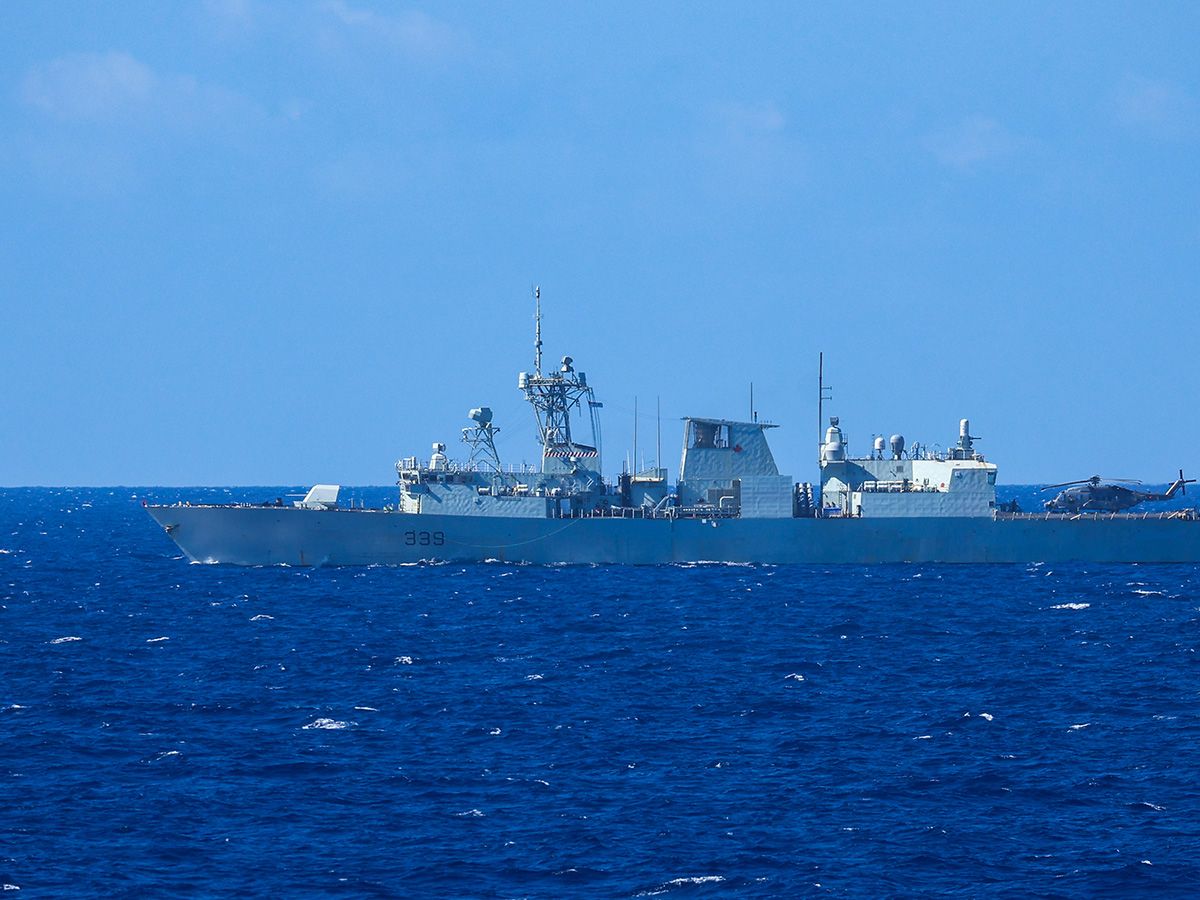
China has issued a strongly worded response after a Canadian warship transited the Taiwan Strait, accusing foreign countries of undermining its sovereignty and security “in the name of freedom of navigation.”
HMCS Charlottetown passed through the 180-kilometre-wide waterway, which separates mainland China from the island of Taiwan, on May 22 and 23 as part of a routine operation, the DND told National Post. The passage was made without any allied ships in tow.
“China respects the right of navigation that all countries are entitled to under international law, but firmly opposes acts that undermine China’s sovereignty and security in the name of freedom of navigation,” Chinese Foreign Ministry spokesperson Mao Ning said on Friday.
Chinese ambassador to Canada Wang Di also said that sending warships through the Taiwan Strait “violates China’s territorial integrity.”
Marine tracking data suggests the Canadian naval vessel passed through the strait on its way to the Sea of Japan after plying the South China Sea near Vietnam. The crucial choke point connects the South China Sea to the East China Sea and handles about one-fifth of global maritime trade.
Days before the vessel’s crossing, Conservative Foreign Affairs Critic Michael Chong travelled to Taiwan to meet with President Lai Ching-te, whom China refers to as a “separatist.” Chong told National Post following the visit that it was meant “to make a statement” after China’s ambassador to Canada warned parliamentarians against visiting Taiwan.
Taiwan is claimed by China as part of its territory but has operated as a de facto independent state since 1949. President Lai has said he would not provoke China while noting Taiwan would not give up its “free way of life under pressure.”
Canada has had no formal diplomatic ties with Taiwan since 1970.
“The Taiwan Strait is an international waterway, and all countries enjoy the right of freedom of navigation,” Taiwan’s defence ministry said in a statement to Reuters. The ministry added that it “closely monitors relevant developments through joint intelligence, surveillance, and reconnaissance mechanisms, but does not proactively disclose the movements of military vessels from allied nations.”
In light of the HMCS Charlottetown’s recent passage, Chong said it was important to show that individual nations do not control access to international straits. “After Beijing recently made an unreasonable demand that Canadian warships no longer transit the Taiwan Strait, the Canadian government had to signal that it wasn’t going to comply and exercise the Royal Canadian Navy’s right of transit passage,” Chong wrote in an email statement.
The warship departed its home port of Halifax in February “as part of Canada’s commitment to a free, open, and inclusive Indo-Pacific,” the DND said in a statement at the time. The frigate will showcase its “operational excellence and ability to project power across vast ocean spaces while working alongside Canada’s allies and partners,” it added at the time. It carries a crew of roughly 240 Royal Canadian Navy sailors and Royal Canadian Air Force personnel.
Canadian warships have transited the strait eight times since the navy launched its Indo-Pacific strategy in 2022. A Canadian warship last transited the strait in September, when it was accompanied by an Australian destroyer. China, which sees foreign military transit through the passage as a challenge to its claims over Taiwan, denounced the move at the time as a “provocation.”
China has stepped up land, sea and air military drills in the strait in recent years, including by carrying out shooting drills. During U.S. President Donald Trump’s visit to Beijing earlier this month, Chinese President Xi Jinping discussed U.S. commitments to Taiwan. The U.S., Taiwan’s chief ally, approved US$11 billion in arm sales to Taiwan last year, while another package worth at least US$14 billion has reportedly stalled, media reports last week said.
On Thursday, China’s Foreign Minister Wang Yi arrived in Ottawa for a three-day visit, the first bilateral visit of its kind in 10 years. It follows Prime Minister Mark Carney’s January signing of a new “strategic partnership” with China during a trip to Beijing, which signalled a diplomatic thaw and greater economic co-operation.
Wang pointed to a “turnaround” in China-Canada relations, which are now “improving and growing,” he said on Friday, Bloomberg reported. Foreign Minister Anita Anand said Canada aims to increase exports to China, it’s second largest trading partner, by 50 per cent by 2030.
Our website is the place for the latest breaking news, exclusive scoops, longreads and provocative commentary. Please bookmark nationalpost.com and sign up for our daily newsletter, Posted, here.