 BURST
BURST
Vancouver Coun. Pete Fry’s hope of demonstrating the city’s values with a largely “symbolic” banning of ICE agents from the city during this summer’s FIFA World Cup failed in council Wednesday, when his motion was ruled out of order.
He and fellow Coun. Sean Orr had put forward a motion to keep the controversial branch of the U.S. Department of Homeland Security from any involvement in the FIFA security operations during this summer’s soccer tournament, but it failed when meeting chairman Mike Klassen ruled it out of order. A challenge to the ruling fell 5-4 along party lines, with all five members of the ABC party voting against Fry, Orr and two others.
“It didn’t totally surprise me,” Fry said Wednesday afternoon. “It was somewhat disappointing, because I think it missed some of the nuance of the intent of the motion, which was to send a pretty clear signal. And I think the grounds under which it was ruled out of order was, in fact, inaccurate.”
The motion, had it passed, wouldn’t have been binding, but would have required Mayor Ken Sim to write the federal government with a request to bar any additional ICE officials from being sent to Vancouver during the tournament.
On Monday, Sim issued a news release saying that there was no indication that ICE planned to do so, and that they weren’t able to conduct any enforcement duties. Fry said he suspected the motion would fail after he heard that.
“It was in the back of my mind when the mayor had put out a press release. This is a classic sort of move that I’ve come to expect from the Mayor’s office to try and own things,” he said. “We see this all the time with non-ABC councillor member motions where they’ll figure out a way to strike and replace it.
“At this point, with the direction that we’ve seen the mayor give, there will be no overture to the federal government. There will be no information sharing that says City of Vancouver is strong advocates against the federal government granting permission for ICE to operate in our city … ICE cannot unilaterally deploy enforcement officers in the city of Vancouver, but (we) can request from the federal government to do so, and that was the entire gist of this motion, which was currently lost on Coun. (Brian) Montague et al.”
ICE has officers at U.S. consulates in Vancouver, Calgary, Montreal and Toronto, and the U.S. Embassy in Ottawa. They work for ICE’s investigations branch, whose mandate is to stop international crime before it makes it to the U.S. They work in conjunction with Canadian police, primarily sharing information about human and drug trafficking, financial fraud and weapons dealing, and don’t carry firearms nor take part in arrests.
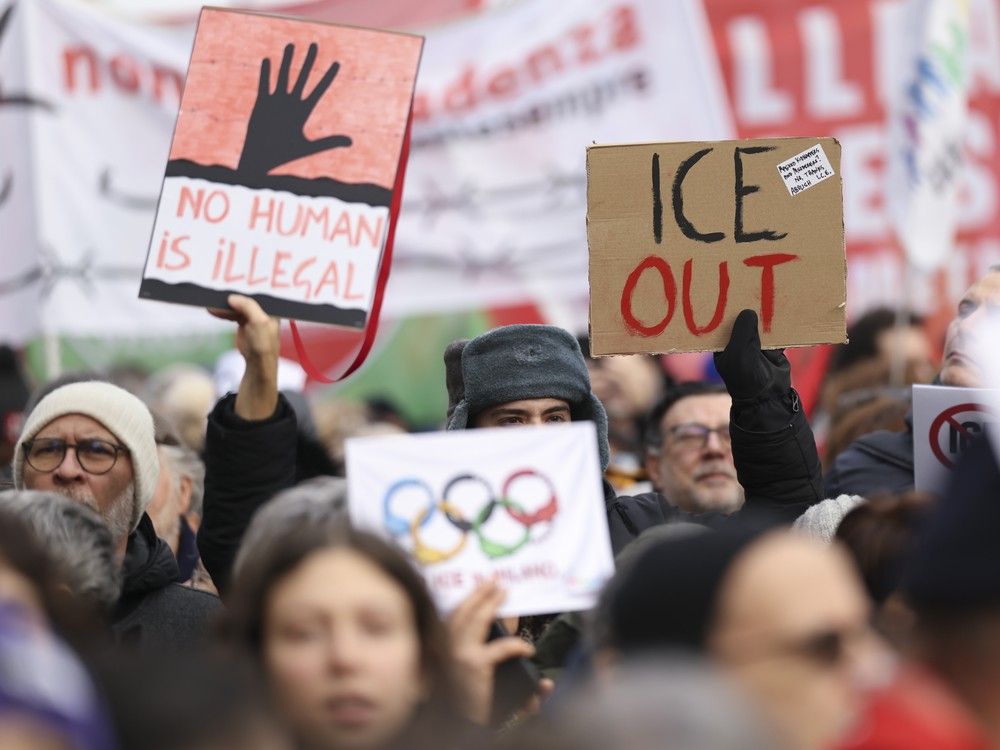
ICE has been dispatched to large events in the past, such as the Olympics, including this past month in Italy for the Winter Games. Their presence sparked large protests across the country.
The investigations unit is separate from the masked officers in enforcement and removal operations, the branch that has been responsible for the operations on U.S. city streets that have sparked so much protest and violence — and include the killings of Renée Good and Alex Pretti.
Anxiety for fans travelling to the U.S. for the Cup has spiked over fears of arrest, as ICE has made it clear that it will be patrolling the Cup stadiums in the 11 U.S. host cities. They have already arrested and deported soccer fans during last summer’s Club World Cup.
More than a dozen countries have issued advisories about travel to the U.S., including eight that have qualified for the World Cup — Australia, Belgium, France, Germany, the Netherlands, New Zealand, Portugal and the U.K. — and two more potential qualifiers in Denmark and Ireland. China and Finland, who haven’t qualified, have also issued travel advisories.