 BURST
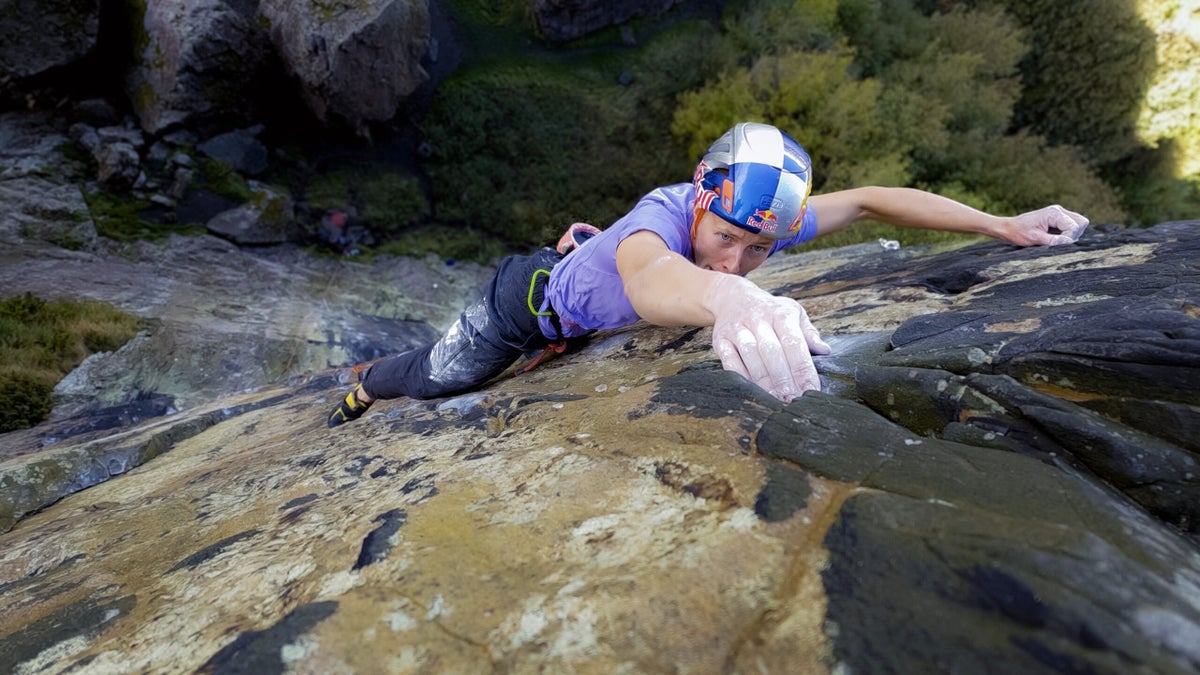
On October 7, Lara Neumeier topped out one of the hardest trad lines in the world amid approaching rain, standing high above the nearby castle walls as a blue-and-white Scottish flag flew in the bracing wind. The 28-year-old German climber just made the first female ascent of Rhapsody (E11 7a/5.14c) at Dumbarton Rock near Glasgow, Scotland, 20 years after it was established by Dave MacLeod as the world’s first E11. With her send, Neumeier became the fifth woman to climb a 5.14c trad route, joining Beth Rodden, Barbara Zangerl, Hazel Findlay, and Emma Twyford. Neumeier is the first woman to succeed on the British E11 grade.
Over two visits to Scotland this spring and fall, Neumeier worked the route alongside Austrian climber Nemuel “Nemo” Feurle, who sent shortly after her on the same day. The pair made the tenth and eleventh ascensionists respectively. British climber Buster Martin also sent the line the previous week.
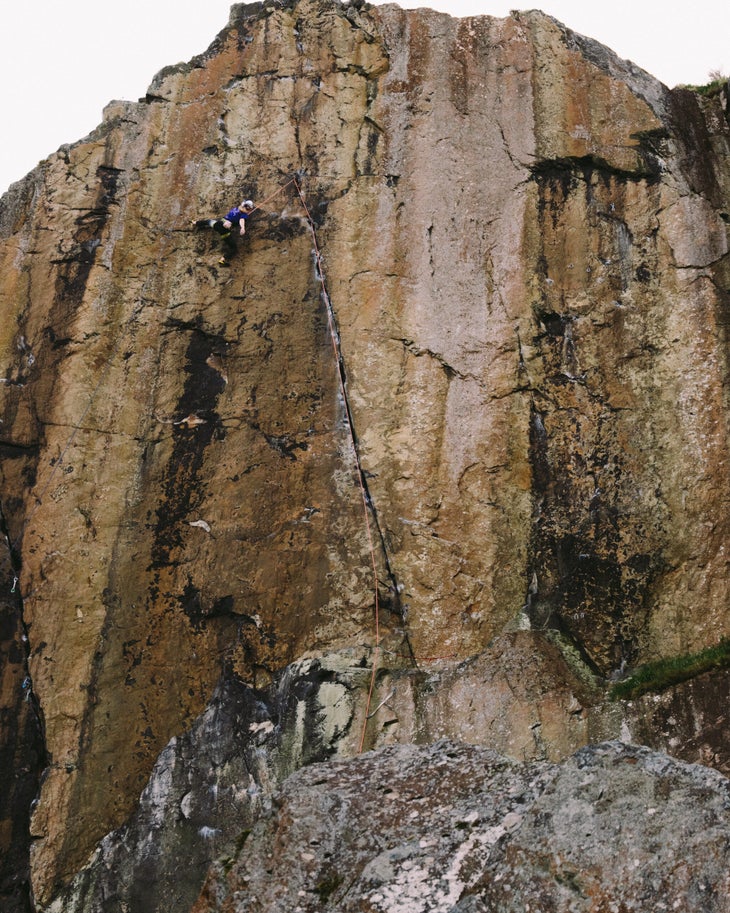
Rhapsody’s 35-meter (115-foot) line involves an easy slab up to a 7c+/5.13a hand crack ahead of a poor rest and a final cluster of small gear: two brass nuts and a micronut. After that, it continues to a V11/8A crux headwall sequence on crimps, with a 10-meter (32-foot) runout. The climbing difficulty is estimated to be around 8c+/5.14c, similar to Meltdown in Yosemite.
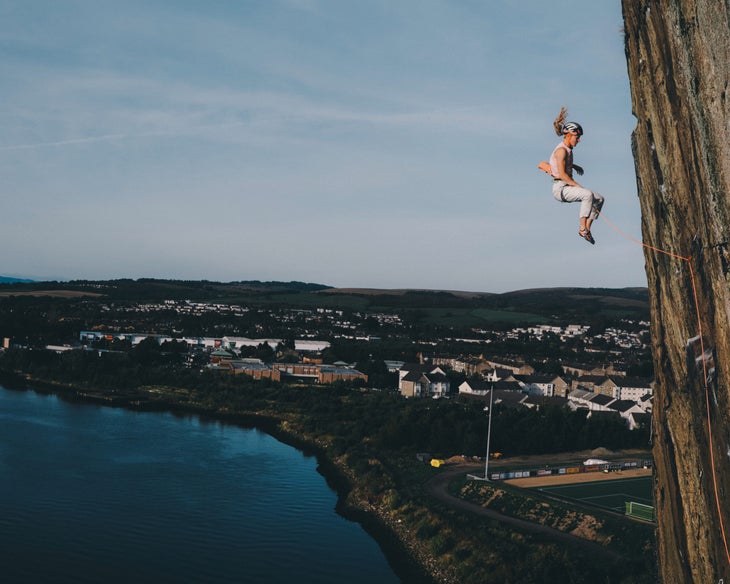
On the first ascent in 2006, MacLeod’s belayer was secured to the rock to minimize fall distance. Since then, the preferred method has shifted to dynamic belaying for a longer fall but a softer catch above the belay ledge. Today, the route still carries the potential for huge, 60 to 70-foot whippers.
Dumbarton Rock is a 240-foot volcanic basalt plug with a 1,500-year-old castle on top. The riverside cliff is the epicentre of hard Scottish trad climbing, sport climbing, and bouldering, made famous by Dave MacLeod. When MacLeod established Rhapsody after two years of effort and proposed a world-first grade of E11 7a, he described projecting the route as “an exceptionally arduous experience in every way.” His violent falls resulted in several lower leg injuries.
“It was lovely to hear Rhapsody got a first female ascent from Lara and that people have been keen for that route in general,” MacLeod told Climbing after Neumeier’s ascent. “I always found that wall an inspiring sheet of rock, but wasn’t sure if that was just because it was my home crag as a kid. So I’m really pleased to see that Rhapsody has encouraged lots of folk from around the world to come over, and they seem to have enjoyed the route.”
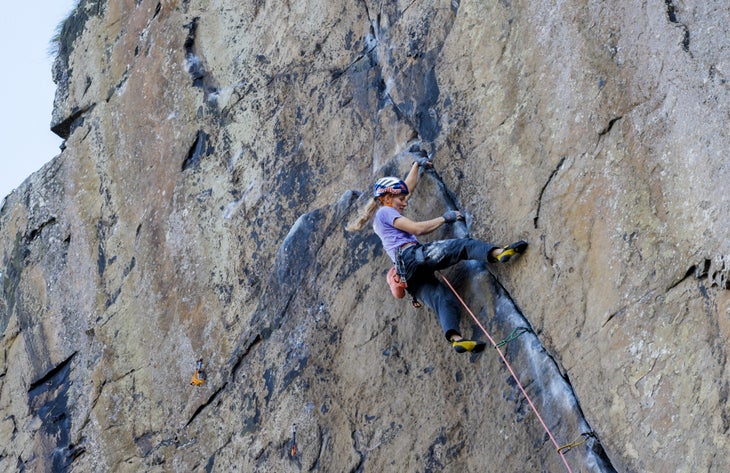
Neumeier was born to climbing parents in Füssen in Germany’s Allgäu Alps and started climbing at the age of two. She adds Rhapsody to a list of achievements in trad and big wall climbing, including two notable free climbs on Yosemite’s El Capitan: a first female ascent of El Corazón via the Muir Blast (5.13b; 3,000ft) with Zangerl in 2023 and a free ascent of El Niño via the Pineapple Express variation (5.13c; 2,500ft) with Feurle in 2024. This summer, Neumeier became the second woman to complete the original Alpine Trilogy, which consists of three 8b+/5.14a multi-pitch sport routes across the Alps: Silbergeier, Des Kaisers neue Kleider and End of Silence. She was also the first woman to complete it within a year.
I met Neumeier the day after her climb to learn about why she chose to project Rhapsody, how it compared to other 5.14c trad climbs that she has tried, what her training involved, and how the big whipper felt.
How Lara Neumeier Sent ‘Rhapsody’
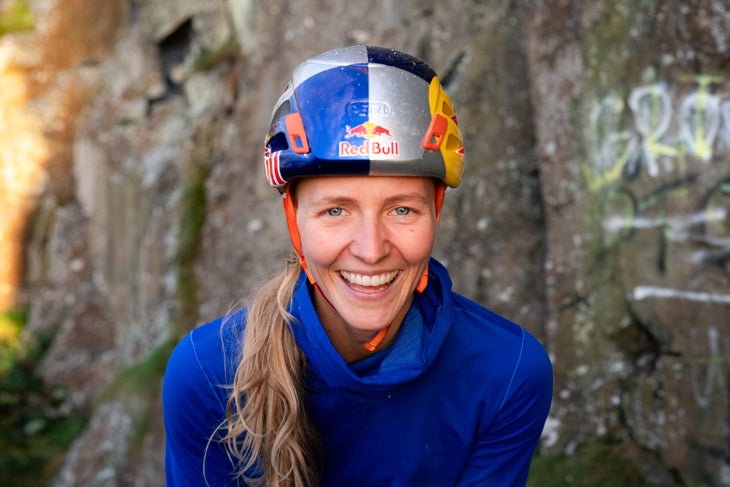
Natalie Berry: Lara, we’re here at Dumbarton Rock, the day after you climbed Rhapsody. How did it feel to top out?
Lara Neumeier: I was extremely happy and also really proud of myself. I have never put more energy and hard work into a route, so it felt really special.
Berry: What inspired you to try Rhapsody?
Neumeier: I first thought of trying Rhapsody at the beginning of 2025, when I did Psychogramm (5.14a R/8b+) at Bürser Platte in Austria, because I really like trying hard trad routes. I enjoy the process: You work the line on top rope first, and only go on lead when you really feel ready.
I first heard about Rhapsody when Jacopo [Larcher] did it. I researched it and thought it would be cool to try.
We came this spring for 10 days to see if I could do all the moves, because I knew it was around 8c+/5.14c. We climbed for five days on top rope, then we had two days of lead attempts.
What makes Rhapsody really special is that it’s a super long trad climb with super compact rock. The rock type is volcanic basalt, and it feels a bit like sandstone. The moves are super nice and technical.
Berry: Can you describe the sections?
Neumeier: It’s hard for me because I’m really bad at grading. The first 15 meters is easy, maybe 6a/5.10a. Then you have a big ledge where you can get a no-hands rest, and I put on my crack gloves there. Then you have the hand crack, which is graded around 7c+/5.13a on trad gear.
The upper part starts from the last placement. It’s 25 moves to the top with no gear. I’d break it down into three sections: the first crux, the traverse and the second crux. People have said the upper boulder problem is the hardest part, and the top crux is an 8A/V11 boulder problem.
Berry: How did you train between trips?
Neumeier: After the summer Alpine Trilogy, my training wasn’t super specific. In August, I climbed cracks in Lofoten, [Norway,] which probably helped with the Rhapsody crack. Back home, I focused on spray wall sessions and improving my finger strength. I tried to practice long, reachy moves and also did a lot of core training.
The Alpine Trilogy also showed me that I’m really strong mentally. When you take on a big project, you don’t know beforehand whether you can do it. I realised that you just have to commit and invest a lot of time, and then it becomes possible. You just have to dream big!
Berry: How was the whipper on Rhapsody?
Neumeier: In spring, I took the fall three or four times. This trip, I took the fall maybe 20 or 30 times.
I was really scared before I went on lead. On my first lead attempt, I passed the first crux and then fell. I felt completely fine afterwards. It wasn’t a problem or dangerous.
But I always fell either on the traverse or two or three moves above it, so I wasn’t very high above the last placement. If you fall at the very top, on the top move or the two moves below, it’s definitely scary.
Berry: Some prior ascensionists of Rhapsody have suggested a French/YDS grade of 8c+/5.14c, and Buster Martin recently called the climbing “8c+ or 9a trad.” What are your thoughts on the grade?
Neumeier: I think 8c+/5.14c works quite well. It’s always hard to say, because it can feel different for different people, but for me, it didn’t feel like 8c/5.14b. I don’t think it’s 9a/5.14d either, so I think 8c+/5.14c works well. Compared with other hard trad climbs I did or tried in Yosemite, it felt like a good grade.
Berry: How did the route compare with Magic Line and Meltdown, both 5.14c, which you’ve tried in Yosemite?
Neumeier: It’s hard to say because I tried Magic Line and Meltdown but haven’t done them, so it’s always difficult to comment on the grade if you haven’t climbed a route.
I think Meltdown felt harder than Magic Line. Rhapsody might be similar to Meltdown, but it’s hard to compare because the styles are completely different. On Meltdown, the crux is in the lower third of the climb, whereas on Rhapsody the crux is at the very top. Rhapsody is also much longer. They’re just different.
Berry: What was the hardest part of doing this route?
Neumeier: For me, it was definitely physically very hard. In sport climbing, 8c+/5.14c is my personal best. I’ve never invested a lot of time in sport climbing, but this felt quite hard.
In the top section, I used super small footholds, and it felt really insecure. Every time I got up there, I could do the traverse, but I would fall on the upper part because the footholds felt so bad. It always felt like I was going to slip, and sometimes I did.
It’s also mentally challenging when the crux is right at the top and you have to climb the whole 30 meters to get there, try the moves, fall, and then do everything again.
Berry: What was it like to project it alongside Nemo?
Neumeier: It was really cool to do it with Nemo because on a route which is close to your limit, it’s really hard. You have bad weather, and you really have to keep your motivation up.
If you’re with someone who’s also trying the same route, it’s just easier. Buster was trying it, too, so we had a really good crew. We got really psyched when someone did well on a lead attempt, and then the next person was psyched and tried to get a new high point.
We had 15 climbing days in total across both trips, and eight days of lead attempts overall.
Berry: Tell us how you celebrated.
Neumeier: We had a proper Scottish celebration! First, we got pizza just around the corner. After that, we went to a pub, drank some whisky and played darts.
Berry: How do you feel about being the first woman to climb the British E11 grade?
Neumeier: It’s really cool to be the first woman to climb this route because it has such a big history and is such an iconic line. It’s crazy that, in 20 years, no other women have done it.
I think Meltdown would be E11 if it had an E grade, and it has been climbed by other women, Beth [Rodden, 2008 FA] and Babsi [Zangerl, 2023]. But there’s only a small circle of women who have climbed at that grade, and being able to add my name to that list makes me really proud.
Berry: Why do you think so few women have attempted Rhapsody?
Neumeier: It’s maybe because of its reputation. It’s known to be really scary, but I think the core climbing community knows it’s safe. There are lots of videos online where you see those big whippers, with Dave crashing into the wall and getting injured. But I think you can make it safe nowadays. Maybe people still have it in their heads that it’s scary and a little bit dangerous.
It’s also known for having really reachy moves. Babsi Zangerl, who tried it before, said she struggled with some of the moves. Maybe now that I’ve done it, some other women will get psyched to try it. There’s beta for shorter people, too.
Berry: What did you think of Dumbarton Rock?
Neumeier: It’s a very special place because you have world-class hard bouldering, sport climbing, and trad climbing, but there’s graffiti on all the boulders and on some days local kids come along to drink or just enjoy life. It’s interesting how lots of different people come together here.
We were quite lucky on this trip because we had really good weather, and there were always lots of people at the crag. We just had really good vibes, and everyone was so supportive.
Berry: Has projecting Rhapsody inspired you to do more hard single-pitch headpointing?
(Editor’s note: ‘Headpointing’ refers to the practice of rehearsing a route on top rope before leading it.)
Neumeier: Yeah, definitely. I really enjoy working a route and trying hard. For me, it’s a mix of doing multi-pitch routes and really hard, single-pitch routes. I’m really psyched to find another hard trad line for next year.
The post Lara Neumeier Makes First Female Ascent of ‘Rhapsody’ (E11) appeared first on Climbing.