 BURST
BURST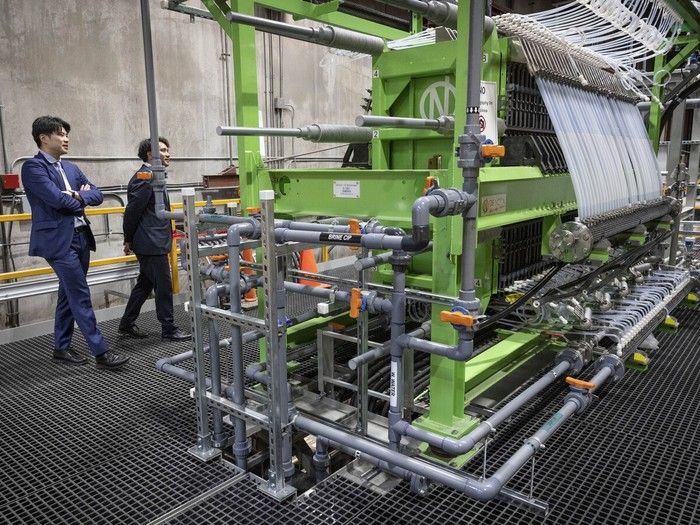
A Delta-based startup opened a lithium-refining plant on Thursday using an electrochemical process that will be a first for North America, betting that the technology can be developed into a made-in-Canada supply chain for the critical mineral.
Mangrove Lithium cut the ribbon on its commercial-scale refining plant with the capacity to make enough lithium — an essential element for the heralded energy transition — for up to 25,000 electric vehicle batteries.
Company CEO Saad Dara called Thursday’s official commissioning “a landmark moment,” which Mangrove Lithium hopes will prove the cost competitiveness of their process and break into a global supply chain that is dominated by mines in South America and refining centred in China and other parts of Asia.
“All of Canada’s lithium, all of our mineral resources from lithium mining, end up in other countries for processing and refining,” Dara said in his remarks.
“That’s not only a geopolitical risk, but it also means that Canada does not capture the full value of its mineral resources,” he added.
Dara hopes the Delta demonstration plant will help justify a final investment decision for a larger-scale commercial refining plant near lithium mines in Quebec with the capacity to refine enough of the element for the equivalent of 500,000 EV batteries.
That scale of development has drawn the attention of both Victoria and Ottawa, which have each contributed early-stage capital along with other investors. Even the provincial agency Emissions Reduction Alberta has signed on as a government partner.
Federal Natural Resources Minister Tim Hodgson was not at Thursday’s event, but in a statement called Mangrove’s venture “exactly the type of cutting-edge, sovereign Canadian project we need.”
Delta MP Jill McKnight delivered Ottawa’s remarks in person Thursday, calling Mangrove’s facility “a significant step forward in building a fully integrated, made-in-Canada, battery supply chain.”

Mangrove lists Export Development Canada, Canada’s Business Development Bank, and the provincial clean technology investment fund among its investors.
On Thursday, McKnight noted that, in March, Hodgson’s department committed $165 million to Canadian critical mineral projects, including a conditional $22 million contribution to Mangrove Lithium to support early engineering work for its proposed large-scale production plant.
In remarks relayed by a recorded video at the event, provincial Jobs Minister Ravi Kahlon said he looks at the $22 million of federal money, from the Canada Growth Fund, as “a clear signal that there’s confidence in (this) Canadian clean technology, that others believe in Mangrove’s ability to scale the tech and become a global leader.”
Kahlon added that B.C. shares Ottawa’s enthusiasm for Mangrove’s facility, which he said “represents B.C.’s position at the forefront of clean technology, reducing reliance on foreign refining, (and) securing a Canadian supply chain for domestic lithium and driving economic growth right here in Delta.”
Lithium is a cost-sensitive sector, with mining dominated by Australia, Chile and China, and refining concentrated in China, which controls almost 60 per cent of the market.
“It looks like a promising new approach,” said energy economist Werner Antweiler, an associate professor at the University of B.C.’s Sauder School of Business. “The question is how cost-competitive it will be.”

Dara said the lithium market continues to weather waves of volatility, including a pull-back by lithium-ion battery manufacturers that over the last two years led to proposed factories being cancelled or put on hold, including a $1 billion expansion of E-One Moli Energy’s facility in Maple Ridge.
Ottawa had pledged $205 million and Victoria $80 million to E-One Moli’s proposal.
“There has been a lot of pull-backs within the battery supply chain,” Dara said. “That is something that we are keeping an eye on, (but) we also understand that, in the long run, and the long term is five years, that demand will return and there will be a need for (lithium).”
Dara added that while China has been aggressively expanding production, “We know there will be a need for a supply chain outside of that. We know that folks are looking for materials to be produced elsewhere so that they can access them in Europe, in North America.
“While there’s some uncertainty now, all we can do is control the things that we do, which is our development and how far along we can go.”