 BURST
BURST"It isn't the mountains ahead to climb that wear you out; it's the pebble in your shoe." - Muhammad Ali
Lots of monopoly news this past week, as usual.
Before getting to the full round-up, I want to explore a new concept I thought about recently, based on a conversation I had with a hotel owner. It has to do with the post-pandemic puzzle so many economists are noodling on, which is why the economy looks to be doing fine in most conventional measurements such as unemployment, jobs, economic growth, and so forth, but the public is just incredibly sour.
Sure, gas prices are high, but the sourness was there before the war in Iran. Sure there’s inequality and health care is expensive, but those problems has long predated this moment. I have identified interest rates, as well as surveillance pricing, as a meaningful cost of living that isn’t incorporated into the Consumer Price Index. But I’m not fully satisfied. Something that isn’t being measured is affecting how we perceive commerce. And I think it has to do with the increasing cost we are paying for everyday goods and services, not necessarily just in cash, but in terms of time dealing with bullshit.
I came to this realization because I was on vacation last week, and I had the common experience of being cheated by a tech platform that connects consumers and hotels. I know it’s common because the hotel owner told me so. “This year, it seems like the amount of cheating from tech platforms has just exploded,” he said. I’m going to keep some of the specifics vague because I don’t love revealing personal info online, but it doesn’t really matter, you’ll get the gist.
We were traveling in New England, and my wife booked a hotel on a third party site called Agoda. They apparently buy blocks of rooms, and then resell them to consumers. We have certain requirements, and my wife is very detail-oriented. She booked a certain sized room. Only when we arrived at our hotel, instead of having the room that my family could sleep in, they had a smaller room in which we couldn’t fit.
It was an independently owned inn, run by lovely people. We showed them our booking receipt for a bigger room, they showed us their booking bill for a smaller room. Clearly, some middleman broker selling blocks of rooms simply lied or had a screw-up somewhere. The innkeeper tried to accommodate us, but the hotel was fully booked. And he couldn’t refund us, because we hadn’t paid him, we had paid Agoda. So we had to book a new room at a different hotel.
As we were talking about the problem with the hotel owner, he explained that this situation has become far more common over the last year, particularly when it involves something called “B2B distribution network,” which is likely a wholesaler owned by Expedia that sells rooms to brokers and online travel agencies, like Agoda. He showed us this document.
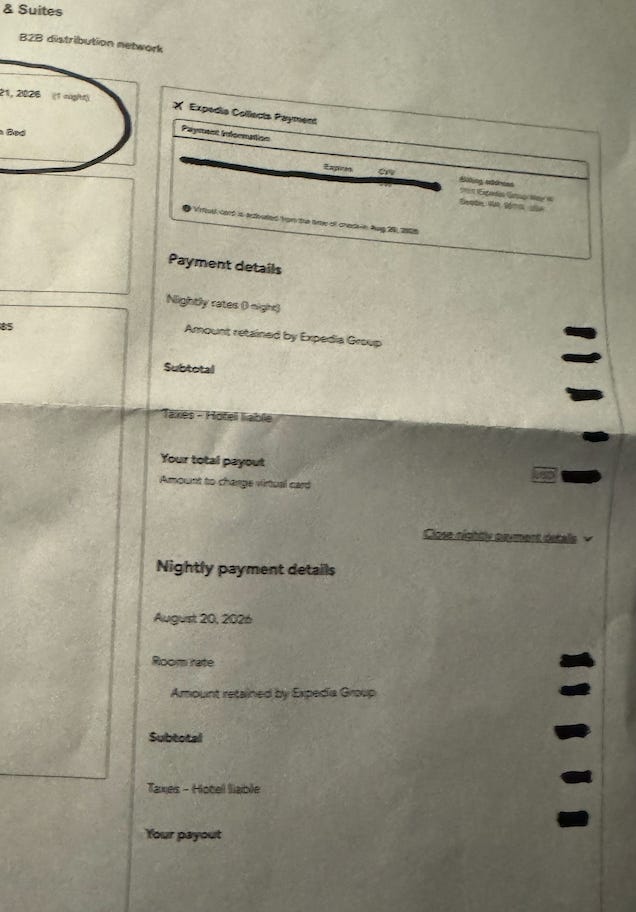
We booked through Agoda, but the hotel was paid via Expedia, which had sent this information representing our reservation to the hotel. And sure enough, the sizes were different. But more interesting than just the screw-up was that he had to take a marker and black out the price he received for what we booked. The hotel is not allowed to tell customers the commission they must pay third parties like Expedia. In addition, the hotel doesn’t get our actual credit card, but a dummy credit card, and he wasn’t even able to get our contact information until we showed up.
The rest of the story won’t surprise you. My wife tried to get in touch with Agoda, but they had her use an AI chatbot and it kept disconnecting. So she went to her credit card company, which gave her the number of the merchant to contact. Somehow she wound up back on the AI chatbot, and presented all of the evidence. Agoda then conceded there had been an error, offered a “sincere” apology but kept asking on a loop if she agreed to keep her booking.
These actions are, of course, fraud. And it’s also a particular kind of fraud. It’s not that the innkeeper is trying to cheat us, or we’re trying to cheat the innkeeper. The actual people trying to conduct business - the consumer and the hotel - were operating in good faith. It’s just that some MBA dipshit realized there was an arbitrage opportunity in cheating both independent hotels and consumers, assuming that you could wear down just enough people to stop asking for refunds such that you’d have a profitable business.
The thing is, whether we get a refund or not, we had to spend time fighting this nonsense. The scammers here are dumping the burden of proof onto consumers and ordinary small business people like these hotel operators, which is a form of social pollution. They may only steal money from a few of us, but they steal time from all of us. They are time bandits. (And yes, I’m naming them after the classic 1981 movie.)
Now, a brief aside, the reason fraud and scams have skyrocketed this past year is because tech-enabled scammers know that there is no cop on the beat. That’s the fault of man named Andrew Ferguson, who is the Chair of the Federal Trade Commission. The FTC was the agency tasked with preventing cheating, but it no longer does that. I’ve known Andrew for a few years, he read my book (or at least said he did), and we had a few fun conversations in 2024 back when the right was doing their flirtation with populism. I may do an essay on Ferguson at some point, but why he has chosen not to police the marketplace is unimportant. That he has chosen not to police the marketplace is what matters, because that is why we’re living in a scammers paradise.
So on our vacation, thanks to Ferguson, my wife and I were spending time doing logistical work to deal with being cheated. And time is a real cost, it is almost as if we were assigned a second job, with the pay being the original amount paid to Agoda. What kind of effect do these scams have on our psyches? It takes a toll. Now, despite being cheated, I’ve been on break, so I’m in a good mood and can take a step back. And all of a sudden, I realized this storm of tech-enabled cheating is relentless. My time is constantly being stolen.
It’s not a one-off here or there. I get 5-7 spam text messages a day from different scam political committees, and another 3-5 spam text messages from scammers trying to sell random services or offer jobs or surveys. I don’t even think about it now, I just type STOP or send them to junk, knowing that they won’t relent regardless. Apple could allow third parties to create text message spam filters, but it won’t, because it’s a monopolist and doesn’t have to. It’s easier to allow time theft.
Another example of time banditry are junk fees and deceptive practices. A few weeks ago, I was looking at hotels using Google Maps, and nearly all the prices were artificially low. You’d see a bunch of hotel prices on the map, and click on one of them, and then it turns out the room wasn’t available, or the price was much higher, or a combination. Again, very minor, but just more time thievery.
Even small things, like the ability to search emails to get receipts to contest fraudulent charges - those are worsening too. I have realized, I am constantly on guard someone might be cheating me. And that’s not even getting to the health care system, which is probably the biggest time bandit of all. In America, when you get sick, you also get a second job dealing with paperwork.
And I think that dynamic of time theft is impacting all of us. If you take that extra time spent dealing with all these hassles, and add it up, it is as if we are all working a lot more than we used to, with no pay. That isn’t measured by any statistic I can see, but it’s very real.
Before my vacation, I was feeling really burnt out. And that is kind of odd, considering the politics that I’ve been pointing to for almost twenty years - economic populism - is on the verge of what seems like some historic victories. Now, there are good reasons for pessimism, but the relentlessness of the scams and cheating, the very routinization of it, is a real and unknowable cost that I just hadn’t thought about. I mean, if I had to tell you how much hotels cost in New England, I couldn’t. Does that include the scam? Does that include the hours we spent frustrated at AI bots?
How extensive is time theft in America? No one knows, but I’m guessing it’s pretty common. Americans filed one million internet crime complaints with the FBI, with fraud losses increasing 26% from 2024 to 2025. Consumers lost eight times as much to scams in 2025 as they did in 2020. And Americans are turning on one another, it is the only nation where Pew found more people think the morality and ethics of their fellow countrymen is bad rather than good. Cheating, it seems, is routine.
Now, I believe Americans are by and large good and honest people. The cheating and bad morals are institutional in nature. Much of the corporate world engages in extractive corrupt pricing games, and there are judges and enforcers like Ferguson who refuse to use the political technology known as consumer protection law. It’s not most Americans acting badly. But it is very hard to know that, because our time is constantly being stolen, and it is increasingly hard to identify credible trusted ways to understand what is happening.
I think this constant barrage of time theft explains why Americans are so angry at data centers and AI. There’s nothing inherently bad about AI, which is just using structured statistical inference technology. But in this historical moment most use cases seem to be neutral or negative. I could point to our recent experience with AI this vacation, which has been dealing with chatbots offering “sincere” apologies while refusing to make us whole. We all know, at some level, that the mistakes AI fosters are going to be dumped on us, as workers, consumers, business owners, whoever we are, having to spend our precious time cleaning up the mistakes that someone else realized they could foist on others.
And so we’re just angry at these extra costs, even though we have no way of articulating them as such and economists and government beancounters aren’t looking for them when they compile their statistics of pricing and wages. But they are very real.
I’ll close out with a note of optimism. These problems aren’t hard to fix. We know how to stop cheating. Do more enforcement, allow people to sue directly by getting rid of arbitration agreements, and put liability onto platforms who are structural bedrock for deceptive practices in the marketplace. That would stop the time bandits, and let everyone chill out a bit more. I am optimistic on this front, because it’s so noticeable how much scamming is going on and the political winds are shifting. We can see that with the polling and action on data centers and surveillance pricing.
Oh, and since it’s the age of cheating, I have a confession. Remember that quote up top from Muhammad Ali on the pebble in your shoe? Yeah, that’s not his. It’s probably from an early 20th century insurance trade publication. Great line, though.
And now, the monopoly-related news of the week, with lots of great stories.
There are a whole bunch of new private antitrust cases, against giants in fertilizer, skiing, and apartment rentals in NYC. The Trump FTC takes a bold stance against price gouging people having heart attacks, saying that ambulance companies must disclose that they are overcharging a dying person. They can still do it, they just have to say they are doing it. Plus, Paramount unwisely aligns itself with the politics of Flock cameras.
That and a lot more, including some really optimistic news on coming elections.