 BURST
BURST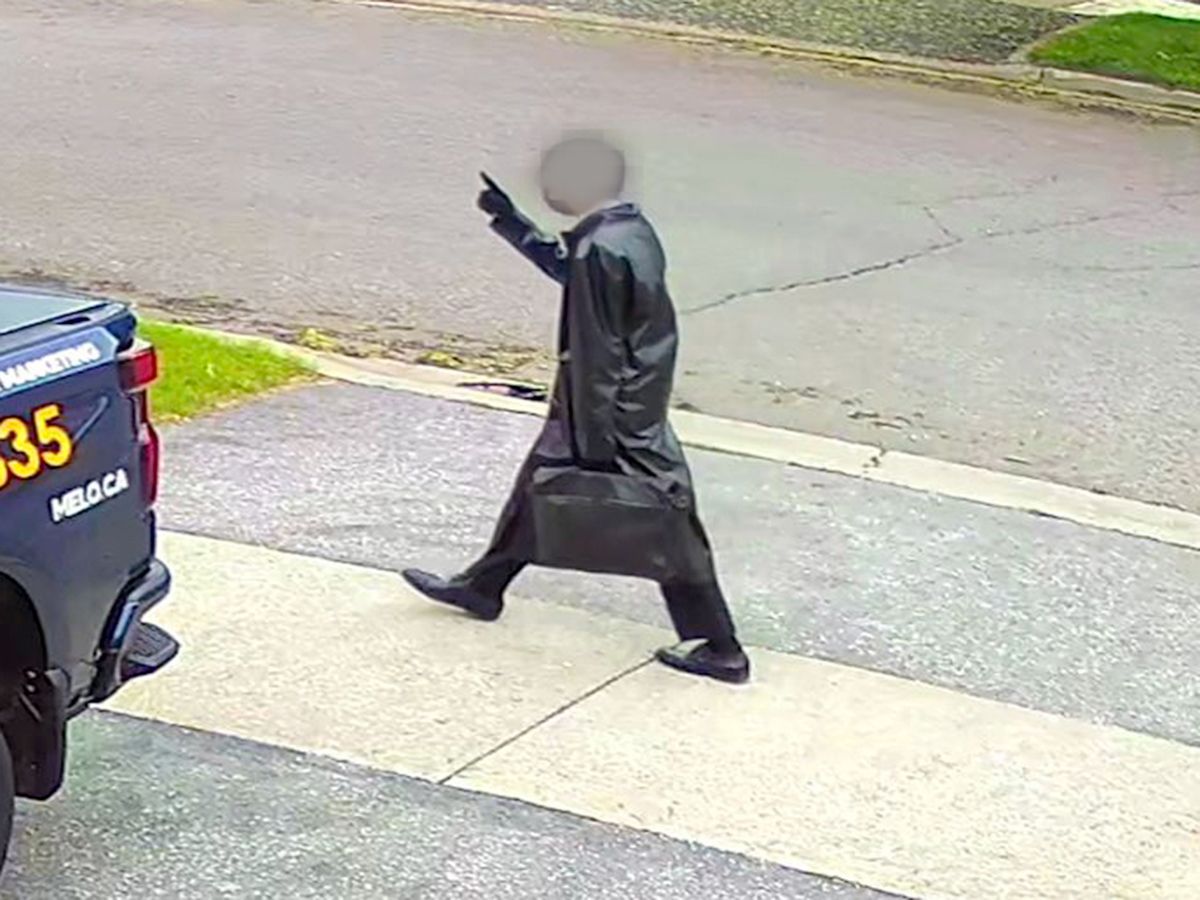
Eighty-three-year-old Eleanor Doney was raking leaves in front of her home on Lynn Heights Drive in Pickering, just east of Toronto, on May 29, 2025. For anyone leaving that dense suburban subdivision, her red brick house with a wide porch and double garage is the last home before a lush forest that leads to one of the continent’s largest electricity transmission stations.
At about 2:55 p.m., as she gardened under the shade of a large tree, an odd figure approached on foot from the east — a teenaged boy dressed in a black shiny trench coat that drooped to his shins, a black COVID-style mask, black gloves, overly large dress shoes, and carrying a briefcase.
What happened during the terrifying interaction between the boy in black and the retired school teacher was recorded by a neighbour’s doorbell camera. The video, police investigation, and the boy’s confessions precisely capture the brutality and banality of Doney’s murder, and reveal the unheeded warnings, disturbing obsessions and online interests of the 14-year-old killer.
Durham Regional Police Chief Peter Moreira said Doney’s “senseless murder” was an important story to hear despite it being a disturbing case that devastated a family, rattled investigators, and shook the community.
“The brutality and gratuitous nature of this crime — captured on video — is shocking, and it underscores the dangerous influence that online platforms can have on young people,” Moreira said in a social media post after the boy’s guilty plea in April. “It also raises serious questions about the responsibility of those who knew what was going to happen and failed to act.”
On the day of the attack, the boy walked past Doney, stopped, put down his briefcase, and turned to speak to her. They talked for about two minutes before he returned to his soft-shell case, took out a knife and walked back to her while holding the weapon in his right hand.
He then promptly stabbed her in the left side of her neck.
Doney staggered backward, turned, and started toward the refuge of her house, but the boy caught up to her in just a few steps and swung his knife again. Doney cried out as she fell but the boy swung again and again and again before retrieving his briefcase and running west along the treeline, past a sign saying illegal dumping is a crime.
A passerby saw Doney on the ground in front of her house and called police at 3:02 p.m. A Durham police officer arrived nine minutes later. He could tell she had stopped breathing and attempted CPR. Paramedics whisked her to Sunnybrook hospital where doctors tried to resuscitate her but pronounced her dead by 4 p.m.
Community fear quickly followed. Police issued an emergency warning for residents to remain indoors while investigators traced the killer’s movements through interviews and security footage, a task made easier by his distinctive outfit. He was seen in one video walking into a wooded area and bending down. Police went to the spot and found a knife there. Tests later proved it was used in the attack on Doney.
The public alert was cancelled hours later once the attacker was identified by school administrators as a 14-year-old boy who was then arrested that night at his home.
Because of his young age his identity is protected by law and cannot be published.
When police searched his house they found a knife was missing from a Cuisinart kitchen set that seemed a match for the one found in the woods. Two cell phones and a computer were seized from his bedroom. Police also seized clothing.
Investigators discovered computer chats the boy had with an online friend using Discord, an instant messaging platform popular with online gamers. Discord chats between the two in the weeks before the murder revealed the boy had interests in psychopathy, killing, murderers, and an obsession with a fictional serial killer.
Yoshikage Kira is a character in a best-selling, long-running Japanese manga graphic novel. In English, the series is called JoJo’s Bizarre Adventure, and it has been turned into an anime TV series, video games and other media. The same character stars in a spin off, called Dead Man’s Questions.
The Kira character is portrayed as a meticulous killer who tries to live unnoticed, working as a white-collar businessman for a department store despite his gruesome, periodic forays into stalking and murdering women, something the fictional character has done since he was a teenager.
The boy’s obsession with the Kira character extended beyond reading manga and watching anime. He often mimicked Kira’s language and monologues. That the boy looked cartoonish on surveillance video wasn’t accidental — his trench coat, dress shoes and briefcase emulated Kira’s business attire. Kira also has a hand fetish and the boy is seen in security video repeatedly looking at his hand as he walks through Pickering.

Online, the boy wrote about killing, getting away with murder, and claiming he would not be caught like historical serial killers had been. He also discussed the possibility of killing his grandmother and harming animals.
Police searches of his electronic devices also revealed his more routine teen interests, including video games, TV shows, movies based on comic books, and social media memes. In the weeks before he killed Doney these hobbies were overshadowed by dark, increasingly intense interests: Sociopathy and psychopathy, serial killers, stabbing, stalking and avoiding detection.
He twice watched a video that showed how to apply maximum pressure when stabbing someone.
On May 20 and 21, 2025, he watched 15 different videos about how to tell if you’re a psychopath or sociopath, and the next day he twice did an online search for “how serial killers got away,” and watched a four-hour YouTube video on the “most sadistic serial killers” in history.
On May 24 he watched six videos on serial killer Ted Bundy. On May 25 he was seen outside at 3 a.m. retrieving a knife from a satchel at a nearby property while wearing his Kira outfit. And on May 26 he watched a two-hour lecture by a psychologist on what goes on in the brain of a psychopath or sociopath, and whether they can feel remorse or empathy.
He was heavily online throughout the day of Doney’s murder. He watched 18 YouTube videos about Bundy and six videos on stalking. He repeatedly looked up the GO Transit schedule for trains leaving Pickering.
Shortly before the murder he watched various videos about serial killers, a clip from the sitcom Modern Family, and a video titled “How geckos defy gravity.” He also accessed an AI version of the Kira character.
Four minutes before he stopped in front of Doney’s house he was scrolling through various web sites and social media. Soon after he killed Doney, he continued watching YouTube, including clips from the TV series Breaking Bad and Family Guy, and the Marvel movie Iron Man. Once he returned home, he kept scrolling online and watching YouTube until about 30 minutes before police arrived and arrested him.
Court heard that on the day before the stabbing school officials had caught the boy with a knife and suspended him for five days.
During two medical assessments being prepared for the boy’s court appearances he told psychologists he had a fluctuating “urge to kill” in the weeks leading up to his attack.
He admitted that he carried a knife in his briefcase and knew it was there on May 29 while out walking. When he saw Doney in front of her house he saw a chance to carry out his plan to kill, and he stopped and engaged her in conversation before stabbing her.
This past April, less than a year after Doney’s murder, the boy pleaded guilty to first-degree murder. Family and friends of the much-loved grandmother learned the horrifying details of her killer’s plotting and the viciousness of his attack.
Media organizations, including National Post and Toronto Star, applied to the court for access to key documents used in the prosecution. At a hearing Thursday, Justice Lisa Wannamaker ruled that reporters should be granted access to a version of the agreed statement of facts and victim impact statements after the court redacted identifying information about the killer.
Doney’s husband, Bruce Doney, had earlier told court he and his wife had been together for 63 years and his life has been a nightmare since that afternoon. He said he has forgiven his wife’s killer and hopes the boy gets the treatment he needs to prevent other crimes.
Erin Dann, the boy’s lawyer, declined to comment on the case outside of court. At the hearing on the media’s access request she defended the need to protect some information, saying the Youth Criminal Justice Act is “designed not only to protect young persons’ privacy but to enhance their rehabilitative potential and, in doing so, protect society at large.”
Dann and Crown prosecutor Tammi D’Eri earlier had jointly told court that the maximum allowable youth sentence for first-degree murder — which is 10 years — is appropriate in this case, recommending six years in custody under a rehabilitative program and the remainder in the community.
A sentencing hearing is scheduled for July.
Concerns over the online activity of young people prior to committing explosive violence is a growing feature of our time.
After February’s deadly mass shootings in Tumbler Ridge, B.C., the digital footprint of 18-year-old Jesse Van Rootselaar revealed the shooter posted videos of guns on YouTube and TikTok, created a mall shooting simulation game on Roblox, and had an account on WatchPeopleDie, a website sharing gore videos with the tagline “People die and this is the place to see it.”
Months before eight people, including six children, were killed, Van Rootselaar was banned from ChatGPT, an artificial intelligence chatbot, after researching public shooting scenarios. Despite the ban, Van Rootselaar managed to create a second account, the company said.
In both deadly cases, nobody who knew the killers’ plans or violent ideation, or at least might have been concerned about the path they were on, alerted authorities in time to make any difference.
• Email: ahumphreys@postmedia.com | Twitter: AD_Humphreys
Our website is the place for the latest breaking news, exclusive scoops, longreads and provocative commentary. Please bookmark nationalpost.com and sign up for our newsletters here.