 BURST
BURST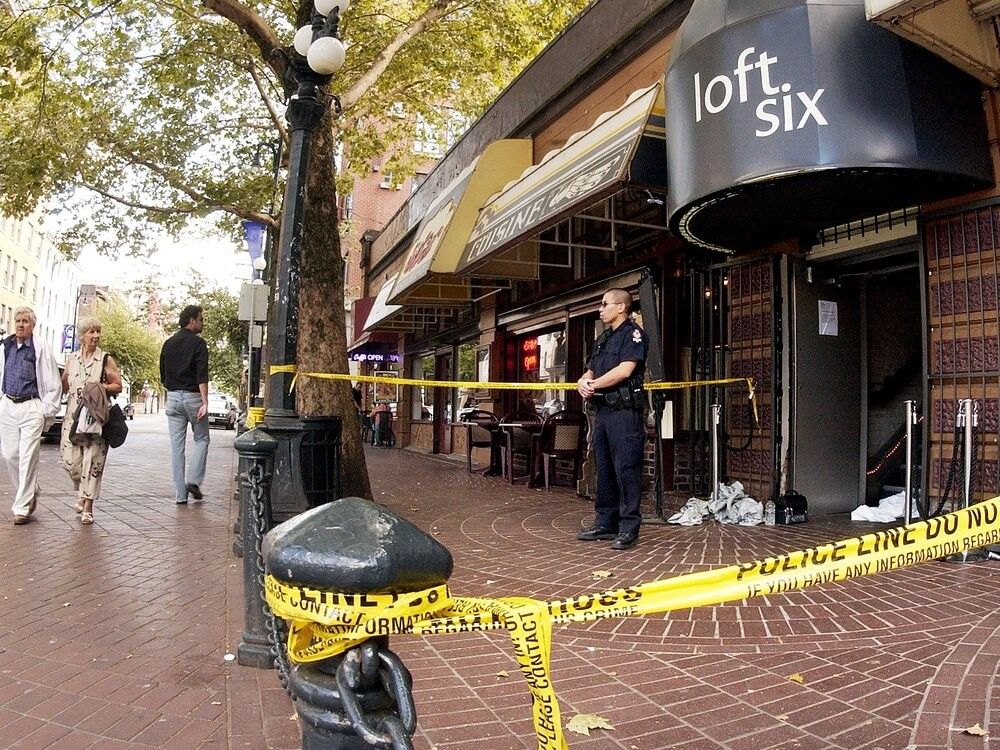
Doug Spencer remembers arriving on the scene of the deadly shooting at the Loft Six nightclub in August 2003 and hearing that gangster Sandip Duhre had been stopped by police as he ran down the back stairs after gunfire erupted.
Officers found a loaded .357 Magnum nearby, but there were no prints on it, the retired Vancouver Police detective recalled, so Duhre was never charged.
Spencer also reviewed security video from inside the Gastown nightclub that night and saw other well-known gangsters take cover or start firing.
By the time it was over, eight people had been shot — three fatally — including Mahmoud Alkhalil, who managed to stumble out of the Gastown club despite his grave injuries.
The 19-year-old, from a notorious gang family, crashed his car on West 15th Avenue minutes later. He died the next day in hospital.
No one was ever charged in the Loft Six shootout. Most of the victims were completely uninvolved bystanders.
Spencer and others now think the nightclub battle 22 years ago was a major flashpoint — if not the start — of a deadly two-decade-long gang war that left scores dead, including Duhre.
“That started a whole storm with the Alkhalil brothers because they were not going to let their brother’s killer go unpunished,” Spencer said in a recent interview.
It was also the beginning of brazen public executions carried out in restaurants, clubs, gyms and mall parking lots — sometimes in broad daylight and sometimes under the cover of darkness.
Retired Mountie Kevin Hackett, who headed the Integrated Homicide Investigation Team during some of the worst gang violence, said those involved “didn’t really care where they did it, as long as they were successful on their mission. There was no real concern about innocent people getting killed.”
Guilty pleas and prison terms
Like the Loft Six gunfight, Sandip “Dip” Duhre’s murder on Jan. 17, 2012, took place in a crowded downtown establishment as panicked onlookers tried to flee.
Unlike Loft Six, a successful multi-year Vancouver Police investigation led to three convictions against Duhre’s gangland enemies: Rabih Alkhalil, the brother of Loft Six victim Mahmoud; Larry Amero, a prominent Hells Angel; and hitman Dean Wiwchar. All three were part of the Wolfpack gang alliance.
In December 2025, Wiwchar, the last of the defendants, was sentenced to 20 years after pleading guilty to conspiracy to murdering both Duhre and fellow gangster Sukhveer Dhak.
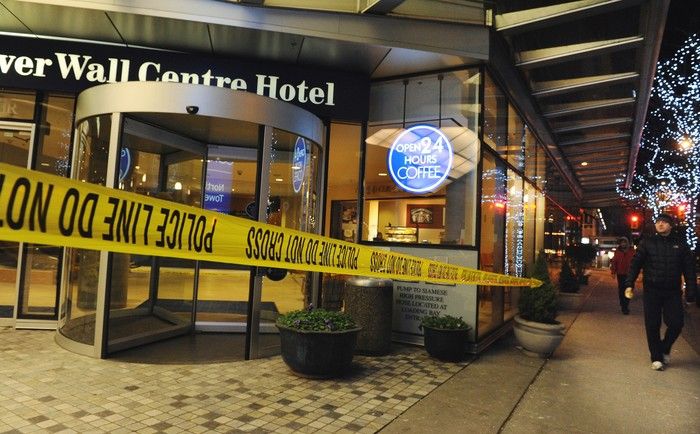
While the charge against him was dropped as part of a plea deal, Wiwchar admitted he was the hitman who walked calmly into the packed Sheraton Wall Centre at 8:45 p.m. and blasted Duhre 10 times as he sat in the restaurant near a window.
Wiwchar was not the only recent high-profile surprise guilty plea related to the deadliest period of the B.C. gang war.
In October, longtime United Nations gangster Conor D’Monte pleaded guilty to conspiracy to kill his Red Scorpion rivals — Jonathan, Jarrod and Jamie Bacon — more than 15 years ago.
D’Monte, who hid out overseas for 11 years, admitted to details laid out in a new indictment — that he formed an agreement with UN gang founder Clay Roueche and others “to bring about the murders of the three Bacon brothers.”
He also agreed that he collected and provided to his gang “information pertaining to the Bacon brothers and their associates, such as residential addresses, vehicle descriptions and licence plate numbers.”
He will be sentenced at the Vancouver Law Courts in February, when more information about his role in the conspiracy is expected to be presented.
End of an era
The two guilty pleas end investigations and prosecutions that spanned more than 17 years. They also mark the end of an era in the conflict, former investigators told Postmedia.
“Lots of good police work led to this, but oh my God, it takes a long time,” Spencer said.
As significant as the guilty pleas are, it “might be dangerous to say that it’s over,” retired Vancouver Police Supt. Mike Porteous said.
“These things always go in peaks and valleys. That peak is over.”
Already in January, two Brothers Keepers gangsters have been murdered. Naseem Mohammed, killed in Surrey on Monday, was a suspect in several hits. Navpreet Dhaliwal, shot inside his Abbotsford home Jan. 9, was facing murder conspiracy charges.
When B.C. Supreme Court Justice Kathleen Kerr sent Wiwchar to prison last month, she said it was “nothing short of a miracle” that no one else was injured in the Wall Centre shooting.
“Regrettably, the Lower Mainland has been and continues to be afflicted by the fallout from ongoing gang rivalries, turf disputes and, at times, seemingly overt warfare on its streets.”
A letter read in court, written by Duhre’s late father Dave, spoke of the lengthy feud his sons had with the Alkhalils.
“The worst and most absurd thing about it is the problem with the Alkhalils started as a simple school kids’ fight between a young tenant that lived in our basement with his mother and the Alkhalil boys,” wrote the elder Duhre, who died Nov. 4, 2025. “We could not do anything to stop this unnecessary and unwanted feud. What followed in the coming years had a profound impact on our lives.”
Sandip Duhre knew he was targeted long before he died. Just months after Loft Six, a friend sitting in Duhre’s parked Audi was murdered outside a Surrey Mac’s store. Duhre was in the store when the shots rang out. Police believed it was a case of mistaken identity. In July 2005, an armoured vehicle he was in was shot up in Vancouver. The bullets bounced off.
Dave Duhre told The Vancouver Sun in October 2005 that he had been trying to get his sons out of the gang life. At the time, Sandip was in jail on a gun charge. His brother, Balraj, had just been shot inside an East Hastings pho restaurant where he was dining with his cousin. Both survived.
“They are at a stage where they want to change, but managing to do it is very hard,” the worried father said.
City streets turned war zones
There were dozens of shootings and murders across the Lower Mainland in the nine years between the Loft Six shootings and Duhre’s slaying. Not every case had direct links to the broader gang war related to the Loft Six shootings when shooter and victim were part of a specific group.
By 2008, the UN gang, with which Sandip Duhre was aligned, and the Red Scorpions, with the Bacons at the helm, were driving around the Lower Mainland hunting each other and opening fire recklessly when any potential target was spotted. They often got it wrong.
UN member Duane Meyers was gunned down on the front stairs of an Abbotsford home in May 2008. The year before, his neighbour was shot dead by mistake. A day after Meyers died, stereo installer Jonathan Barber was killed in Burnaby as he drove along Kingsway in a vehicle owned by the Bacons.
In January 2009, Jamie Bacon was shot at in a busy Abbotsford intersection, just months before he and other Red Scorpions would be arrested for the unprecedented October 2007 murders of six men, including two bystanders, in Surrey’s Balmoral Tower.
Former UN member Kevin LeClair, a close friend of the Bacons, was fatally wounded outside a Langley restaurant on Feb. 6, 2009, as shocked onlookers watched. He died two days later.
Police investigators made progress on multiple fronts. By April 2009, several UN gangsters were behind bars and charged with plotting to kill the Bacons and other Red Scorpions for more than a year. They eventually pleaded guilty to conspiracy.
Hackett, the former RCMP assistant commissioner, said police began to change their tactics as the bodies piled up. They started to collaborate with other agencies to collect more intelligence on all the players involved because the “target group one day is the victim group the next day. You need to know both sides.”
At the time, the anti-gang Combined Forces Special Enforcement Unit and the Organized Crime Agency were focused on higher-end drug files and not the gang violence, Hackett said.
New police tactics, more success
Resources were redirected. Special investigative projects were set up. Agencies began to work more closely together.
Porteous said Vancouver Police began to adopt “more of a wrap-around approach” after UN gang leader Clay Roueche’s bodyguard was shot in the head outside a Granville nightclub in February 2007.
Until then, officers would react to a violent crime and investigate it. The new approach meant more proactive policing to suppress the violence before it happened.
While key gangsters were sidelined by charges and prosecutions, the tit-for-tat shootings continued.
Gurmit Dhak was gunned down at Metrotown mall in October 2010, leaving his younger brother Sukh devastated. He blamed enemies who would form the Wolfpack out of the Red Scorpions, Independent Soldiers and some Hells Angels.
On Dec. 12, 2010, Sukh Dhak’s hit team showed up outside a birthday party at the Best Neighbours restaurant on Oak Street. Some of those rivals were there. Then-Mayor Gregor Robertson lived around the corner at the time.
The gunmen started blasting when the bash broke up about 2 a.m. Ten gangsters and their girlfriends were wounded by bullets. No one was ever charged in the attack — one of the city’s worst.
The hunting continued with Dhak and Duhre working in lockstep with the UN gang to go after the Wolfpack.
Months later, on a sunny afternoon in August, came another shocking gun attack outside Kelowna’s Delta Grand resort, where Jonathan Bacon, Larry Amero and James Riach had been staying with two women.
As the five of them got into a Porsche Cayenne just after 2:30 p.m. a Ford Explorer pulled up slightly in front of them. An unidentified gunman shot at the Porsche from the back seat with a Norinco assault rifle. Two others got out and kept firing.
Bacon was hit several times and died minutes later. Amero was shot in the cheek, the chest and the left forearm, but survived. The two women were seriously injured. Riach escaped unharmed.
Within days of the Kelowna shooting, Amero and Alkhalil’s plot to take revenge was underway. Police issued more public warnings, specifically mentioning that anyone close to Dhak, Duhre or UN members should watch their back.
While some named by police told Postmedia at the time that they had nothing to do with the Kelowna attack and had been unfairly linked to the conflict, encrypted BlackBerry messages between the Wolfpack conspirators showed they believed otherwise.
A message from Alkhalil to an associate, dated Sept. 19, 2011, said: “They all formed together against me and my crew. Now UN zapping me begging to be left out of this, say they made mistake and want nothing to do with it. Too late, u can’t ask to be left alone midway, they accepted these goofs knowing they were in the middle of a beef with me. I haven’t done much ’cause I’m preparing some crazy shit.”
A message to Alkhalil, who along with Amero was convicted by a jury in 2022, said Duhre, Dhak and the UN “are all one crew now.”
Similar encrypted messages were flying among the UN conspirators hunting the Bacons and Red Scorpions, according to evidence at the trial of UN hitman Cory Vallee, convicted in 2018 of killing LeClair, dubbed “Traitor” by his former gang.
One UN gangster turned Crown witness testified that on the afternoon LeClair was shot, “he got an email from UN’s D’Monte stating ‘Traitor got it.'”
Strong evidence led to pleas
Wiwchar and D’Monte finally admitting their parts in murder conspiracies on each side of the gang conflict shows the strength of the cases that were built by investigators, said both Hackett and Porteous.
“That was a good VPD investigation. It was huge,” Porteous said.
They were on Wiwchar and their other suspects in the Duhre murder almost immediately, executing search warrants at his apartments and finding caches of firearms.
Another search warrant was executed in Montreal, where Alkhalil and Amero shared an apartment off René-Lévesque Boulevard. It was there that police found the encrypted BlackBerrys full of damning messages about their efforts to kill both Duhre and Dhak, who was killed in November 2012. Police also found a distinctive jacket that Wiwchar wore to the Sheraton for the killing.
The BlackBerrys not only laid out the murder plans, but were full of information about drug trafficking and other crimes, Porteous said.
“It was like a complete encyclopedia of … transnational organized crime.”
He said the investigation was almost “like a movie with all these twists and turns.” One of the twists was Wiwchar taking off to Toronto in June 2012 to kill John Raposo on behalf of Alkhalil while under investigation in Vancouver. Both men were convicted earlier of murder in that killing.
“It shows you what the police can do when they decide — or the powers that be decide — they’re actually going to throw everything at a case. More often than not, they solve it,” Porteous said.
Hackett said the success of IHIT and CFSEU’s major projects targeting the most violent gangsters came from pushing for resources and coming up with creative tactics, like flipping gang members to testify for the Crown against their former associates. He also praised the efforts of prosecutors in the gang murder cases.
“I would argue that working these high-end targets, and the most violent targets, has a positive effect on cutting down on the violence,” he said. “Who knows how many homicides did not happen because we were on them, and we were targeting them and we could intervene.”
He said what the public may not know is “that there were a whole bunch of other things happening in the background that were actually making the city safer without handcuffs going on.”