 BURST
BURSTThe very first thing one encounters after choosing to become a lawyer is the Law School Admission Test, or the LSAT. In its idealized form, the LSAT tests logical reasoning, critical thinking, reading comprehension, and writing skills, and it is designed to predict the success of potential law students. One’s score on the LSAT is the single most important factor in terms of acceptance to one of the 197 ABA accredited law schools in America, and thus becoming a lawyer.
The most important theme of modern American economics is that increasingly, no one trusts any of our institutions. I spend a lot of time discussing big business, and its relationship with our political leaders. But the broad-based corruption, that sense of “Screw you, I’m gonna get mine.’ Today, I’ll to discuss how it has infected law schools, the gateway to the legal profession that organizes justice in America.
The history of the LSAT is interesting in and of itself, but it also parallels the transformation of American higher education from a New Deal framework of equality towards a more corporatized and extractive set of institutions. Prior to the LSAT, law schools would admit a large number of people, and then get rid of many of them after the first year. That was both wildly inefficient, and cruel. It was also impractical in the middle of the 20th century, as large numbers of Americans were about to enter college after returning home from World War II as veterans.
So in 1947, representatives from Columbia, Harvard, and Yale met to discuss creating a better admissions process for law schools, an objective “law capacity test,” and a means to refine it over time. At the time, admissions were not professionalized, but were overseen by law school faculty themselves.
Creating a test, giving it all over the country, and updating it was a significant task best shared by universities. So Columbia, Harvard, and Yale contacted other law schools, and the result was this new test, and the organization to run it, known as the Law School Admission Council (LSAC). In 1948, the test began, with a fee of $10, which is about $140 today. That money was to be used to pay for the LSAC, reimburse law schools for their contributions to the test, reduce the price of the test in subsequent years, and help finance new testing materials or research.
That was then.
Today, universities are no longer run by faculty. Most of those who teach are adjunct professors making barely minimum wage; some are still tenured scholars, but they increasingly have little overall power. University admissions, as with the rest of administrative apparatus of the university-industrial complex, has become its own world of professionalized officers and experts, distant from the faculty who used to organize academic affairs.
The culture of admissions reflects this increasing corporatization. Here, for instance, is the LSAC invitation to its 2016 annual conference for law school admissions officers.
“We make law school applicants’ dreams come true, so it is fitting for us to hold our annual gathering at the official headquarters for making dreams come true—Disney World!”
LSAC had speakers discussing inclusivity, leadership, and customer service, in their conference whose theme was non-ironically labeled as “Making Dreams Come True.’ One featured talk was by Elizabeth Slavitt, a former McKinsey consultant and Khan Academy veteran. Another was from Vernā Myers, a renowned diversity consultant and the author of What If I Say The Wrong Thing: 25 Habits for Culturally Effective People.
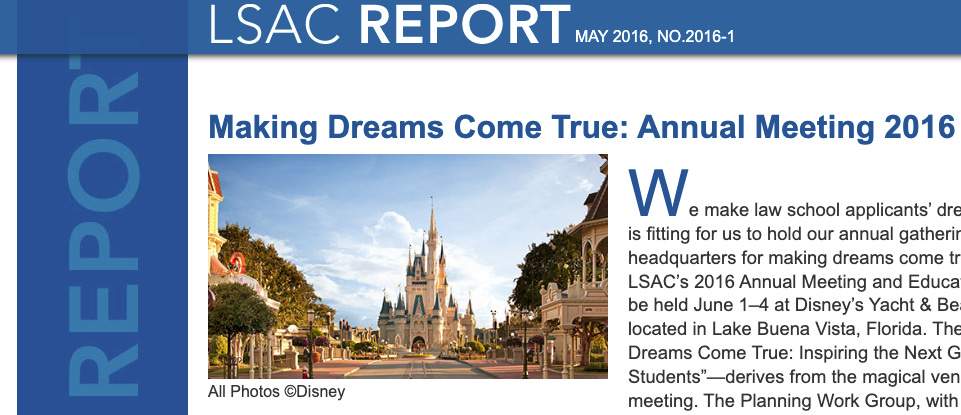
It’s hard to imagine that the original vision of standardizing law school admissions was to enable a bunch of clerks to play with each other as Disney World while listening to dull overpaid corporate speakers drone on about diversity and technology. But so goes American academic institutions.
Who finances these sad useless conferences? Well, it’s the tens of thousands of applicants to law schools. There’s the test itself. It cost $253 to take the LSAT in the 2025-2026 admissions year, which is roughly double the price in 1948. Now, it wouldn’t normally be unreasonable to charge a few hundred bucks for the test-taking, which does have real costs - a venue, grading, technology, and remitting scores.
LSAC, though, has serious quality issues, with cheating scandals for its now-canceled online version, and a huge problem in 2020 when the organization simply lost a bunch of scores due to a “technical glitch,” requiring students to re-take the test. It’s hard to convey how stressful taking the LSAT is, it’s a life-time altering experience that people spend months preparing for. So to lose a score is inexcusable.
What has happened, it seems, is that the LSAC no longer focuses on its original mission of making law school admissions efficient and helpful to the students and institutions it serves. Instead, it has expanded outward into a bloated harvester of cash from aspiring students, nearly $500 per person in total fees for the 60,000 people who apply every year. There are, for instance, the odd airline-style junk fees, like a LSAT score preview ($46 to $87), a score audit ($150), or test date change fees ($153).
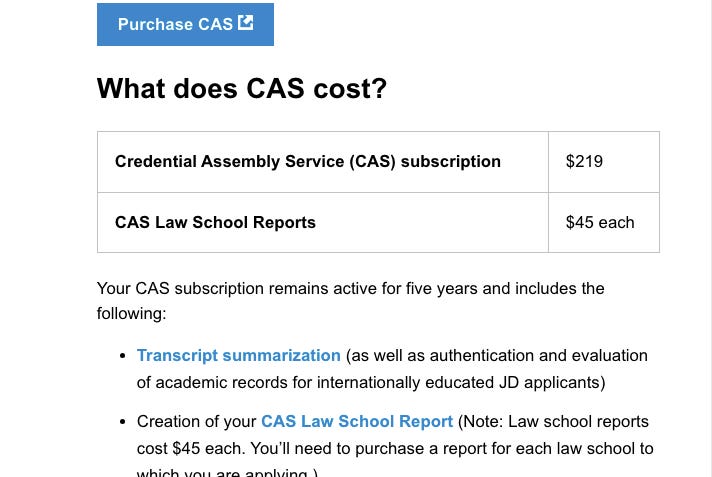
And then there’s a mandatory fee for something called a Credential Assembly Service subscription. What is CAS? It’s a software system that stores transcripts, letters of recommendation, and test scores, and then sends them to different schools. It’s basically a Google Drive, a simple technology one could get from Salesforce, Oracle, Liaison, etc. At this point, one could probably vibe code something like CAS fairly easily. But the tech is not the point, CAS is a chokepoint. In order to submit your application electronically to a law school, you have to pay $219 for a subscription to LSAC, plus $45 to each school. Since 2006, these prices have gone up much faster than inflation, despite the costs of software dropping.
Oh, and law schools often add on fees, of between $50 to $105, in addition to everything else. Welcome to becoming a lawyer!
Recently, the LSAC started facing some competition, and a few schools accept a rival test, the GRE. And it’s about time. But that test hasn’t caught on, because of the actions of LSAC and its network to defend its monopoly.
LSAC’s CAS service, which is distinct from the LSAT, brings in $30 million a year. And that money goes to subsidizing the schools in a variety of direct and indirect ways. There are grants from LSAC, with 27 law schools getting at least $100,000 from 2013-2023. There are indirect subsidies as well, such as helping admissions officers get to Disney World. In 2011, then LSAC President Daniel Bernstine explained this pot of money helped subsidize the “cost to law schools of participating in many of our programs, including the Annual Meeting, Forums, and workshops.” That presumably includes the 2016 conference at Disney’s Yacht & Beach Club Resorts, and its other annual meetings.
A lot of this money goes to LSAC itself, which now has a portfolio of $250 million, mostly stocks. It also has a highly paid staff, including a CEO paid $1 million in 2023 and five other executives making $400,000 a year. I’m sure there’s also a bunch of unnecessary bloat for an organization which administers a standardized test and should be run by a couple of middle class clerks.
One could argue that all standardized testing frameworks are costly, and there’s merit to that. But the LSAC is unique. By way of comparison, when applying to college, there’s a common application, similar to CAS. But to applicants, it’s not $219, it is free. Individual schools charge application fees, paying for the common application themselves. And they compete to attract applicants, varying their fee, just as a competitor in a market should. The same is true for applying to business school, the application costs are free to the end user, and schools themselves independently charge fees.
The difference for law schools is that there is a coordinated body that forces applicants to pay for a software platform at hundreds of times its actual cost. That sounds like price-fixing. So if you’re asking why all the law schools can work together to mandate all law school applicants to pay a couple hundred dollars just to use a simple database, well, you’re not alone.
In 2025, class action lawyers Peter McCall, William Burgess, and Bennett Rawicki filed a complaint on behalf of law school applicants, alleging that this system is a conspiracy between law schools and LSAC. The 197 American Bar Association-approved law schools all belong to LSAC, and electronic submissions of applications must be made through their system.
The allegation is that LSAC has organized a conspiracy with its member schools to force the use of an overpriced software platform everyone has to use to upload their transcript, recommendation letters, and any other documents to send to law schools. It is both an organizer of a conspiracy, and a conspirator itself. It explicitly disadvantages rival tests, like the GRE, and overcharges applicants.
Former Big Tech on Trial writer Tom Blakely wrote up the antitrust case in detail. And the good news is that it’s going well. Blakely reported that the judge, John Murphy, “had sharp questions for LSAC’s lawyers in the oral arguments.” Aside from the rebates and high fees, Blakely argued there is clear evidence of disciplining members who refuse to participate in the cartel price-fixing arrangement.
The complaint also alleges that LSAC trustees who are deans of member law schools issued a report to the full board of trustees that recommended denying full membership to certain schools that accept the LSAT. The trustees concluded that those schools could not be members because they do not use LSAC’s Application Platform and “thus do not contribute significantly to the revenue needed to support LSAC’s services to members.” Those schools have not been granted membership.
Blakely has a number of other important observations, which I’ve confirmed by talking to a consultant in the space. LSAC has a policy forcing law schools to preference LSAT scores instead of rival tests, and it is the center of a network of self-satisfied law school admissions officers who profit from this system. A particularly noxious observation is that 74% of LSAC’s revenue comes from rejected applicants, meaning that its 2016 conference premise of “Making Dreams Come True” was deeply cynical.
Now, this little scam isn’t that important in the scheme of things. It’s $30 million a year, and the system basically works, even if there are some problems with it. But the problem is less about the money and the extraction than the moral statement it makes to would-be lawyers upon attempting to enter the profession. In 1948, the goal of the LSAT was to help students, by preventing the ones who couldn’t become lawyers from wasting their time, while allowing a much broader pool of applicants to enter the profession. Today, law schools, through a professionalized cadre of busybody admissions officers, are implicitly telling their students that the law is a scam, used to extract.
As Blakely noted, there’s a much bigger “admissions racket” than just LSAC. There an entire “education-admissions stack” to “serve as tollbooth operators collecting supracompetitive fees from students and their families for tasks with de minimis costs, driving up the cost of education.” And behind this change is something even more significant, the collapse of the legitimacy of academia itself.
In BIG, we’ve written about the cartel-nature of universities, in particular around admissions and endowment funds. In the Atlantic, former professor Tyler Harper wrote an important article about the decline of tenure and the resulting cultural madness that overtook higher education in the last five years. Another professor, John Paul Rollert, has covered how university leaders are now de facto allowing an epidemic of AI-powered cheating to offer morally destructive lessons to students.
The transformation of the university from 1948 to today is a much longer story than the one I’ve laid out here. The inflection point was in the Carter administration, when a law called the Bayh-Dole Act turned higher education into corporatized institutions focused on commercializing patents. Fundamentally, these institutions are no longer controlled by faculty, who ostensibly guard knowledge and tradition. They are run based on the extractive principles of Wall Street.
The result is that higher education in America is in a lot of trouble, with the public increasingly distrustful of academic institutions.
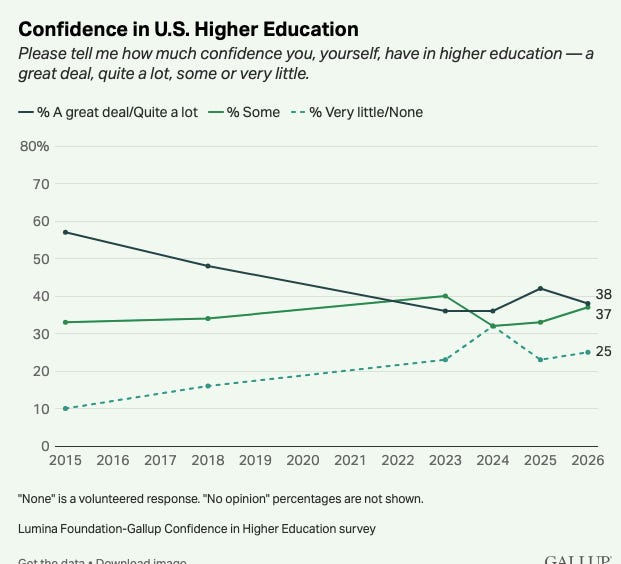
One could go along with the premise that the reason is America is full of Trump-supportive rubes and yokels, who have been told not to trust eggheads and experts with their woke nonsense. But there is a real crisis, where universities, like every other American institution, have turned away from their role as guardians of knowledge, and are increasing used as a mechanism for extraction.
And that’s why the LSAC story matters. It’s not the biggest cartel in the world, it doesn’t directly cause any deaths. But in its very shabbiness, it shows how institutions ostensibly dedicated to the pursuit of truth can be no different than Ticketmaster in their pursuit of junk fees. The admissions racket represents yet one more economic termite, something nickel and diming a lot of people in a way that is quite annoying, but not enough to really call some sort of social crisis.
The good news here is that the public disdain towards academia means lawyers are no longer shy about bringing cases, and judges don’t hold these institutions as sacred. So this case, which will likely stretch into 2027, has a good chance of undoing the admissions racket. In other words, distrust of untrustworthy institutions s a good place to start for reform.
And with that, I’ll leave you with an inspiring message from the admissions officer racket: “There is no place like Walt Disney World® Resort, and there is no meeting like LSAC’s Annual Meeting and Educational Conference!”
Thanks for reading! Your tips make this newsletter what it is, so please send tips on weird monopolies, stories I’ve missed, or other thoughts. And if you liked this issue of BIG, you can sign up here for more issues, a newsletter on how to restore fair commerce, innovation, and democracy. Consider becoming a paying subscriber to support this work, or if you are a paying subscriber, giving a gift subscription to a friend, colleague, or family member. If you really liked it, read my book, Goliath: The 100-Year War Between Monopoly Power and Democracy.
cheers,
Matt Stoller