 BURST
BURST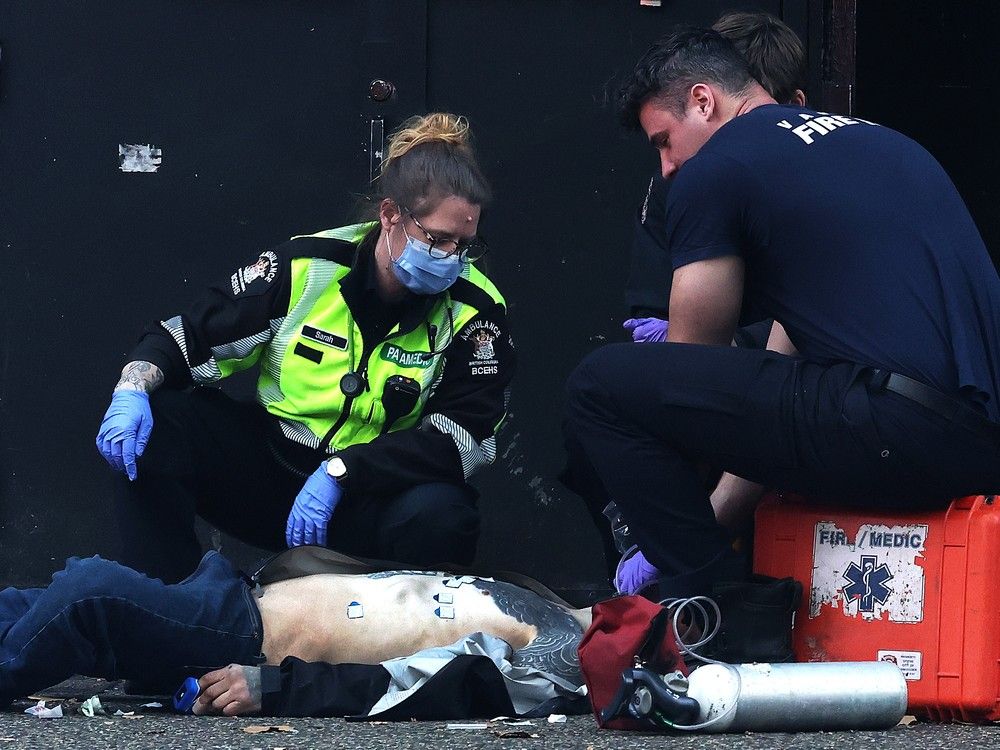
Health officials are concerned that unregulated street drugs are becoming even more dangerous as they are being mixed with potent non-opioid sedatives that don’t respond to the overdose treatment naloxone.
Vancouver first responders recently linked a spike in 911 calls and overdoses to drugs mixed with fentanyl and the animal tranquillizer medetomidine.
Here’s what we know so far about what’s happening in B.C.
What is medetomidine?
Medetomidine is a strong, non-opioid veterinary sedative that can cause cardiac and respiratory depression and deep prolonged sedation, according to the B.C. Centre for Disease Control.
It’s used to help control aggression in animals or for pre-surgical sedation.
It is increasingly found in illicit drug samples in combination with highly potent opioids like fentanyl in drug poisoning deaths in B.C.
Is it illegal?
Medetomidine is approved for use in Canada in veterinary medicine. It’s about 200 times stronger than xylazine, another powerful non-opioid sedative used mainly for horses and cattle that has previously been found in B.C.’s drug supply.
It is not regulated for use in humans, although there are similar drugs used in hospitals.
Is it more dangerous than fentanyl in street drugs?
Several health authorities in Canada have issued warnings about medetomidine and xylazine increasingly being found in illicit drugs. Officials say the combination of these drugs with other depressants like opioids or benzodiazepines increases the risk of overdose.
Naloxone can reverse the effect of opioids but not medetomidine or xylazine, increasing a person’s risk of dying from an overdose.
Health officials also say users may also experience more intense withdrawal symptoms, including high blood pressure, a fast heart rate and agitation.
Dr. Mark Lysyshyn, deputy chief medical health officer with Vancouver Coastal Health, said that in Philadelphia, medetomidine is contaminating an estimated 90 per cent of illicit opioids, and hospitals there are seeing hundreds of people come in with severe withdrawal.
He said it is still unclear how long a person needs to be exposed to metathominine before developing withdrawal but what they are seeing is severe.
“Some of these people with the withdrawal syndrome had such severe high blood pressure that they basically had to have that condition managed in an intensive care unit.”
“That’s a scary side-effect of this contamination, where all of a sudden, if you don’t get it, you might require management in hospital.”
He added that it can be very difficult for physicians to diagnose.
When did it show up in B.C.’s unregulated drug supply?
Last year, first responders reported a drop in the number of overdoses, thanks in part to more people having knowledge and training to use naloxone. But then Vancouver firefighters sounded the alarm about overdose calls starting to climb again in mid-October.
On Nov. 21, there were 54 overdose calls in the city, a single-day record.
There’s no data yet from the coroner to connect the spike to medetomidine but health officials say street drugs are being tainted with much stronger sedatives.
Chief Karen Fry of Vancouver Fire and Rescue said that the high number of overdose calls has continued into the New Year, and that as of Wednesday, firefighters have responded 486 overdoses, or an average of 16 a day.
“When we start seeing an increase in calls, we know that something’s changed. And then I think it was after we started talking about the increase in calls, there was more of an awareness of these new type of drugs,” said Fry.
“We definitely saw an increase at the end of the year.”
Lysyshyn said they started seeing xylazine show up in the drug supply in about 2023 and then medetomidine a year later. But since the summer of 2025, health officials think 25 to 50 per cent of opioid street drugs may contain medetomidine.
How does it affect people?
Drug effects include low heart rate, slowed breathing, initial high blood pressure followed by low blood pressure, sedation, dry mouth and hypothermia, according to the Centre for Disease Control.
Complex drug poisoning involves deep and prolonged sedation and very low or no pulse. Other reported experiences include dizziness, nausea, vomiting, fear and delusions. Health officials say effects can last from 90 minutes to up to several hours or longer when taken with other depressants or opioids, like fentanyl.
Have B.C. residents died from taking it?
Lysyshyn said at a recent provincial meeting with B.C.’s coroner, the provincial toxicology lab reported there are deaths where medetomidine has been detected. But none of the deaths have been linked solely to medetomidine because it is usually mixed with a cocktail of drugs.
More information is expected in the coming months.
Lysyshyn said what health professionals are seeing in the community is not an increase in overdose deaths but a decrease.
He said the reason the number of non-fatal overdose calls might be going up is that while naloxone may save the patient’s life from an overdose death on fentanyl, the person is still heavily sedated from medetomidine or something similar, so people are calling 911.
“So metetomidine doesn’t appear to be causing increased death. It just appears to be causing increased overdoses that require intervention,” said Lysyshyn.
Why would drug dealers add animal tranquillizers to street drugs?
Lysyshyn said as the potency of a drug goes up, the more it tends to be used in street drugs.
“That’s why we saw a shift from heroin to fentanyl because it is more potent and can be concealed better when transporting it,” he said. “And now that’s what we’re seeing in this case of xylazine and metetomidine because they can move 200 times less but still get the same bang for their buck.”
He said this is a serious concern because these drugs keep making the unregulated drug supply increasingly toxic, such as with drugs like carfentanil, which is 100 times stronger than fentanyl.
“If you get even a grain of drugs wrong with carfentanil, it causes death, because you’re basically getting twice the dose that you should have, and that becomes lethal.”
What are health authorities doing about it?
The health authorities have issued alerts to local physicians to make sure they understand about both the toxicity and the withdrawal, said Lysyshyn.
The B.C. Centre on Substance Use recently conducted a pilot using test strips to accurately detect medetomidine and confirmed they work.
“There are things we’re doing, but it’s hard to know how long this is going to stay in the drug supply. Is this going to be a permanent contaminant or will we see this come and go?”
What is the latest news on B.C.’s opioid crisis?
B.C. declared a state of public health emergency in 2016 due to the opioid overdose crisis. The worst year of overdose deaths since then was 2023 when 2,589 deaths were reported. Most of the deaths are due to the opioid fentanyl being mixed into street drugs.
According to the latest available data from the coroner, 150 people died in October 2025 because of unregulated drug toxicity, or about 4.8 deaths a day.
Fentanyl and its analogues continue to be the most common substances, followed by fluorofentanyl, cocaine and methamphetamine.
Many people survive overdoses, due in part to the widespread availability of the reversal drug naloxone, but it can leave people with permanent brain damage. Since 2016, more than 16,000 British Columbians have died from toxic drugs.