 BURST
BURST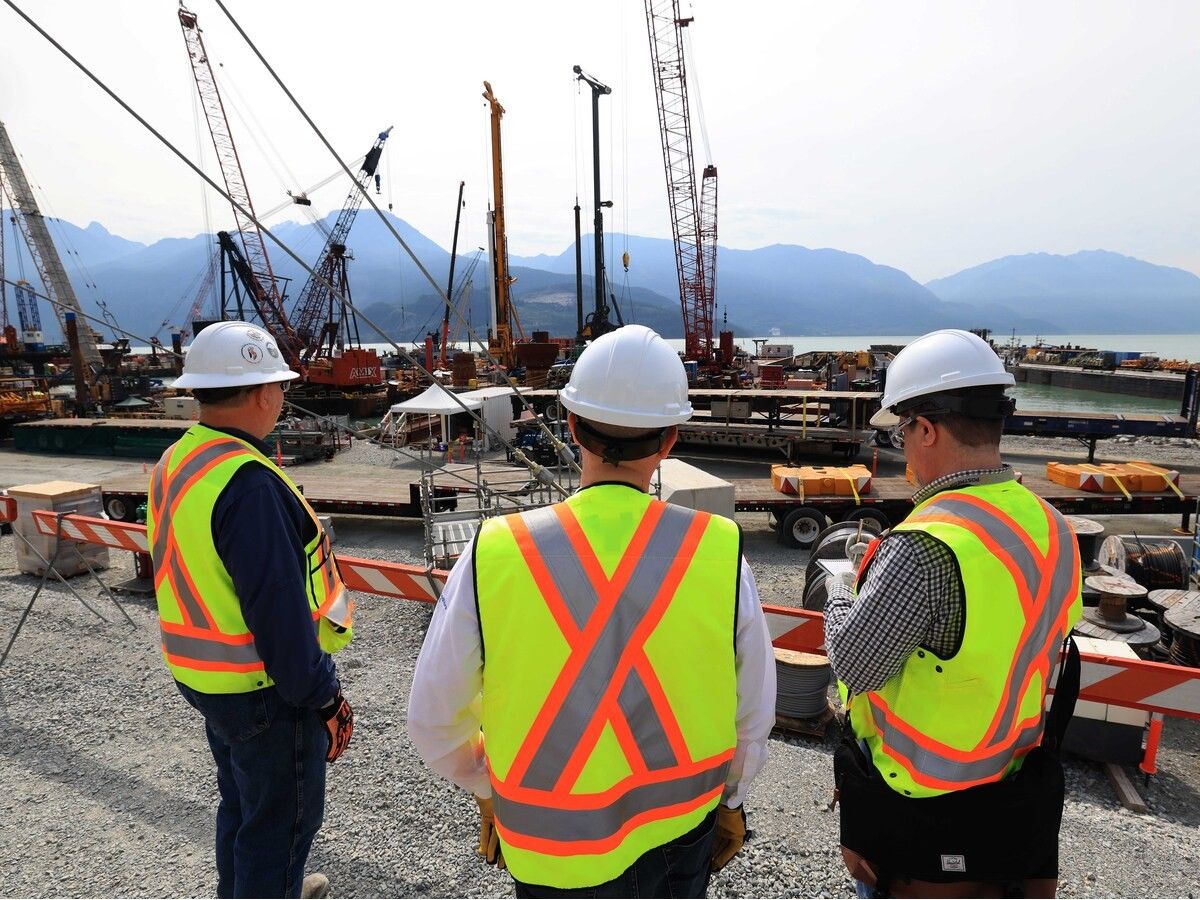
From the eastern shores of Howe Sound in southwestern B.C., it may be difficult at first to appreciate the sheer size of Woodfibre LNG’s construction site on the opposite side — especially as it is set against the forested slopes of the towering Tantalus Range mountains.
But take the six-kilometre boat ride across the sound’s glacial-green waters, and the scale of the project — representing B.C.’s expanding LNG-export industry — becomes apparent.
The site’s true size really hits once you arrive. Massive steel frames house a complex network of pipes, pressure vessels, compressors and cryogenic cooling units that will take natural gas originating from northeastern B.C., treat it, and freeze it into liquid form.
The steel columns of those frames rise 10 to 13 storeys from concrete footings that dwarf construction workers below. And the structures now lined up to each other stretch out like a blocks-long wall of downtown office buildings.
“It’s a fun part of the project where you actually see those modules come in,” said Woodfibre CEO Luke Schauerte as he led Postmedia on a tour of the project that is now 70 per cent complete.
“It starts to bring the site to the shape and size of what it’s going to look like. (And) some of those big ships, being an ex-navy person, are just fantastic and cool to see.”
Woodfibre LNG’s site seven kilometres south of Squamish stretches along a tidy gravel road. Two bright white-painted ferry ships are home to 1,300 construction workers. Along the basin, a small forest of cranes are busy driving pilings for floating storage tanks.
Crews changing shifts walk along a pathway marked by yellow chains and dotted with regularly spaced safety stations that house bear spray. Remediation of Mill Creek, which cuts through the middle of the site, has brought back salmon that attracts black bears.
Woodfibre LNG has been more than a decade in the making, its origins tied to the early speculative frenzy around LNG that emerged in the early 2010s. The facility is taking shape at a time when the burgeoning industry has been pushed into the spotlight by conflict in the Middle East, which has cut off LNG production in Qatar, the world’s second-largest producer after the U.S.
The conflict has left LNG’s buyers scrambling to shore up supplies and clamouring for producers to deliver more of the fuel faster. Prime Minister Mark Carney has taken it up as a national challenge, promising Canada as a reliable trading partner as his government supports expansion of its energy infrastructure.
With construction expected to be complete at the end of 2027, Woodfibre LNG is next in line to export Canadian LNG to markets in Asia. Shell-backed LNG Canada in Kitimat in northern B.C. started production in the middle of 2025.
Woodfibre will be considerably smaller than LNG Canada, with a planned capacity of 2.1 million tonnes per year, versus 14 million tonnes per year for LNG Canada. Given the Carney government’s ambitions, though, there is already external pressure for Woodfibre to perhaps do more.
Natural Resources Minister Tim Hodgson hinted in April at the desire to “double and triple the size of their production,” during remarks he made at a major energy conference in Houston, Tex.
However, the Squamish Nation, which jointly approved the Woodfibre project after an independent environmental review, said in April that any amendments to its permit would be subject “to a full review.”
The project that has been permitted is backed by an offtake agreement with energy giant BP Gas to purchase 90 per cent of its output for 15 years.
Standing aboard the Isabelle X, one of the two passenger ferries converted into a floating hotel, or “floatel”, for Woodfibre LNG construction crews, Schauerte said the company is focused on delivering the project that has been permitted.
“I am encouraged by what Minister Hodgson has been doing. I’m encouraged by what (B.C. Energy Minister Adrian Dix) has been doing in talking about the future for the industry and growth for the industry,” Schauerte said.
“But at this time, we’re laser-focused on this. And it’s busy. It’s all-encompassing.”
Various challenges have also pushed the project’s budget to $8.8 billion US from a $5.6 billion US estimate at the start of construction in 2023, starting with its promise to power its liquefaction process exclusively with electricity.
Woodfibre is billing itself as the world’s first net-zero LNG plant with electric-drive compressors at the centre of its liquefaction process, a claim helped by B.C. Hydro’s reputation for producing 98 per cent of its power from renewable sources.
“If you are going to be the first e-drive export facility, net-zero, and you’re doing it in a UN biosphere, it’s complex,” Schauerte said.
Installing marine pilings to support the project’s floating storage facility, which they hoped would take one construction season, is stretching into a third season, for instance.
Regulatory hurdles delayed the arrival of the first converted passenger ferry to serve as workers’ accommodation. There are now two of the vessels docked alongside the site, each at a cost of around $100 million, Schauerte said.
Then the logistics of delivering everything to a water access-only site “was quite impactful and quite costly,” he said.
Today, however, much of the future LNG production plant is in place.
Sixteen of 19 prefabricated production modules made in China have been delivered to the site.
Construction manager John Baily explained how crews moved them up the foreshore on the backs of specialized flat-deck vehicles called “self-propelled mobile transporters” in carefully choreographed manoeuvres to set them down next to each other on their foundations with millimetres of tolerance.
“It makes it easier on the welders,” Baily said.
Walking up into the framework between two of the modules, Baily pointed to how seamlessly the pipes have been connected together.
“The modules are like Lego,” Schauerte added. “But there’s still a year, a year-and-a-half ahead of you to connect them.”
Crews of 1,300 workers, working 24/7 on staggered shifts, two-weeks on, one-week off, are doing that work to knit the modules together — welding and insulating piping, pulling the 450 kilometres of electric cables that will power and operate the facility.
“I’ve built these all over the world,” Baily said. “The equipment’s the same, more or less. The challenge is putting it there.”
Environmentalists remain concerned. An explosive wildfire season across Canada has renewed calls for the country to turn its focus to renewable energy instead of LNG.
Schauerte agreed that the world needs to reduce its carbon emissions, but global energy demand is still increasing 1.5 per cent a year, which will be hard to meet with renewable energy alone.
“If we aren’t participating in that (energy growth), then other fuel sources will be used,” Schauerte said. “There has been continued growth in the use of coal, particularly across Asia.”
By contrast, Schauerte believes Canada’s role should be in “raising the bar” for producing lower-carbon production of LNG, such as through Woodfibre’s electric-powered production facility.
“When you look at that overall mix, the energy is going to come from somewhere,” Schauerte added.