 BURST
BURST
Across the country and even across political lines, most Canadians say that ditching trade talks with the United States was the right move for the Carney government to make, according to new polling by Angus Reid .
In a poll that was conducted over the weekend, nearly 1,500 Canadian adults were asked: “Overall, based on what you have seen, read or heard so far, do you think Canada did the right thing or the wrong thing by refusing the terms being offered and ending negotiations without a trade agreement ?”
More than three-quarters (76 per cent) chose “Right thing – Canada needed to stand its ground rather than accept a bad deal” as their response. Only 13 per cent went with “Wrong thing – Canada should have made the compromises necessary to reach a deal.” The other 11 per cent weren’t certain or couldn’t say.
There is also strong backing for the dollar-for-dollar retaliatory tariffs that have been threatened against the U.S. but not yet implemented, pending a Sept. 8 deadline. More than three in five Canadians (62 per cent) called the idea of counter-tariffs “about right under the circumstance.”
Support for walking away from the table was strong across the country, though a little more so in the east, where 84 per cent of Atlantic Canadians and 85 per cent of Quebecers said it was the right thing to do. Alberta and Saskatchewan had the lowest “right thing” numbers at 67 and 65 per cent, respectively. Those provinces also had a slightly higher percentage in the “don’t know” column, at 16 per cent.
There was more divide among respondents of different political stripes, but even there a majority were in favour of ditching the talks. Among those who voted Conservative in the last federal election, 53 per cent said it was the right move, and 30 per cent were against, with the rest undecided.
Those who voted for other parties were even more in favour, with 97 per cent of Liberal voters, 85 per cent of NDP supporters and 89 per cent of those who voted Bloc Quebecois in favour. French speakers were also more likely to say it was the right move, with 86 per cent versus 74 per cent of English speakers.
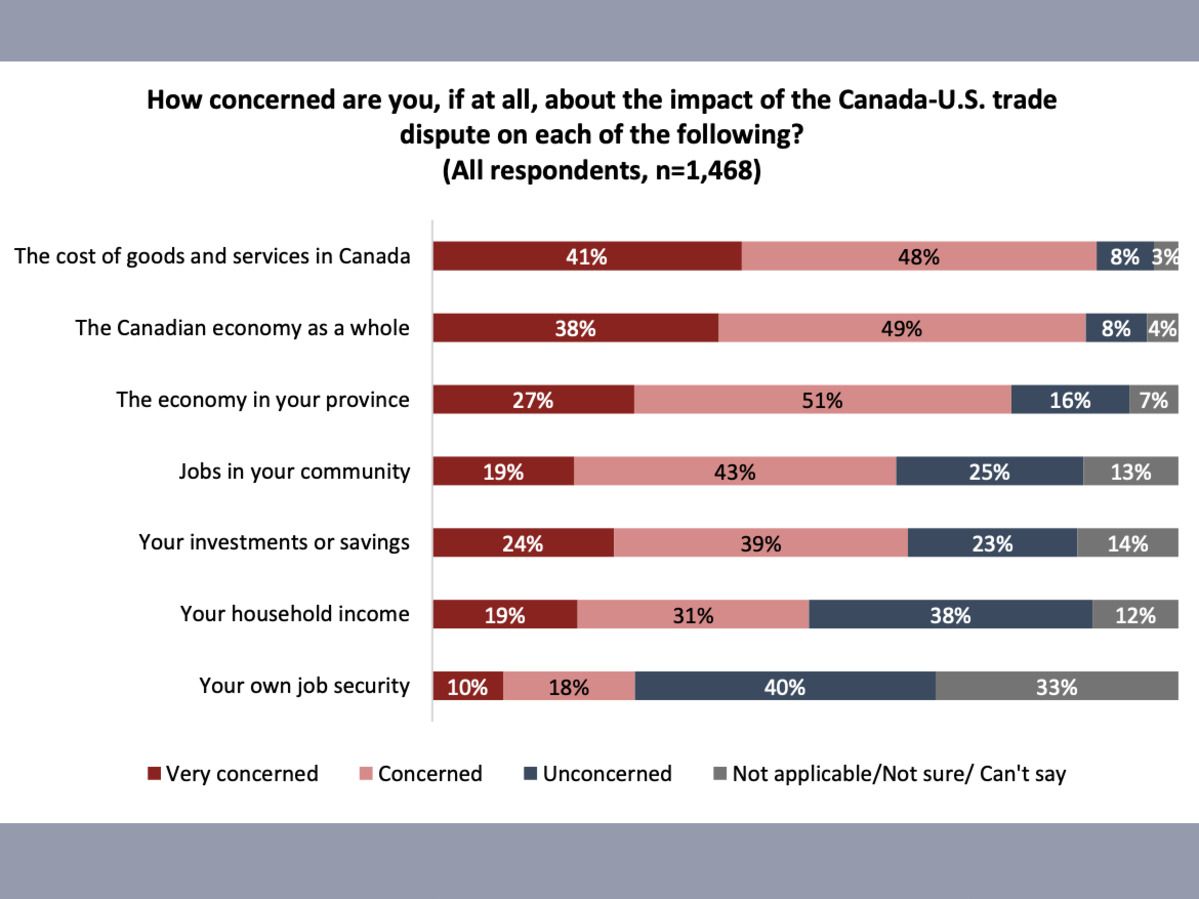
However, fears of the aftermath of the decision were also top-of-mind among many Canadians. One quarter of respondents said they were concerned for their own job security, while another 13 per cent said they were very concerned.
More broadly, 89 per cent of respondents said they were concerned or very concerned about the cost of goods and services in Canada moving forward. A similar number, 87 per cent, said they were concerned or very concerned about the Canadian economy as a whole, while 78 per cent said said they feared for their own province’s economy.
Personal investments and savings was a concern for 63 per cent of those polled, while almost half (49 per cent) said they worried about the impact on their household income.
The survey also found a mix of pessimism and resolve among Canadians. Asked “How confident are you that Canada and the United States will eventually be able to reach a new trade agreement?” almost half (48 per cent) were not confident, while just 39 per cent were confident or very confident.
But on the question “Which of these better describes how you feel about Canada facing a prolonged trade conflict with the United States?” a majority (59 per cent) chose the reply: “This will be difficult, but Canada can weather the storm and adapt.” Only 35 per cent picked: “This is a very serious situation that could cause lasting damage to Canada.”
And when asked if they thought the trade war would make Canada weaker or stronger over the long term, a strong majority of 64 per cent said stronger, with only 26 per cent choosing weaker, and the other 10 per cent uncertain.
The poll is considered to carry a margin of error of plus or minus two percentage points, 19 times out of 20.
Our website is the place for the latest breaking news, exclusive scoops, longreads and provocative commentary. Please bookmark nationalpost.com and sign up for our newsletters here.